AirDroid Parental Control
24/7 Kids' Guardian via App & Web
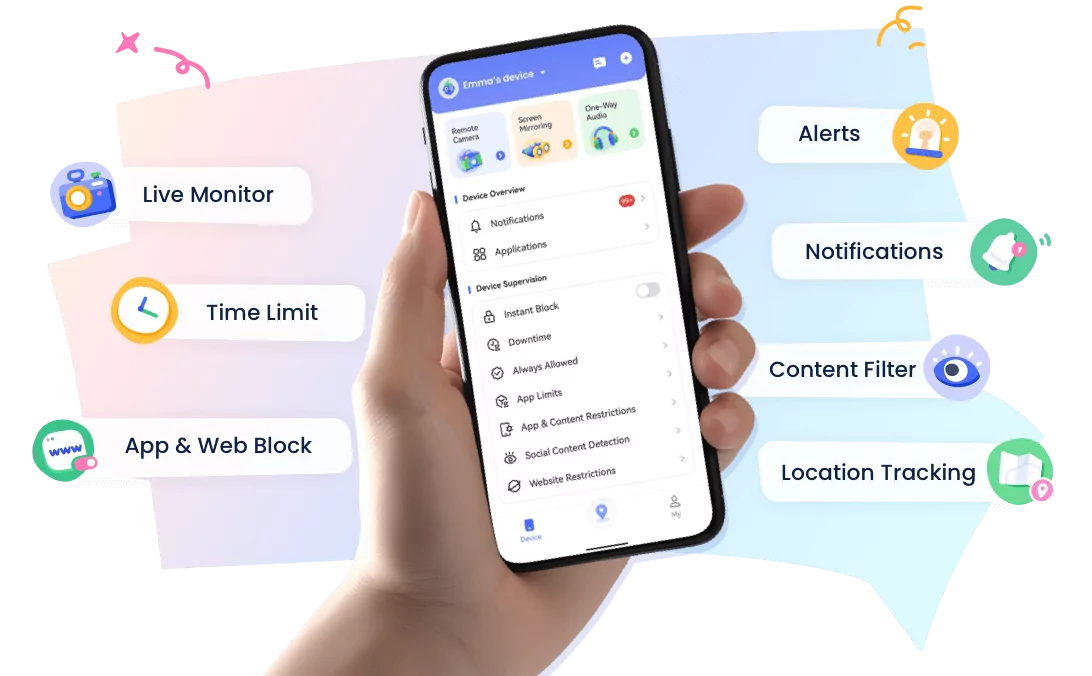
- 👀Live surroundings and location tracking
- 🔞Content Monitoring and App/Web Blocking
- ⚠Instant alerts for online risks and geofences
- ⌛Screen time control and monitor
How to Make a Snapchat Family Digital Agreement Work With Your Teen
Has your teen ever suddenly hidden their phone screen as you walked by? Parents' spontaneous reactions of immediately scolding the teen or confiscating the device often only trigger lengthy arguments and make the teen even more withdrawn.
To address this effectively, we first need to understand: why do teens use Snapchat so obsessively? For them, it is a space for spontaneous, visual expression—featuring disappearing messages and fun lenses that remove the pressure of curated profiles. Given that 55% of teens use Snapchat as a main way to interact, as a parent you might wonder, should you let your child have Snapchat?
At this stage, a strict parenting style no longer works. As they become older, parental guidance strategies need to move from a restrictive approach to a more dialogue- and empathy-based approach.
For this reason, it is crucial to have a Family Media Agreement in place as a collaborative middle ground to create a shared responsibility online. This transparent agreement allows you to safely guide your child's digital habits without violating their privacy boundaries.
Why You Need a Family Digital Agreement Instead of Dictating Rules
Unilateral rules are usually not well received by teenagers, as they feel they indicate their parents' lack of trust. As a result, 59% of children hide their online activities, including deleting browser history or simply shutting down their screens when parents approach.
Online rules that are too restrictive can make teens more likely to engage in social media behaviors that can cause issues, particularly among teens over 15. This is because they need space for independence—that is, one-sided pressure only compels their resistance.
A Family Digital Agreement encourages you and your child to sit down together and think about responsibilities in the online world. This is extremely effective in reinforcing each safety rule and provides a logical explanation of why they are necessary without the threat of judgment.
Teenagers will be far more willing to cooperate if they are directly involved in creating a Family Media Agreement. When they feel their opinions are heard and valued, they are better at controlling their use of the internet.
- Building Trust over Restriction: Blocking apps often makes kids create secret accounts, whereas a mutual agreement builds the trust they need to tell you about bad online experiences.
- Fostering Independence: Ultimately, this helps prepare them for digital independence as adults through a supportive family bond.
Snapchat Family Digital Agreement: What Must-Have Rules Should It Include?
Drafting clauses in a Family Media Agreement is not merely about creating a list of rigid prohibitions, but rather formulating shared guidelines. Each point within it should be designed to help children understand safe boundaries while simultaneously respecting their personal space.
Want the full printable Snapchat Family Digital Agreement With Your Teen?

Snapchat Family Digital Contract With Your Teen
1Basic Principles: Responsibility and Respect
46% of teens in the US have been subject to cyberbullying, while the most frequent types are teasing and rumors. This emphasizes the importance of discussing various Snapchat risks and dangers for kids, so that mutual respect always becomes their main foundation when surfing the Internet.
The APA even states that online bullying can be more detrimental to teenagers' mental health than physical bullying. Therefore, guide your child to always treat others on the Internet with the same empathy as in the real world.
Fostering responsibility means encouraging the child to think twice before hitting the send button to maintain their reputation. Remind them that all posts have a permanent digital footprint and can be shared by many people without their knowledge.
Early social media literacy education is crucial so that children can navigate online conflicts more peacefully. The empathy instilled through this Family Digital Agreement will serve as their best mental shield against various digital risks.
2Child's Commitment: Core Safety Rules
Messages from strangers that seem friendly can slowly lead to extortion threats or sextortion. NCMEC recorded a surge in these cases of over 300%, thereby emphasizing the importance of an agreement that Snapchat is only for real-life friends.
The teenage brain is still highly vulnerable to peer social pressure. Therefore, guide them to genuinely commit to not sending intimate or violent content, which often stems from a momentary, impulsive act.
Through open discussions about digital risks, children will gain more courage to refuse inappropriate requests from those around them. This understanding greatly helps them navigate online social pressures with much wiser steps.
- Immediate Reporting: This agreement must include the child's promise to immediately report any threats to you. Respond to every story they share calmly and without judgment, so that the child is not at all afraid of having their device confiscated when they are in need of protection.
- Periodic Renegotiation: This Family Media Agreement should be periodically renegotiated to adjust to the child's stage of maturity. Family trust will grow naturally as they learn to self-regulate, with you serving as their safest haven.
3Parent's Commitment: Respecting Privacy & Targeted Safety Checks
Imagine when your barrage of interrogative questions about their chat buddies actually makes your child feel cornered and start lying. This underscores the importance of your commitment to respect their privacy by not checking their conversations every day.
Research on 351 teenagers found that highly interrogative surveillance is often perceived as an invasion of privacy that triggers strategies of concealment. However, when combined with an autonomy-supportive attitude, 945 teenagers are willing to share their daily activities voluntarily.
Agree that companion tools like AirDroid Parental Control will only be utilized if truly clear risk signals appear, such as keyword alerts. This feature serves purely as a background seatbelt, not as a means to spy on their personal space.
Rather than conducting surprise device inspections, schedule a specific time to simply sit down and casually review their digital activities together. Turn this routine moment into an opportunity to share stories about the latest apps, rather than a trial session to find the child's faults.
This trust will make the child realize that you are a discussion partner, not a supervisor restricting their freedom. It is this supportive communication that ultimately makes them always feel safe discussing any obstacles in the online world.
4Usage Time and Context Rules
Teens spend an average of 3.5 hours a day on social media, and 1 in 3 children continue to stare at their screens past midnight. Tragically, the effects of this addictive design can be seen in the case of 11-year-old Selena Rodriguez, who suffered from sleep deficiency as a result of overusing Snapchat and eventually lost her life.
The tragedy had triggered resistance from the child when her device was forcibly confiscated by her parents. This heartbreaking incident emphasizes the importance of establishing a healthy digital routine for the child, preventing them from falling into the same pattern of addiction.
Referring to the Mayo Clinic guidelines, agree on screen-free zones at home, such as during family meals or one hour before bedtime. The commitment to always charge phones outside the bedroom at night is also crucial so the child gets optimal rest without interruption.
- Balancing Life and Entertainment: Also, discuss that social media playtime should never displace the child's study obligations or physical activities. This understanding will train them to self-regulate, so online entertainment always runs in balance with their daily life in the real world.
- Parental Role Modeling: Lastly, experts remind us that the success of this agreement depends heavily on your direct role modeling at home. If teens see you constantly on your phone, it will be tough for them to develop a healthy digital routine.
5Family Digital Agreement: Age-Appropriate Tools & Settings
Research found that 79% of children hate parental control apps because they feel their privacy is violated and consider their parents too lazy to communicate.
Analysis of safety apps proves the importance of balancing supervision with parental communication and the child's self-regulation skills. Experts advise that you should still provide space for the child to practice risk-coping independently.
Therefore, the installation of digital tools must be openly discussed and adjusted to the child's maturity. For teenagers, agree that native features like Snapchat Family Center are sufficient to guide them without restricting their freedom.
Given that Snapchat Family Center has some shortcomings in protecting against cyberbullying and harmful content, supplementary apps such as AirDroid serve as an extra layer of protection, rather than a means of surveillance. By setting up a robust Snapchat 3-layer security protection system, you can intervene immediately once the danger is detected.
According to APA recommendations, provide the understanding that these rules are flexible and supervision will certainly be loosened as the child becomes responsible. This will reassure the child that your trust continues to grow as their digital independence grows.
6How to Handle Broken Rules & Crossed Boundaries
Imagine getting furious and confiscating the child's phone because they were caught playing on it late into the night. This kind of emotional response often actually triggers resistance, so the handling of violations must be formulated logically from the beginning.
The AAP warns that harsh punishments are completely ineffective and actually harm a child's mental well-being. Therefore, replace the concept of unilateral punishment with the implementation of logical consequences, which have proven to be far more educational.
A study on 214 teenagers proved that logical consequences are highly effective in encouraging children to adhere to the value of a rule. This allows them to know what it is for and not simply do it out of fear.
- Enforcing Rules through Consequences: For example, if a child deliberately ignores study hours to use social media, the logical consequence is that they will not have device privileges that day. This firm rule trains children to be responsible for their choices while learning to make wiser decisions.
- Resolving Issues through Discussion: When a violation occurs, turn that moment into a calm discussion to simply find the root of the problem. This approach helps the child not feel afraid to admit their mistake, and the trust between the child and the family becomes stronger.
How to Have the Talk and Get Your Kids on Board
Discuss this Family Media Agreement in a relaxed atmosphere so that the child understands its purpose is purely to build healthier Snapchat habits. Explain calmly that this agreement is created to guide them safely, not to restrict their freedom.
Provide a definite assurance that no matter what problems they encounter, you will always be ready to help. Promise that as long as they proactively ask for help, you will focus on finding a solution together without immediately punishing them, even if it is purely their fault.
Research shows that family rules are more likely to be respected when you communicate in ways that support the child's independence. It is this promise of problem-solving without punishment that actually makes children brave enough to be honest when encountering danger.
You must realize that children are facing a digital ecosystem intentionally designed to be addictive. Furthermore, the success of this Family Digital Agreement also heavily depends on the real-world example of your own internet habits at home.
Considering every child's character is different, an empathetic communication style will make them feel much more personally valued. Ultimately, the child will sincerely agree to the contract because they believe you are the safest haven.
Revisiting & Fine-Tuning the Agreement as Your Child Grows
Family Digital Agreement must continuously be adjusted as your child grows older and matures. Research proves that parental guidance must shift from mere strict restriction to active dialogue as children enter their teenage years.
Make moments like birthdays or the start of a semester a routine time to casually evaluate the contents of the agreement. Psychology experts suggest that you routinely check how device usage affects the child's mood, sleep patterns, and behavior.
You can gradually relax rigid rules and focus more on discussing the quality of the content they view. Greater freedom on social media is very reasonable to grant, although you must still limit crucial matters such as online transactions. If open social platforms still feel too risky, steering them toward a safe messaging app for kids is a practical way to grant independence within secure boundaries.
These routine discussions become valuable moments to discuss the latest app trends in order to improve the child's digital literacy. Continuously open conversations will provide you with real insights into how the child manages risks on the Internet.
Respect the child's opinions by inviting them to revise rules that might already feel too restrictive. This joint adjustment to the Family Digital Agreement is purely aimed at guiding them gradually toward complete digital independence.
List of Sources
- Teen Behavior & Social Media Usage
- AirDroid — Why Do Teens Use Snapchat (https://www.airdroid.com/parent-control/why-do-teens-use-snapchat/)
- AirDroid — Is Your Child Ready for Snapchat (https://www.airdroid.com/parent-control/is-your-child-actually-ready-for-snapchat/)
- McAfee — Behind the Screens of Parents, Tweens and Teens (https://www.mcafee.com/blogs/family-safety/behind-the-screens-of-parents-tweens-and-teens/)
- Online Safety, Cyberbullying & Mental Health
- Pew Research Center — Teens and Cyberbullying 2022 (https://www.pewresearch.org/internet/2022/12/15/teens-and-cyberbullying-2022/)
- AirDroid — Snapchat Risks and Dangers for Kids (https://www.airdroid.com/parent-control/snapchat-risks-and-dangers-for-kids/)
- APA — Social Media Use in Adolescents Advisory (https://www.apa.org/topics/social-media-internet/health-advisory-adolescent-social-media-use)
- HHS — Youth Mental Health and Social Media Advisory (https://www.hhs.gov/sites/default/files/sg-youth-mental-health-social-media-advisory.pdf)
- Parental Guidance & Communication Research
- Self-Determination Theory — Parental Solicitation Study (https://selfdeterminationtheory.org/wp-content/uploads/2021/04/2020_BaudatVanPetegem_ParentalSolicitation.pdf)
- Self-Determination Theory — Logical Consequences Study (https://selfdeterminationtheory.org/wp-content/uploads/2022/03/2020_RobichaudMageauSoenens_TheRoleofLogical.pdf)
- Screen Time, Health & Real-Life Cases
- BBC — Selena Rodriguez Case (https://www.bbc.com/news/world-us-canada-60091899)
- Mayo Clinic — Screen Time Guidelines (https://www.mayoclinic.org/healthy-lifestyle/childrens-health/in-depth/screen-time/art-20047952)
- ScienceDaily — Kids and Parental Control Apps Study (https://www.sciencedaily.com/releases/2018/04/180403144447.htm)










Leave a Reply.