AirDroid Parental Control
24/7 Kids' Guardian via App & Web
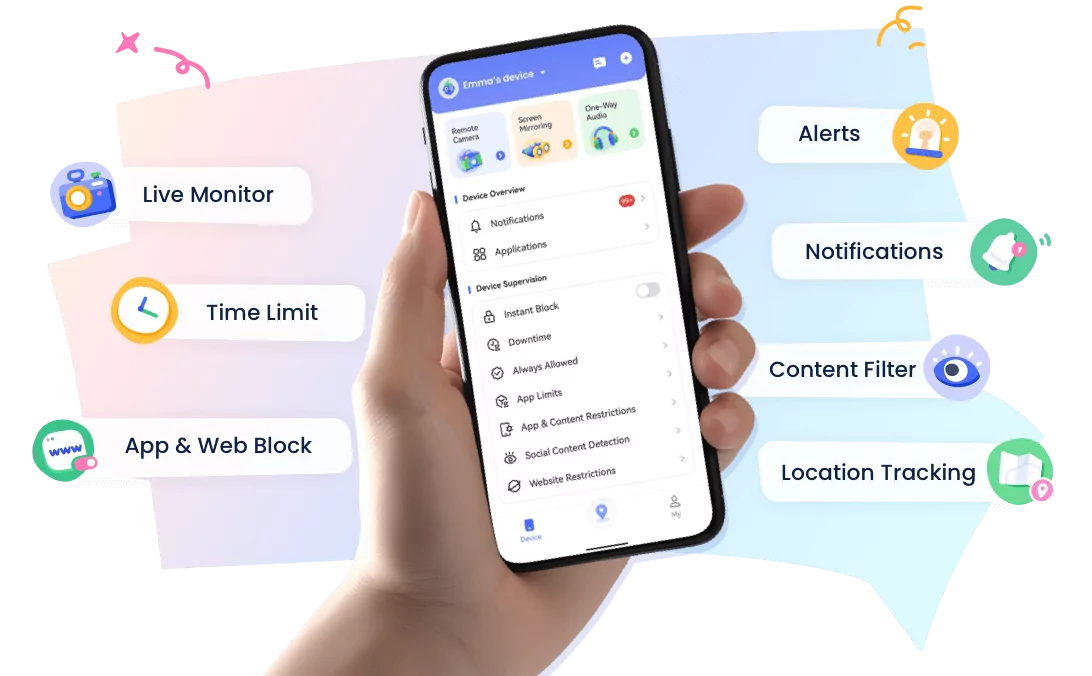
- 👀Live surroundings and location tracking
- 🔞Content Monitoring and App/Web Blocking
- ⚠Instant alerts for online risks and geofences
- ⌛Screen time control and monitor
Snapchat vs. TikTok vs. Instagram vs. WhatsApp vs. Telegram: Which Messaging App Protects Teens Most?
Understanding why do teens use snapchat is the first step for parents; the app focuses on instant visual messaging, location sharing via Snap Map, and Stories. Because its content is designed to disappear quickly, it is crucial to discuss with your child that digital footprints can still be saved by the recipient.
Each of these apps offers unique features that bring both benefits and real potential hazards. Through this comparison, we will analyze the level of protection to ensure online safety for kids, enabling you to take the most effective preventive measures.
Where Each Platform Shines
The following is a functional comparison of five popular social media apps. This guide will help you find a safe messaging app for kids and navigate their digital interactions effectively.
| Platform | Primary Position & Function | Content Characteristics | Approach for Parents |
|---|---|---|---|
| Snapchat | Instant visual messaging, Snap Map, Stories | Ephemeral, camera-based | Discuss the reality of digital footprints that never truly disappear. |
| TikTok | Algorithmic short video discovery | Public, highly addictive, viral trends | Guide children's understanding of content consumption and screen time. |
| Visual social network (photos/videos) | Public and semi-public mix, aesthetics | Understand how this platform influences your child's self-image. | |
| Contact-based personal communication | Private, encrypted, texts/calls | Instruct children to only interact with contacts they know. | |
| Telegram | High-privacy messaging and communities | Large groups, channels, bots | Navigate carefully regarding potential access to unmoderated communities. |
Snapchat focuses on instant visual messaging, location sharing via Snap Map, and Stories. Because its content is designed to disappear quickly, it is crucial to discuss with your child that digital footprints can still be saved by the recipient.
TikTok presents a stream of public, algorithmically curated short videos to continuously capture user attention. Although the focus is on content discovery, parents must guide children to understand screen time limits while navigating the risks of private messages.
Meanwhile, Instagram is a visual social network blending public and semi-public audiences. This platform serves as a primary space for children to build their self-image, while also engaging in intense communication through the Direct Message feature.
Transitioning to personal communication, WhatsApp is an encrypted messaging app via phone numbers. However, you still need to provide guidance to ensure their conversations remain safe.
Finally, Telegram offers a multi-layered privacy system while supporting mass interactions through anonymous groups and public channels. You must proactively discuss how to navigate the risks of gray-area content circulation on this platform.
Comparing the Risks Across 6 Key Dimensions
To evaluate children's digital security, we must thoroughly examine these five popular platforms. Let us analyze them based on six key dimensions of risks and primary protections.
1Content Risks
According to findings from Common Sense Media, Snapchat's high-frequency notification system frequently interrupts adolescents' attention. While designed to maximize user engagement and interaction, evaluating these Snapchat risks shows that this mechanism can lead to persistent distractions and contribute to digital fatigue among younger users who feel compelled to check the app constantly.
TikTok's personalised recommendation algorithm is highly effective at driving prolonged user engagement, which can inadvertently lead to excessive screen time. Research indicates that the automated feed occasionally surfaces content related to depression and self-harm, posing a potential risk to the emotional well-being of vulnerable teenagers.
The visually driven nature of Instagram can significantly influence how adolescents perceive their own bodies. As demonstrated in documented cases—such as Anastasia Vlasova's fixation on highly curated influencer content—continuous exposure to idealized imagery can foster unhealthy comparisons, potentially increasing the risk of body dissatisfaction and related eating disorders.
WhatsApp's broadcast and group messaging features, while convenient, present challenges regarding the rapid dissemination of unverified information. During major events like the COVID-19 pandemic, the viral spread of conspiracy theories via the platform occasionally escalated public anxiety and, in some instances, indirectly contributed to localized acts of vandalism against public infrastructure.
Telegram's emphasis on strict privacy and minimal content oversight within large public groups can make the platform susceptible to the spread of harmful material, such as deepfakes. Because the platform limits proactive moderation, it has been leveraged by anonymous networks to coordinate and escalate real-world unrest, such as the civil disturbances observed across the UK.
2Social and Stranger Risks
Interactions with strangers on Snapchat are highly vulnerable to being exploited by cybercriminals for sextortion. The case of a student who took his life highlights the importance of online safety for kids regarding threats of intimate photo distribution by fake accounts.
Not much different, the direct chat feature on TikTok is also frequently abused by predators to trap underage victims. This is one of the dangers of social media proven to be highly hazardous, as seen in dozens of 15 to 16-year-old girls being exploited through anonymous profiles.
A similar threat lurks on Instagram, where open profiles allow crime syndicates to study their targets.
Beyond social media platforms, WhatsApp group settings can also expose children to the threat from unknown numbers. This vulnerability was starkly demonstrated when hundreds of school students in Gloucestershire were suddenly forced into WhatsApp groups containing explicit material, highlighting a major loophole in the app's default privacy settings.
Given the vulnerabilities in those chats, Telegram is particularly prone to being misused as a hidden criminal space. As reported by the BBC, this digital blind spot was starkly exposed during the infamous South Korean chatroom sex abuse scandal, where anonymous discussion rooms were weaponized to hold hostage and exploit dozens of women and teenagers online.
3Location Sharing and Risks
The Snap Map feature, which allows real-world location sharing, has raised significant safety concerns regarding minor exploitation.
Law enforcement and safety advocates warn that illicit actors, including drug dealers, can easily exploit this feature to track and target teenagers. This accessibility presents a critical security vulnerability that has, in the most tragic cases, been linked to fatal overdoses among youth, as documented in ongoing Snapchat Fentanyl Lawsuits.
Location privacy can also be compromised indirectly through a user's social network rather than platform architecture alone.
The experience of content creator Ava Majury highlights this risk: an individual managing to stalk her by purchasing her private residential information directly from acquaintances within her social circle, a case detailed by The New York Times, demonstrating how peer-level data leaks can compromise physical safety.
The practice of sharing real-time activities or luxury items on Instagram can inadvertently disclose geographic and residential details through background cues. The vulnerability of publicizing sensitive location data was tragically illustrated in the fatal targeting of rapper Pop Smoke, where social media posts reportedly gave attackers key clues, as covered by the Los Angeles Times. This underscores the real-world physical security risks associated with sharing unedited, location-revealing media.
As a widely used messaging application, WhatsApp is frequently targeted by scammers employing social engineering tactics. According to consumer investigations by Which?, fraudulent schemes often involve sending malicious links—such as fake delivery or transaction receipts—designed to harvest personal data. These phishing methods can allow unauthorized actors to compromise both the digital security and the physical location of users.
Telegram's high degree of user anonymity can facilitate unauthorized attempts by strangers to solicit location information from minors. While the platform has mitigated some direct risks by later modifying its proximity features, technical analyses by Ars Technica previously demonstrated how the "People Nearby" feature could expose a user's precise geographical address to malicious actors, presenting ongoing challenges for managing geographic privacy.
4Algorithm and Addiction Risks
The instant-interaction design of Snapchat has raised concerns regarding its tendency to foster repetitive checking behaviors among adolescents. While engineered to maximize peer connectivity, prolonged engagement can disrupt healthy routines.
The instant-interaction design of Snapchat has raised concerns regarding its tendency to foster repetitive checking behaviors among adolescents, forcing parents to reconsider: should you let your child have Snapchat? While engineered to maximize peer connectivity, prolonged engagement can disrupt healthy routines.
These dynamics have been scrutinized in ongoing legal discussions, such as the Snapchat Product Liability Lawsuits, which investigate the platform's role in extreme cases where excessive nighttime scrolling and subsequent exposure to harmful content correlated with severe psychological distress in youth.
TikTok's personalized recommendation algorithm is highly effective at driving extended user engagement, which can inadvertently lead to excessive screen time.
Data indicates that a significant portion of adolescent users experience difficulties managing their platform usage. This lack of behavioral regulation frequently results in delayed sleep schedules and reduced sleep quality, shifting the focus of research toward how automated content delivery impacts teenage circadian rhythms.
Instagram's automated recommendation system can create repetitive content consumption cycles that may exacerbate pre-existing psychological vulnerabilities. The potential risks of algorithmic amplification were highlighted during the landmark inquest into the death of Molly Russell.
As reported by the BBC, the investigation concluded that the platform's algorithms continuously delivered large volumes of content related to depression and self-harm to the vulnerable teenager, underscoring the critical need for safer content curation.
The obligation of responsiveness on messaging applications like WhatsApp introduces unique behavioral pressures. For some users, the perceived necessity to reply immediately can manifest in compulsive habits, leading to neglected rest and diminished real-world social interactions.
Academic research published in the National Institutes of Health (NIH) documents how communication overload on instant messengers can negatively interfere with daily functioning and interpersonal relationships.
Similarly, the continuous stream of notifications within large-scale chat networks, such as Telegram, often correlates with elevated user anxiety.
A comprehensive study available on Frontiers in Psychology analyzes these patterns, linking problematic smartphone attachment to higher rates of depression, heightened psychological burden, and the Fear of Missing Out (FOMO).
5Who's Watching? Message Visibility and Tracking Explained
The auto-disappearing messages of Snapchat make the content of a child's conversations impossible for anyone else to view. This feature allows chat histories to be permanently deleted, so you cannot trace conversation details if a problem occurs.
TikTok limits visibility by banning image sharing and disabling chats for accounts under 16. However, a major blind spot remains if a child registers with a fake older age, as all their text conversations will be completely hidden from your monitoring.
Activating the Vanish Mode feature on Instagram erases direct messages without a trace the moment a child closes the chat. The main blind spot here is the complete loss of communication history, leaving parents unable to review potentially risky conversations.
The end-to-end encryption system on WhatsApp ensures messages are securely scrambled and can only be read by the sender and recipient. This closed system means it is technically impossible for you to monitor or intercept your child's conversations remotely.
If a child uses the Secret Chats feature on Telegram, its status as a safe messaging app for kids becomes highly restricted. Messages are visible only on one device and can auto-delete, meaning this digital paper trail can be destroyed instantly.
6Youth Protection Design
Snapchat's Family Center:
Snapchat takes an initial step toward safety by automatically restricting teenage profiles and providing a dedicated Snapchat Family Center. However, this tool has heavy limitations because it completely denies parents access to read the actual contents of their messages.
Once enabled, parents can:
- View the child's contact list over the past 7 days.
- Identify members within group chats.
- Filter sensitive content in Stories and Spotlight.
- Restrict responses from the My AI virtual assistant.
- Report accounts or content that violate rules.
TikTok's Family Pairing:
TikTok provides an official Family Pairing feature to limit kid's screen time. Although it can filter content, this tool cannot monitor direct messages or protect children if they fake their age upon sign-up.
Once connected, parents can enable:
- Schedule Tiktok time.
- Get a summary of your teen's time spent on TikTok.
- Decide who can send messages or message requests to your teen.
- Restrict your teen's to appropriate content.
Instagram's Privacy Defaults:
Similar to the profile protections above, Instagram makes teenage accounts private by default and offers a Family Center portal to monitor follower lists. The weak point, however, is identical to Snapchat and TikTok: you cannot view the contents of their direct chats (DMs).
Features:
- Default Privacy Setting: Accounts are automatically set to private by default for all users under 18.
- Teens Under 16: Must obtain explicit permission from a parent or guardian to switch their account to public.
- Teens Aged 16-17: Can independently change their account to public, provided they have not enabled parental supervision features.
WhatsApp's Privacy Checkup:
Shifting to messaging apps, WhatsApp's default privacy focuses on encryption and provides a Privacy Checkup menu to hide a child's activities from strangers. Unfortunately, this platform has no dedicated parental control tools, meaning you cannot limit usage time or monitor their chats.
Telegram's Limited Safeguards:
Just like Instagram, Telegram relies solely on basic privacy settings to hide phone numbers so a child's profile is not easily searchable by strangers. Crucially, the app does not provide any native parental control features to prevent children from joining dangerous, unmoderated anonymous groups.
To overcome these various monitoring blind spots, AirDroid Parental Control serves as a comprehensive solution for parents. Through features like its social content monitor, the system proactively safeguards your child's digital security while respecting their privacy.
It monitors communication across 14 popular social media platforms and delivers real-time alerts to parents the moment specific keywords are detected, enabling early intervention before risks escalate.
Family Collaboration in Safeguarding Digital Activities
Parents' primary concerns revolve around the dangers of social media—specifically the impact of content algorithms that can influence a child's psychological state and moral values. In fact, studies show that 75% of parents view social media as the main trigger for teenage mental health crises.
Besides content, parents are also anxious about platform monitoring blind spots, such as disappearing message features. The fear of being unable to view chat histories often triggers the implementation of unilateral bans, which actually risks driving children to become more secretive.
To navigate these challenges, raising teenagers requires different levels of supervision: younger teens (10–14) need active guidance, while older teens (15–18) need greater independence. The APA (American Psychological Association) recommends balancing this monitoring with open discussions to respect your child's growing need for privacy.
When it comes to digital boundaries, age matters. While younger teenagers generally accept strict rules, older adolescents respond much better to guidance than surveillance. Fostering their critical thinking, rather than just watching their every move, is key to building mutual trust.
Effective parenting here requires leading by example, since teenagers are quick to mirror our own screen habits.
Ultimately, for comprehensive protection, parents should blend family expectations—such as establishing a Snapchat family digital agreement—with robust technical solutions, including configuring the Snapchat 3 layer security protection, native phone controls, and advanced tools like AirDroid Parental Control.
Emergency Procedures and Evidence Preservation
Thorn notes that shame often causes children to remain silent when they become victims of the dangers of social media or digital crimes. To prevent this, educate children early on about how to face online harassment, threats, or extortion so they realize it is not their fault.
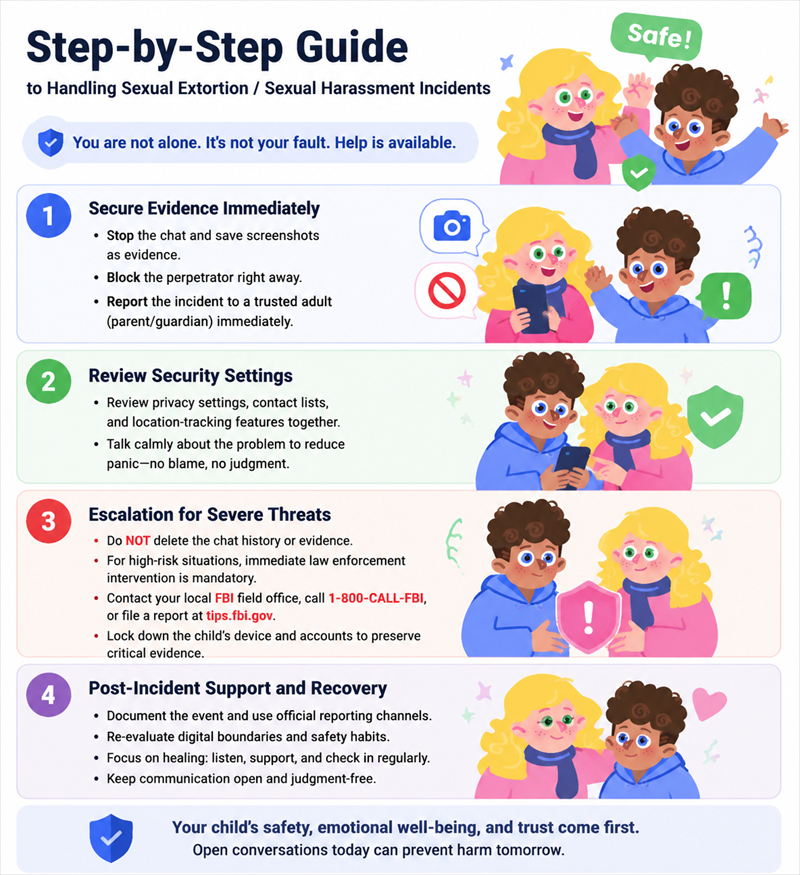
1Step 1: Secure Evidence Immediately
The first step when a problem occurs is to stop the chat and save screenshots as evidence. Once the evidence is secured, teach your child to immediately block the perpetrator and promptly report the incident to you.
2Step 2: Review Security Settings
When a child reports an issue, help them review their privacy settings, contact lists, and location-tracking features. Discuss the problem calmly to ease the child's panic without passing judgment.
3Step 3: Escalation for Severe Threats
For high-risk situations such as sexual extortion (sextortion), offline stalking, or the dissemination of minor nudity, immediate law enforcement intervention is mandatory. Do not delete the chat history. Instead, immediately contact your local FBI field office, call the federal hotline at 1-800-CALL-FBI, or file an urgent digital report online directly at tips.fbi.gov.
Additionally, cyber safety organizations and federal agencies provide critical awareness tools to guide families through crisis management. For instance, this educational FBI sextortion public service video shares emotional and powerful survivor stories, illustrating how victims can safely break their silence and seek help. Ensuring your child's device and account data are locked down prevents the destruction of vital criminal evidence needed for federal investigations.
4Step 4: Post-Incident Support and Recovery
If the incident is mitigated or milder, document the event, utilize official reporting channels, and re-evaluate the child's digital boundaries. Regardless of the severity, healing from digital trauma requires patience; parents must consistently prioritize and monitor their child's emotional and mental well-being through open, judgment-free communication.
Moving Forward: A Multi-Layered Ecosystem is Key
After dissecting the various risk dimensions above, it is evident that not a single app can guarantee absolute child protection. From Snapchat to Telegram, each platform always has its own monitoring blind spots that are highly risky if left unchecked.
Therefore, finding the ideal safe messaging app for kids does not rely on selecting one specific app, but rather on the monitoring ecosystem you build. By combining open family communication, built-in privacy settings, and proactive tools like AirDroid, you can ensure your child navigates the digital world much more safely.
List of Sources
- Youth Mental Health & Media Impact Studies
- Common Sense Media — Smartphone Research & Teen Data Report (https://www.commonsensemedia.org/sites/default/files/research/report/2023-cs-smartphone-research-report_final-for-web.pdf)
- Psychological Science — Corporate Internal Documents on Instagram Harm (https://www.psychologicalscience.org/news/facebook-knows-instagram-is-toxic-for-teen-girls-company-documents-show.html)
- National Institutes of Health (NIH) — Media Overload & Social Wellbeing (https://pmc.ncbi.nlm.nih.gov/articles/PMC4919976/)
- Thorn — Youth Sexual Extortion and Digital Trauma Report (https://info.thorn.org/hubfs/Research/Thorn_SexualExtortionandYoungPeople_June2025.pdf)
- Official Reporting Channels & Case Inquests
- Federal Bureau of Investigation (FBI) — Official Digital Tips Submission Portal (https://tips.fbi.gov/)
- FBI YouTube Channel — Victim of Sextortion Speaks Out PSA (https://www.youtube.com/watch?v=ixAYkkub4Pw)
- BBC News — Inquest Into the Algorithmic Harm of Molly Russell (https://www.bbc.com/news/uk-england-london-63073489)
- News Coverage & Legal Actions
- BBC News — Gloucestershire School WhatsApp Privacy Loophole (https://www.bbc.com/news/articles/cn82p2yyg4zo)
- BBC News — South Korean Telegram Chatroom Abuse Scandal (https://www.bbc.com/news/world-asia-55082072)
- Social Media Victims Law Center — Ongoing Snapchat Fentanyl Lawsuits (https://socialmediavictims.org/snapchat-lawsuit/fentanyl/)
- Los Angeles Times — Pop Smoke Social Media Tracking Investigation (https://www.latimes.com/california/story/2020-02-21/pop-smoke-social-media-posts-may-have-given-his-killers-key-clues)
- Which? — Verified WhatsApp Business Account Phishing Scams (https://www.which.co.uk/news/article/scammers-use-a-verified-whatsapp-account-to-carry-out-new-delivery-scam-a42741b3EVKO)











Leave a Reply.