Face Swap Bots on Telegram: The Deepfake Risk Parents Should Know
In a 2025 NCMEC report, four male students at an Iowa high school were charged after using AI apps to generate explicit nude images of their 44 female classmates.
The incident shocked many families. However, most parents don't realize that deepfake technology is no longer limited to apps.
On platforms like Telegram, AI-powered Face Swap bots can create realistic face-swapped images and videos in seconds. As these tools become more accessible, it's important for parents to understand how they work, the risks they pose, and how to reduce that.
What Are Face Swap Bots on Telegram?
Telegram's Face Swap bots are AI-powered tools that operate directly inside Telegram. Instead of installing a separate app or purchasing a subscription, users simply open a chat with a bot, upload an original photo, and receive a manipulated image within seconds.
Varying with different needs, these bots fall into two categories:
- Face-swapping bots: replacing one person's face in a photo, video, meme, or GIF with someone else's.
- Undress AI or deepfake bots: removing the clothes or generating explicit images from ordinary photos.
Why Parents Should Pay Attention to Telegram Face Swap Bots
Though face-swap technology is normal in today's age, Telegram makes this problem much more concerning. Here's why this platform, and its face swap bots, deserve your attention.
1 Your Child Can Be Both a Victim and a Participant
Many parents worry about their children becoming victims of deepfake abuse. However, with just a few taps on a Telegram Face Swap bot, children can easily become creators, sharers, or participants.
And a study surveyed US teens aged 13-17 and found that 55.3% of them had created at least one nudified image using AI, and most are male participants.
2 Face Swap Bots Are Easy to Find
Many face swap bots can be easily found through Telegram searches, shared links, or recommendations in groups and channels. If your child uses Telegram, they are one curious search away from accessing these tools. Some of these bots even have millions of monthly active users.

3 Telegram Makes It Hard to Detect
Unlike iMessage or standard SMS, Telegram's features like end-to-end encryption and self-destructing messages leave almost no visible trace. That means if your teenager becomes a victim of Telegram deepfakes, the evidence may already be gone by the time you find something is wrong.
Worried About What Your Child Is Receiving on Telegram?
AirDroid Parental Control can sync your child's Telegram messages in real time and send you instant alerts when harmful keywords appear in the conversation.
4 Image Spreads Faster Than You Can React
What's more, as an instant messaging app, once the image is generated on Telegram face swap bots, it can also be quickly shared across multiple chats or platforms with just a forward button.
Real Risks of Telegram Face Swap Bots
Just as the very beginning case shows, face swap bots can be a threat to your child's safety, reputation, and mental health. Some risks of face-swap bots on Telegram include:
Risk 1: AI Nude Deepfakes
This is the most devastating risk. In 2024, Telegram was warned by authorities that there are many chatrooms run by teenagers that create and spread sexually explicit deepfakes of young women.
And this risk is happening in schools right now. Iowa is far from an isolated case. 21 girls at a Tasmanian, Australia, private school have also been targeted in a deepfake incident.
A selfie or personal photo taken from social media can be manipulated into explicit content without the person's knowledge and then shared. For teenagers, they may experience embarrassment, anxiety, cyberbullying, and even refusal to go to school.
In some cases, once these images are spread, they're difficult to remove. The reputational damage also becomes long-term.
Risk 2: School Bullying
At first glance, many teenagers just use face swap bots on Telegram to create embarrassing memes of classmates or friends for jokes or pranks. However, jokes usually create opportunities for bullying.
When your child's face is swapped onto a degrading image or an explicit scene, repeatedly shared, and laughed at by peers, will it be a joke? Obviously, it turns into a form of cyberbullying.
Because the AI-generated images often look realistic, the embarrassment and humiliation can feel very real to the victim.
Risk 3: Scams Caused by Impersonation
Face swap technology has been used as a tool for impersonation fraud and blackmail.
Some Telegram Face Swap bots can create highly convincing images or videos that imitate your child and their voices. And scammers won't stop here.
They additionally use these "AI-generated" realistic videos of teenagers to contact their parents, posing as the child in distress and requesting urgent money transfers or blackmailing. The FTC also warned families about this type of AI scammer in 2023.
A recent example occurred in India. A family received an AI-generated video call showing their son kidnapped and stabbed with a knife. Then they paid ₹1 lakh in ransom, only to find him safe elsewhere.
Risk 4: Legal Consequences
A growing number of laws now treat AI-generated intimate images of minors as child sexual abuse material (CSAM). That is, creating, sharing, or distributing deepfake content can have serious legal consequences:
- The UK is the first country in the world to create new AI sexual abuse offenses.
- In the United States, the TAKE IT DOWN Act, S. 146, makes it a criminal offense to publish non-consensual intimate visual depictions of individuals, whether they are AI-generated or authentic. Violations can result in fines and criminal penalties (e.g., prison).
- Beyond federal law, many states, such as California, Texas, etc., have enacted their own legislation targeting deepfake pornography image sharing. This means your child could face civil or criminal penalties if they are a participant.
Risk 5: Distorted Values and Behaviors
Perhaps the most overlooked risk is how repeated exposure to these tools can influence a child's thinking and behavior.
When face-swapping someone without permission becomes normal, their ability to distinguish real from fake gradually erodes. According to a Microsoft survey, only 25% of global users (teenagers included) have the confidence to recognize AI-generated deepfakes. And this ratio is dropped from 46%.
At the same time, when they see face swaps are unremarkable for entertainment, they may begin to believe that privacy doesn't really matter and start using face swap bots to target other classmates.
Is Your Child at Risk? A Quick Checklist for Parents
Not every teen who uses a face-swap bot ends up in trouble. But certain behaviors make them much more likely to be victims or participants.
Hence, go through this list to identify how easily your child could get caught up in face swap risks.
Is Your Child at Risk?
Check the boxes that apply to your child.
-
Uses Telegram regularly -
Is part of large group chats or channels -
Has a strong interest in AI tools and technology -
Frequently shares personal photos and keeps social media accounts fully public -
Prefers to upload selfies as profile photos online -
Often tries new social trends or apps before you hear about them
If you checked 3 boxes or above, consider having an open conversation with your child and reviewing the steps at the end of this guide.
How Parents Can Protect Children From Deepfake Risks
Knowing the risks is the first step. Then, what can you actually do about it?
If You're the Parent of a Girl:
Research and real-world cases show that women and girls are victims in deepfake sexual images and videos, even accounting for 99%. For this reason, you'd better do the following to protect your girl:
- Teach them to set social accounts to private
- Talk to her about deepfakes
- Check if she is already targeted on Telegram
By limiting accounts or shares, strangers and malicious people have little access to original high-quality photos to create fake images. Also, educate them to remove their selfies from their profile photos.
Many girls who are targeted by deepfakes don't tell their parents, out of blackmail or shame. Make it clear in advance that if something like this ever happens to her, she can come to you, collect the evidence, and report it to authorities or the platform.
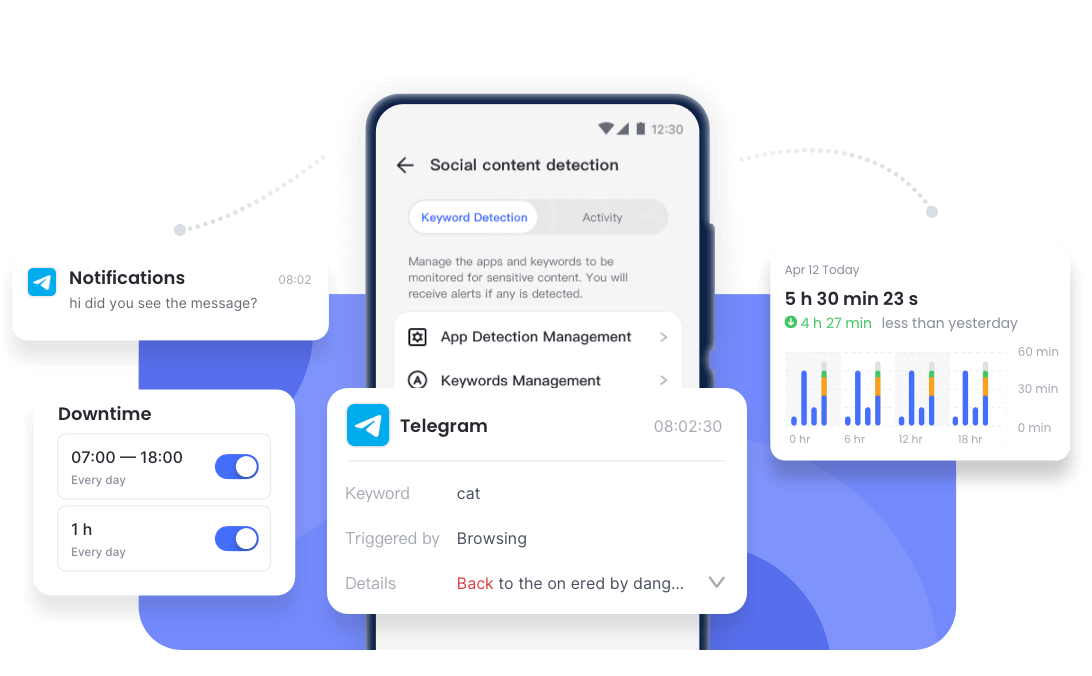
Tools like AirDroid Parental Control allow parents to monitor conversations across Telegram and social apps by flagging risky keywords.
If You're the Parent of a Boy:
In most documented school cases, including Iowa, the perpetrators of AI nude deepfakes have been teenage boys. Many of them didn't think what they were doing was an offense. So, your job is to make sure your son never ends up in that position.
- Talk about "consent"
- Show him consequences as real stories
Using someone's image without their permission, even to create a funny fake meme, is a less respectful behavior. It doesn't matter if it was meant as a joke or if peers were doing it.
Make the legal consequences concrete. Instead of telling him that creating or sharing non-consensual intimate deepfakes is a crime, show him what that actually looks like. For instance, two teens were placed on juvenile probation and ordered to pay $12,000 to their victims.
FAQs
List of Sources
- Legal Actions
- U.S. Congress — S.146 TAKE IT DOWN Act (119th Congress, 2025-2026) (https://www.congress.gov/bill/119th-congress/senate-bill/146)
- UK Government — Britain’s Leading the Way Protecting Children from Online Predators (AI Sexual Abuse Offenses) (https://www.gov.uk/government/news/britains-leading-the-way-protecting-children-from-online-predators)
- Understanding California’s Deepfake Law: Scope and Penalties (https://legalclarity.org/understanding-californias-deepfake-law-scope-and-penalties/)
- Research & Statistics
- PLOS ONE — Prevalence of Generative AI Sexualized Image Usage by Adolescents in the United States (https://journals.plos.org/plosone/article?id=10.1371/journal.pone.0342824)
- Microsoft News — Safer Internet Day 2026 Survey: Only 25% of Global Users Confident in Recognizing AI Deepfakes (https://news.microsoft.com/source/emea/2026/02/microsoft-safer-internet-day-2026/)
- FactCheckNI — Do 99% of Pornographic Deepfakes Depict Images of Women? (https://factcheckni.org/articles/online-safety-in-ni-do-99-of-pornographic-deepfakes-depict-images-of-women/)
- SQ Magazine — Face Swap App Usage Statistics 2026 (https://sqmagazine.co.uk/face-swap-app-usage-statistics/)
- News Reports & Real-World Cases
- NCMEC — The Deepfake Dilemma: New Challenges Protecting Students' Confidentiality (2025) (https://www.missingkids.org/blog/2025/the-deepfake-dilemma-new-challenges-protecting-students-confidentiality)
- AP News — The Rise of Deepfake Cyberbullying Poses a Growing Problem for Schools (2025) (https://apnews.com/article/deepfake-ai-school-cyberbullying-takeaways-bf65455142a088824d3571a727d9a8c7)
- ABC News (Australia) — Parents Slam ‘Weak’ Response at The Friends’ School After Girls Targeted in AI Deepfake Pornography Scandal (2026) (https://www.abc.net.au/news/2026-04-29/tas-friends-school-criticised-after-deepfake-scandal/106577310)
- BBC News — Telegram Was Warned by Authorities About Teen-Run Deepfake Chatrooms (2024) (https://www.bbc.com/news/articles/cvg45kz47dno)
- ESET — Are Deepfakes Harmless Fun or a Bullying Weapon? (https://www.eset.com/blog/en/home-topics/family-safety-online/deepfakes-fun-bullying-weapon/)
- Bhaskar English — Indore Parents Threatened, Extorted ₹1 Lakh in Deepfake Kidnap Scam (https://www.bhaskarenglish.in/local/mp/indore/news/indore-parents-threatened-fraudsters-extort-rs-102-lakh-deepfake-kidnap-scam-137296189.html)











Leave a Reply.