SecureTeen Review: Features, Pricing, Pros & Cons [2026]
SecureTeen is a parental control app with screen-time rules, app blocking, web filtering, location reporting, and selected activity records. In this SecureTeen review, we separate features documented by the company from results observed in our Android hands-on test.
Our verdict: SecureTeen delivered fast screen-time and app-blocking changes on our Google Pixel 7, but its web filter was inconsistent and its app-management tools were less flexible than some alternatives. Android has the clearest feature coverage; SecureTeen's public iPhone and iPad documentation lists a narrower set of controls.
SecureTeen Review: Quick Verdict
We rate SecureTeen 3 out of 5 based on its performance across the areas below: setup, screen-time and app management, website filtering, location tools, and activity monitoring. In our Android hands-on test, SecureTeen performed well in setup speed and basic time controls, while inconsistent category filtering and limited app-management options reduced its overall score. We also considered platform coverage and the overall experience.
It is best suited to families that want Android-focused device schedules, app blocking, location check-ins, web controls, and selected activity records in a remote dashboard. It is less compelling for families that need reliable category filtering, app-specific time limits, an Always Allowed App list, or clearly documented feature parity between Android and iPhone.
The strongest result in our test was enforcement speed: Time Controls, Daily Quota, and app blocking took effect within seconds. The biggest limitation was web filtering, because some sites in restricted categories still opened. The product also requires sensitive Android permissions, so families should use only the features needed for a clear safety purpose and explain the setup to the child.
| Item | Review Finding |
|---|---|
| Documented platforms | Android, iPhone and iPad, and Windows, with different features by platform |
| Premium price | $39.99 per year for 3 devices |
| Premium Plus price | $69.99 per year for 3 devices |
| Hands-on test platform | Google Pixel 7 running Android |
| Best for | Families seeking Android-focused schedules, app blocking, location check-ins, web controls, and selected activity records |
| Main limitations | Inconsistent category filtering, basic app management, and unclear platform requirements for some features |
| Hands-on rating | 3 out of 5 |
Note: Prices and public product pages were checked on September 17, 2026. Taxes, currency, promotions, app-store billing, and package contents may differ at checkout.
What Is SecureTeen and How Much Does It Cost?
SecureTeen is a parental control service from Infoweise. Parents can create child profiles, install the child app on a supported device, and manage rules or review available reports through the SecureTeen Parent app or web dashboard.
As checked on September 17, 2026, the official SecureTeen package lists two annual plans. Both cover three devices, but Premium Plus documents more communication and picture-logging features. The package page does not clearly identify the operating-system requirements for every Premium Plus feature.
| Plan | Price and Devices | Selected Documented Features |
|---|---|---|
| Premium | $39.99 per year for 3 devices | Internet filtering, app blocking, time-based controls, location tracking, Safe Search, remote management, and selected Android communication or web-history features |
| Premium Plus | $69.99 per year for 3 devices | Premium-level controls plus additional documented messenger, call, SMS, MMS, and picture-logging capabilities |
Note: Confirm the required operating system, plan, app version, and setup method with SecureTeen before purchasing for a specific feature.
How We Tested SecureTeen
We tested SecureTeen on a Google Pixel 7 as the child device, using the parent app and web dashboard to apply rules and review results. We focused on the tasks families are most likely to rely on: setup, screen-time enforcement, app blocking, web filtering, location check-ins, and selected activity records. No real child's private data was used.
The Android test is the basis for every statement labeled as our finding. We did not perform an iPhone or iPad hands-on test, so the iOS column below summarizes SecureTeen's current public documentation. Our broader scoring and review standards are explained in how we test parental control apps.
1SecureTeen Android and iOS Feature Comparison
| Feature | Android | iPhone and iPad |
|---|---|---|
| Internet filtering and Safe Search | Supported | Supported |
| Time-based controls | Supported | Supported |
| App blocking | Supported | Supported |
| Location tracking | Supported | Supported |
| Web history | Supported | Not Supported |
| SMS, MMS, and call records | Supported | Not Supported |
| Social messenger or picture logging | Supported | Not Supported |
| Remote Management | Supported | Supported |
2Test Scenarios and Evidence Standards
We used controlled profiles, harmless websites, test messages, and sample photos. For each completed test, we recorded the change made in the parent interface, what appeared on the Pixel 7, whether the rule took effect, and any visible delay or limitation.
Setup: We created a new account and child profile, downloaded the Android child app from SecureTeen's installation flow, linked the Pixel 7, and granted the permissions required by the tested features.
Screen time and apps: We created Time Control schedules, changed Daily Quota values, blocked an installed app, and observed how quickly each change reached the child device.
Website filtering: We enabled categories including adult content, dating, gambling, and violence, then tried a selection of sites. We also added specific URLs to the blocklist to compare category rules with direct URL blocking.
Location: We requested an on-demand location refresh and reviewed how the dashboard presented the latest location and earlier records.
Activity records: We checked picture access and used controlled Facebook Messenger and Snapchat activity to see what the dashboard captured. We treated screenshots, notifications, and keystroke records as partial context, not a complete conversation archive.
Billing: We reviewed SecureTeen's published renewal terms and compared them with recent Google Play complaints. We did not experience an unexpected charge in our own test.
This was a single-device Android test, not a long-term reliability study. We did not test iPhone, iPad, Windows, every supported browser, every messaging app, or every mobile network condition.
We did not complete a systematic restart, offline, permission-revocation, or operating-system-update test. We therefore do not claim that the controls remain reliable under those conditions.
Google Play comments were used only to identify billing concerns worth checking. Generic praise such as "good" or "great" does not provide enough detail to verify a feature, and individual complaints do not establish how common a problem is.
SecureTeen Hands-On Review: What We Found
1Setup and Installation
We began with a new account and followed the complete Android setup path: creating a child profile, installing the child app, granting the requested permissions, and connecting the device to the parent dashboard.
Setting up the parent side is fast and seamless—simply download the app and register an account. However, the SecureTeen Child App is not available on the Google Play Store. Instead, SecureTeen directs parents to install the child app from its website using an APK.
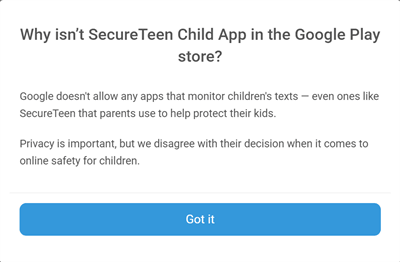
During setup, Google Play Protect may block the installation because the app is downloaded from an external source. To help parents navigate this setup step, here is the quick fix:
When the "App blocked to protect your device" prompt appears, tap More details and select Install anyway to proceed. Before doing so, ensure you have downloaded the APK directly from SecureTeen's official website.
If Play Protect continues to interrupt the process, you can temporarily pause app scanning: open Google Play on your child's phone, tap the profile icon in the top-right corner, select Play Protect > Settings (gear icon), and toggle off "Scan apps with Play Protect." Once the installation is complete and all permissions are granted, we strongly recommend turning this setting back on to maintain baseline device security.
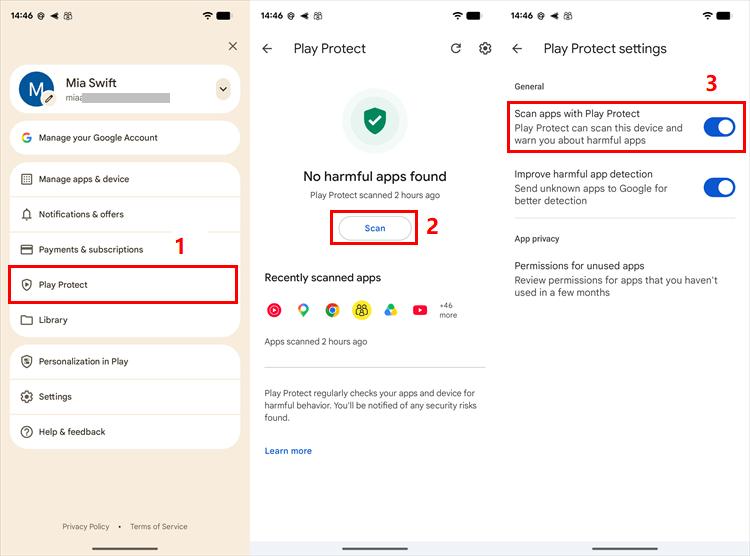
Overall, the setup is straightforward, with the child app installation being the only minor hurdle. It would be ideal if the child app were available directly on Google Play.
2Screen Time and App Management
SecureTeen provides two screen-time tools: Time Controls and Daily Quota.
Time Controls let parents schedule periods such as School Time, Bedtime, or Family Time. In the tested Android interface, a schedule could block phone access or restrict selected apps and websites. Website rules could use categories, such as Adult Content, Dating, and Gambling, or specific URLs.
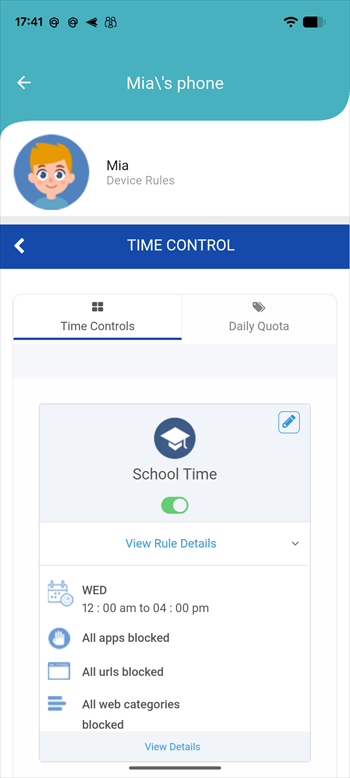
Daily Quota works as an overall daily device-use limit. In our test, changes to Time Controls and Daily Quota reached the Pixel 7 within a few seconds.
App Management was more basic in the interface we tested. We could block an app and the restriction took effect immediately, but we did not find app-specific time limits or an Always Allowed list. SecureTeen's wider website makes broader app-quota claims, so families should confirm which controls appear in the current app and plan.
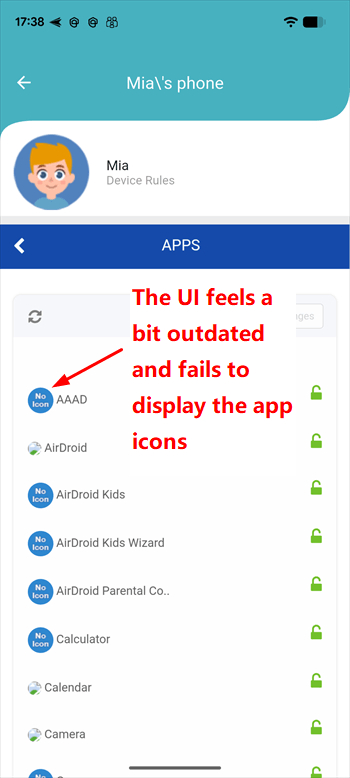
The App Block screen also looked dated and did not display icons for the apps installed on the Pixel 7, making a long app list harder to scan.
3Website Filtering
SecureTeen's tested Android interface offered URL blocking and 37 website categories. We attempted to open sites associated with restricted categories including adult content, dating, gambling, and violence. Some were blocked, while others still opened.
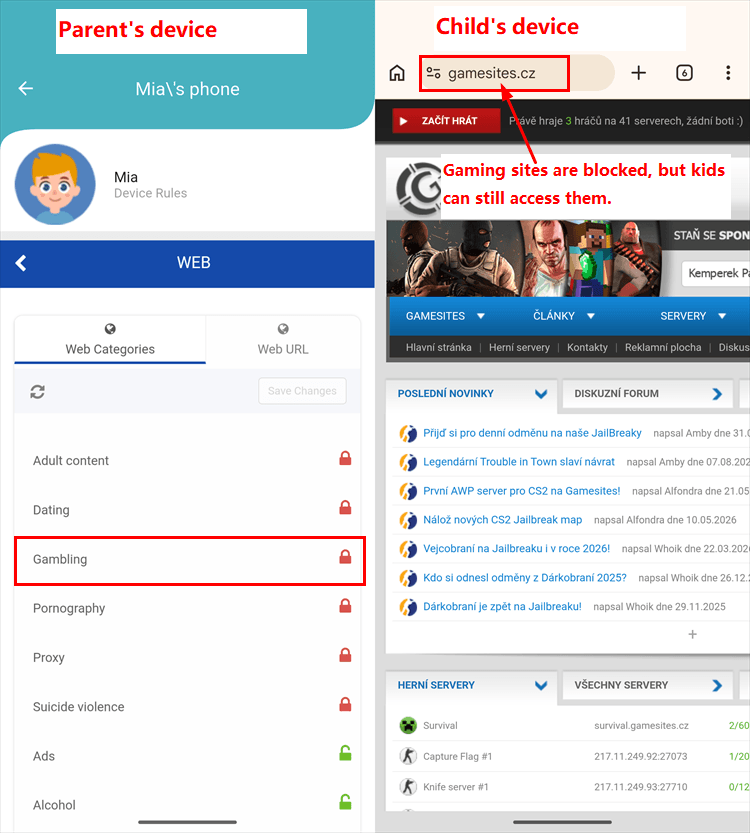
Category filters can be affected by site classification, browser behavior, permissions, and product updates. Regardless of the cause, direct URL blocking was more reliable than category blocking in our test. Parents should test must-block sites on the child's actual browser and avoid treating any filter as complete protection.
SecureTeen also showed a basic history of allowed and blocked sites.
4Location Tracking
SecureTeen's location tracking uses scheduled and on-demand updates. When we tapped refresh in the web dashboard or parent app, the system requested the Pixel 7's latest location.
The returned location was sufficient for a general location check during our spot test. The history interface, however, lacked a single-date filter, so we had to page through older records manually.
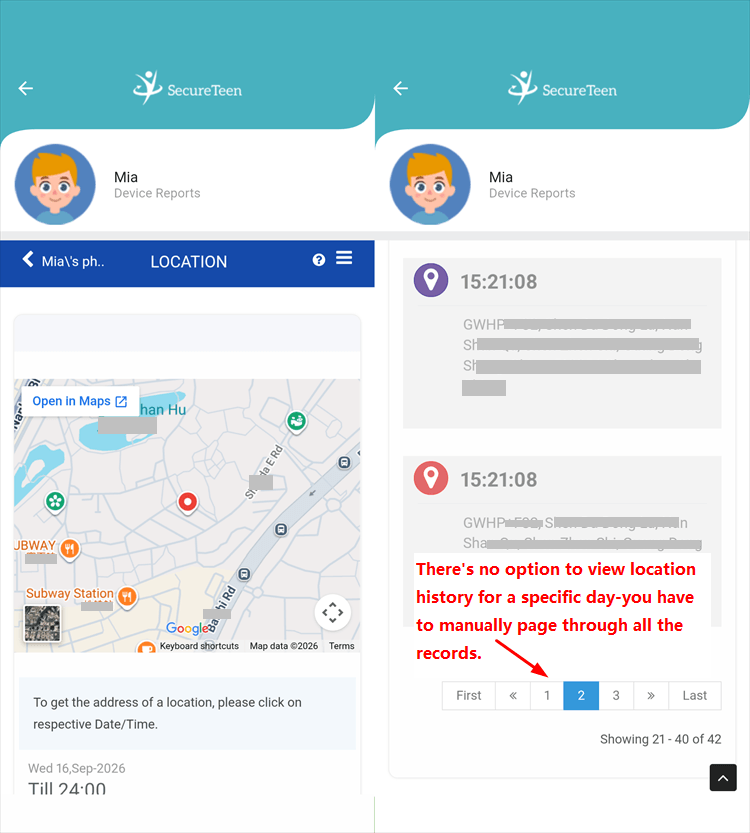
SecureTeen's tools were adequate for a basic device-location check, but we did not find the kind of live route view or clearly surfaced geofence workflow offered by some alternatives.
5Activity Monitoring and Alerts
Pictures Monitor: The test account displayed the first 3 photos stored on the Pixel 7 and then required an upgraded plan for broader gallery access. Photo access is highly sensitive, so it should be used only for a specific safety concern, with transparent family rules, rather than as routine privacy monitoring.
SMS and Call Monitor: SecureTeen documents incoming and outgoing SMS, MMS, and call records for selected Android plans and maps phone numbers to saved contacts. We did not test enough devices, carriers, or message types to claim complete capture.
Chat Messengers Monitor: SecureTeen supports monitoring popular social platforms including Facebook Messenger, Snapchat, WhatsApp, Skype, and Viber. In our controlled tests with Facebook Messenger and Snapchat, we observed outgoing keystrokes, periodic screenshots, and system notifications appearing in the dashboard. These records provided partial activity context.
6Subscription Terms and Google Play Billing Complaints
We found several recent Google Play reviews reporting unexpected subscriptions or charges associated with SecureTeen. Some users said they were subscribed without realizing it, while others reported continued charges after trying to cancel. These are user-reported experiences and have not been independently verified, so the reviews alone do not establish whether the issue resulted from an unauthorized subscription, an unclear subscription process, or another billing issue.
For example, one reviewer wrote that they were "subscribed ... without my permission" and reported difficulty canceling the subscription. Another described SecureTeen as a "money graber" and claimed that they were automatically subscribed.
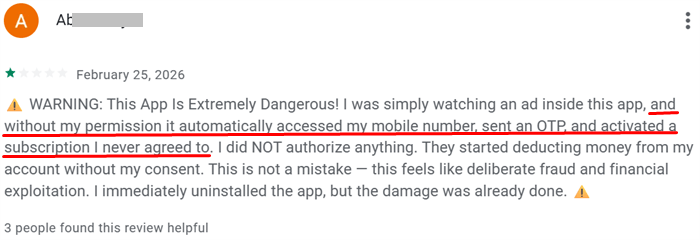
SecureTeen's Google Play listing states that subscriptions automatically renew unless canceled before the current subscription period ends. It also indicates that subscriptions can be purchased through the parent app. This means parents should carefully review the subscription terms, billing period, and renewal settings before completing a purchase.
We did not encounter any unexpected subscription or unauthorized charge during our own testing. However, when we sorted the Google Play reviews by recent activity, we found more than a dozen users reporting similar concerns about unexpected subscriptions or charges. While these reports do not by themselves confirm a systematic billing issue, the recurring nature of the complaints is something parents may want to keep in mind when signing up for SecureTeen.
SecureTeen Pros and Cons
1Pros
- Fast rule syncing in our test. Time Controls, Daily Quota, and app blocking reached the Pixel 7 within seconds.
- Broad Android toolset. SecureTeen combines schedules, app blocking, web controls, location check-ins, and selected activity records.
- Remote access. Parents can manage child profiles and supported rules through the parent app or a web dashboard.
2Cons
- Category filtering was inconsistent. Some sites in restricted categories still opened during our test.
- App management felt basic. The tested interface lacked app-specific time limits and an Always Allowed list.
- Android installation requires extra caution. The child app was installed from an APK and triggered a Play Protect warning in our test.
- Sensitive data may be processed. SecureTeen's privacy policy says the service may transfer device identifiers, contacts, browsing details, installed apps, location, and app-usage information to its servers.
- Billing complaints deserve attention. Recent Google Play comments included repeated reports of unexpected charges or cancellation difficulty, although we did not reproduce an unauthorized charge.
Hands-on conclusion: SecureTeen delivered quick Android rule changes and useful basic controls, but inconsistent web filtering, and limited app-management options kept it at 3 out of 5.
Before enabling activity records, parents should read the SecureTeen privacy policy, review the permissions on the child device, and use only the access needed for a clear safety purpose. An alert or partial record is a reason to check context calmly, not proof that a child did something wrong.
SecureTeen Alternative: AirDroid Parental Control
SecureTeen may suit families that prioritize traditional Android activity records and simple app blocking. AirDroid Parental Control takes a more comprehensive child-safety approach, combining granular app management, supported online-safety alerts, location and emergency tools, and teen-driving safety insights in one family solution.
| Category | SecureTeen | AirDroid Parental Control |
|---|---|---|
| Best for | Android-focused schedules, app blocking, web controls, location check-ins, and selected activity records | Families seeking broader protection across digital habits, online-risk signals, location safety, emergency support, and teen driving |
| App time management | Time-based device controls and immediate app blocking in our test | Individual App Limits, shared Total Time Limits, Downtime, Instant Block, Always Allowed apps, and extra-time requests |
| Child participation | Not supported | Children can request more time, and Focus Mode can support a self-directed distraction-free period |
| Website safety | Category filters, Safe Search, URL rules, and supported web-history logging; category results were inconsistent in our test | Website restrictions on both Android and iOS, including filtering modes, URL blacklists/whitelists, and browsing history; iOS also supports web time limits |
| Location safety | Scheduled or on-demand device location with a basic history interface | Live device location, route history, geofence alerts, and an SOS feature the child can use to request help |
| Safety alerts and risk context | Web, app, call, message, or social records depending on platform and plan | Activity reports plus supported keyword, social-content, AI-chat, notification, inappropriate-image, and calls or SMS safety alerts; coverage is broader on a child's Android device |
| Teen driving safety | Not supported | Trip routes, start and end points, speed, distance, duration, real-time speeding alerts, and post-trip hard-braking or rapid-acceleration records |
AirDroid's advantage is the way these layers work together. Parents can set a separate limit for a distracting app, receive a supported safety alert when selected risk signals appear, check location or geofence information when a child is traveling independently, and review driving-related trip data with a teen. These tools are intended to support timely conversations and age-appropriate safety rules, not constant surveillance.
- Consider SecureTeen. It may fit families that verify its Android controls and need the specific activity records included in their chosen plan.
- Consider AirDroid Parental Control. It may be a stronger fit when the family wants comprehensive protection that connects granular app rules, child time requests, supported safety alerts, live location, route history, geofences, SOS, family communication, and teen-driving insights.


Whichever product a family chooses, the goal should be to support the child's safety and healthier digital habits, not to collect unrelated private information. Explain the rules, use the least intrusive feature that addresses the concern, and reduce oversight as the child develops greater responsibility.
SecureTeen Review FAQ
SecureTeen's value depends on how reliably its selected controls work in the family's real setup. Test the must-have feature on the child's device, confirm the current plan and renewal terms, and choose the least intrusive tool that addresses the family's actual safety need.








Leave a Reply.