AirDroid Parental Control
24/7 Kids' Guardian via App & Web
- 👀Live surroundings and location tracking
- 🔞Content Monitoring and App/Web Blocking
- ⚠Instant alerts for online risks and geofences
- ⌛Screen time control and monitor
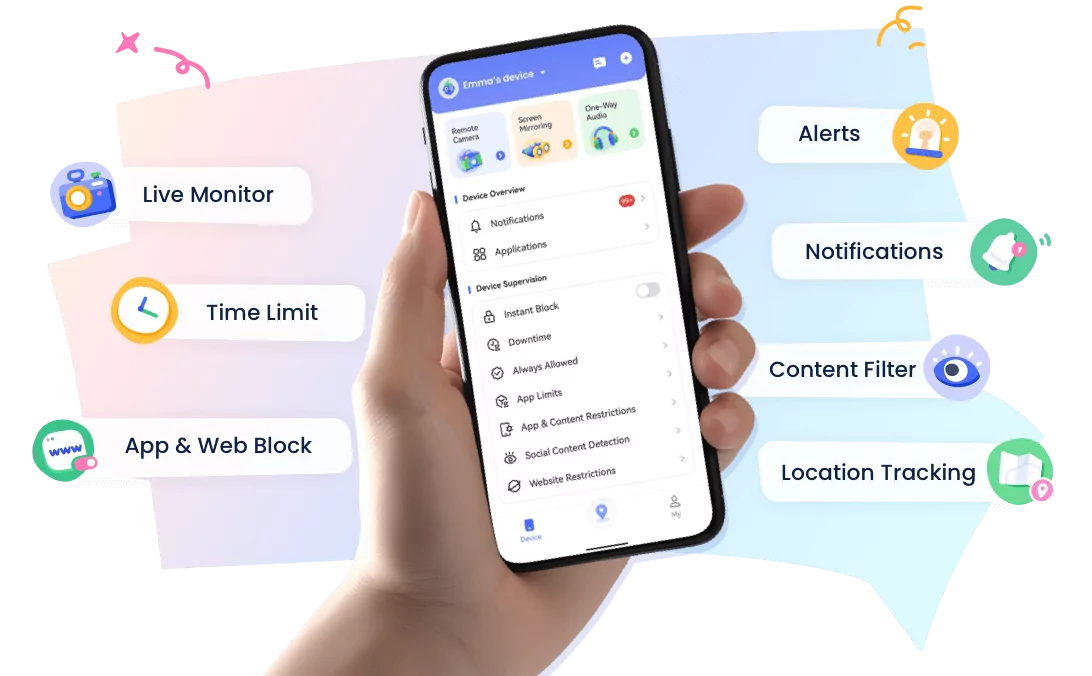
How to Monitor Children's Snapchat — Parental Controls & Risk Alerts
Snapchat's disappearing messages and private interactions can leave parents feeling uncertain. They may worry about cyberbullying, inappropriate content, contact from strangers, or simply how much time their teen spends on the app.
Wanting to "check" Snapchat does not always mean wanting to read private conversations. For many families, it means understanding recent interactions, setting healthy limits, or receiving a warning when supported activity may point to a safety concern.
This guide explains what parents can realistically check, when Snapchat's own Family Center may be enough, and how a parental-control app such as AirDroid Parental Control can add risk alerts and device-level controls on supported devices.
Quick Answer
The simplest place to start is Snapchat Family Center. It helps parents understand who their teen has recently communicated with and manage selected safety settings without revealing the content of private conversations.
If you also want alerts about potentially concerning activity, a parental-control app may help. On a supported child's Android device, AirDroid Parental Control offers Social Content Detection for selected keywords, access to supported device notifications, Snapchat usage reports, and app limits. Snapchat-related content detection and notification access are more limited when the child uses an iPhone.
No parental-control app should be assumed to capture every disappearing Snap, private conversation, or in-app interaction. Treat an alert as a reason to check in and understand the context, not as proof that your teen has done something wrong.
What Does It Mean to Check In on a Teen's Snapchat Use?
Some parents say they want to "check" their teen's Snapchat because the app feels difficult to supervise. But it helps to define the concern before choosing a tool. Checking in might mean learning who a teen has recently interacted with, understanding their screen time, or receiving an alert about selected warning signs. These are different goals and require different methods.
Checking in also does not necessarily mean reading every private conversation. Starting with the least intrusive option that addresses a specific concern can help parents support safety without creating unnecessary intrusion.
| Parent's Safety Goal | Suitable Method | What It Helps Parents Understand | Main Limitation |
|---|---|---|---|
| Understand who their teen has recently interacted with | Snapchat Family Center | Recent contacts and selected safety settings | Does not show the content of private conversations |
| Understand how much time their teen spends on Snapchat | Built-in device tools or a parental-control app | Usage reports, app limits, and scheduled restrictions | Usage data does not provide access to chat content |
| Receive alerts about potential safety concerns | A parental-control app that supports risk detection | Supported keyword, content, or notification-related alerts | Available information depends on the device, operating system, permissions, and app support |
| Understand the full context of every Snap and conversation | No tool can reliably guarantee complete access | Some tools may provide limited message, notification, or screen information | Disappearing content and platform restrictions prevent guaranteed access to everything |
Recent-contact visibility, usage reports, potential-risk alerts, and conversation content are separate capabilities. Parents should compare tools according to the specific concern they are trying to address rather than treating all forms of Snapchat oversight as interchangeable.
The Simplest Way to Check In on Your Teen's Snapchat Use
If you want a simple app or method for checking in on your teen's Snapchat use, follow this three-step approach.
- Step 1. Start with Snapchat Family Center
- Use Snapchat's built-in tools to understand recent interactions and manage the safety settings available to your family. Family Center does not reveal private chat or Snap content.
- Step 2. Decide whether you need time controls or risk alerts
- If excessive use is the main concern, usage reports and app limits may be enough. If you are concerned about bullying, self-harm, sexual content, drugs, or contact from strangers, consider a tool (like AirDroid Parental Control) that offers supported risk alerts.
- Step 3. Add AirDroid Parental Control when you need more support on Android
- On a supported child's Android phone, AirDroid Parental Control can combine selected keyword alerts, device-notification visibility, usage reports, and app limits in one parent dashboard. The sections below explain the setup and its limitations.
For many families, this layered approach is simpler than trying to monitor everything: begin with the official tool, add only the controls that match the concern, and talk openly with your teen about what is being used and why.
Start With Snapchat's Official Family Center
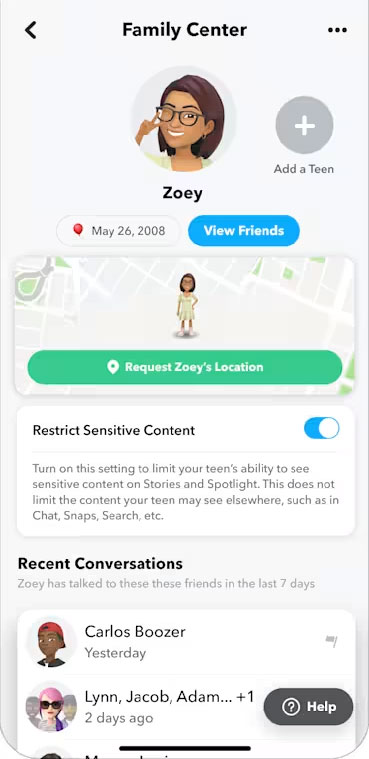
Snapchat Family Center is the least intrusive starting point for many families. Depending on the features available to your account, it can help parents review recent contacts, manage selected content and privacy settings, report an account, and use supported location-safety tools. It does not show parents the content of private chats or Snaps.
- Review recent interactions: See the friends or groups a teen has recently communicated with without seeing the conversation itself.
- Review the friends list: Help identify unfamiliar contacts and start a conversation about adding people safely.
- Manage selected safety settings: Use the sensitive-content and other controls currently available in Family Center.
- Report safety concerns: Report an account when there may be a violation.
- Use supported location tools: Location sharing and related alerts depend on the feature, account, and the teen's participation.
To get started, the parent needs a Snapchat account and must connect with the teen through Family Center:
- Step 1. Add your teen as a friend on Snapchat.
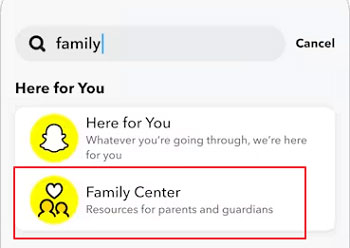
- Step 2. Use Snapchat search to find Family Center.

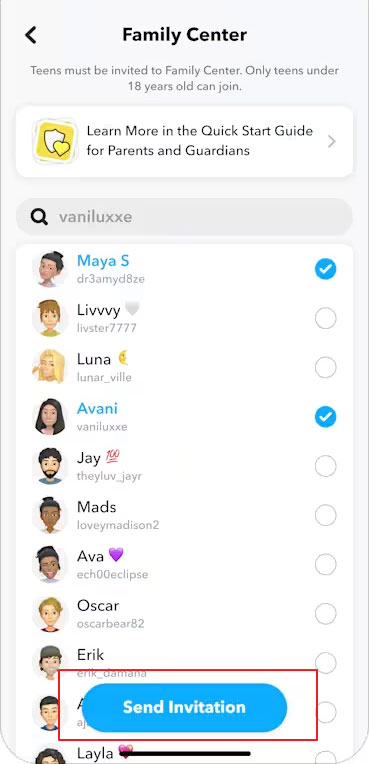
- Step 3. Select your teen and send an invitation.

- Step 4. Ask your teen to accept the invitation.
- Step 5. After the connection is accepted, review the controls available in Family Center.

What Family Center Does Not Provide
Family Center is designed to give parents useful safety information while preserving a teen's privacy. As a result, it does not provide several forms of device-level oversight:
- It does not show the content of private chats or Snaps.
- It does not guarantee visibility into disappearing messages, images, or videos.
- It does not provide customizable keyword alerts for Snapchat conversations.
- It does not replace device-level usage reports, schedules, or app limits.
If one of these capabilities is necessary for a specific safety concern, AirDroid Parental Control may provide an additional layer of support with compatible parental-control features.
Which Parental-Control Apps Can Alert Parents to Risky Snapchat Activity?
Several parental-control apps offer some form of Snapchat oversight, but they do not all detect the same information. Some focus on selected keywords, while others analyze supported activity for broader risk categories. Coverage may change with the child's device, operating system, permissions, subscription, and product version.
| App | Snapchat-Related Oversight | Important Consideration |
|---|---|---|
| AirDroid Parental Control | On supported child Android devices, combines Social Content Detection for selected keywords with device-notification visibility, usage reports, and app limits. | Social Content Detection and Notifications are Android-focused; neither feature guarantees access to every Snap or complete conversation. |
| Bark | Its official documentation describes issue alerts for supported Snapchat text activity, including selected DMs, Stories, profiles, and searches on Android. | Its Snapchat content monitoring is Android-focused and may capture only part of a disappearing conversation. |
| Qustodio | Its Social Monitoring feature lists Snapchat among the services analyzed for potentially concerning topics and may provide an alert with a conversation snippet. | The feature Snapchat monitor is Android-focused. |
| FamiSafe | Its Social Apps Detection documentation lists Snapchat and describes keyword alerts and AI-assisted insights for supported activity. | Supported content and available context depend on the child's device and current app permissions. |
This is a capability snapshot rather than a full product ranking. Check each provider's current documentation before choosing an app. For detailed pricing, compatibility, and feature comparisons, see our guide to Snapchat monitoring apps.
For families with a supported child Android device, AirDroid is useful when the goal is to combine customizable keyword alerts with everyday controls such as notification visibility, app-usage reports, and time limits. Here is how to set it up.
How to Set Up AirDroid for Snapchat Safety
Setup: Is AirDroid Parental Control Easy to Get Started?
AirDroid Parental Control is relatively easy to set up, with a guided process for connecting the parent's and child's devices.
- Start on the parent's device: Install AirDroid Parental Control from the App Store or Google Play, sign in, and follow the in-app instructions to add your child's device.
- Set up the child's device: Install AirDroid Kids on the child's Android or iPhone, then enter the binding code shown in the parent app.
- Allow the required permissions: Depending on the child's device and the features you want to use, AirDroid Kids may require permissions such as location and photo access. Some Android devices may also require permission to install the app from the selected source.


Overall, the basic setup is straightforward, taking about 6 minutes or less, although the exact steps vary by the child's device and the features you want to use.
For a Child's Android Device
1. Set Up Alerts for Selected Risk Keywords
AirDroid's Social Content Detection can send an alert when a supported app on the child's Android device receives a message containing a selected keyword. This can help parents focus on specific concerns instead of trying to review every interaction.
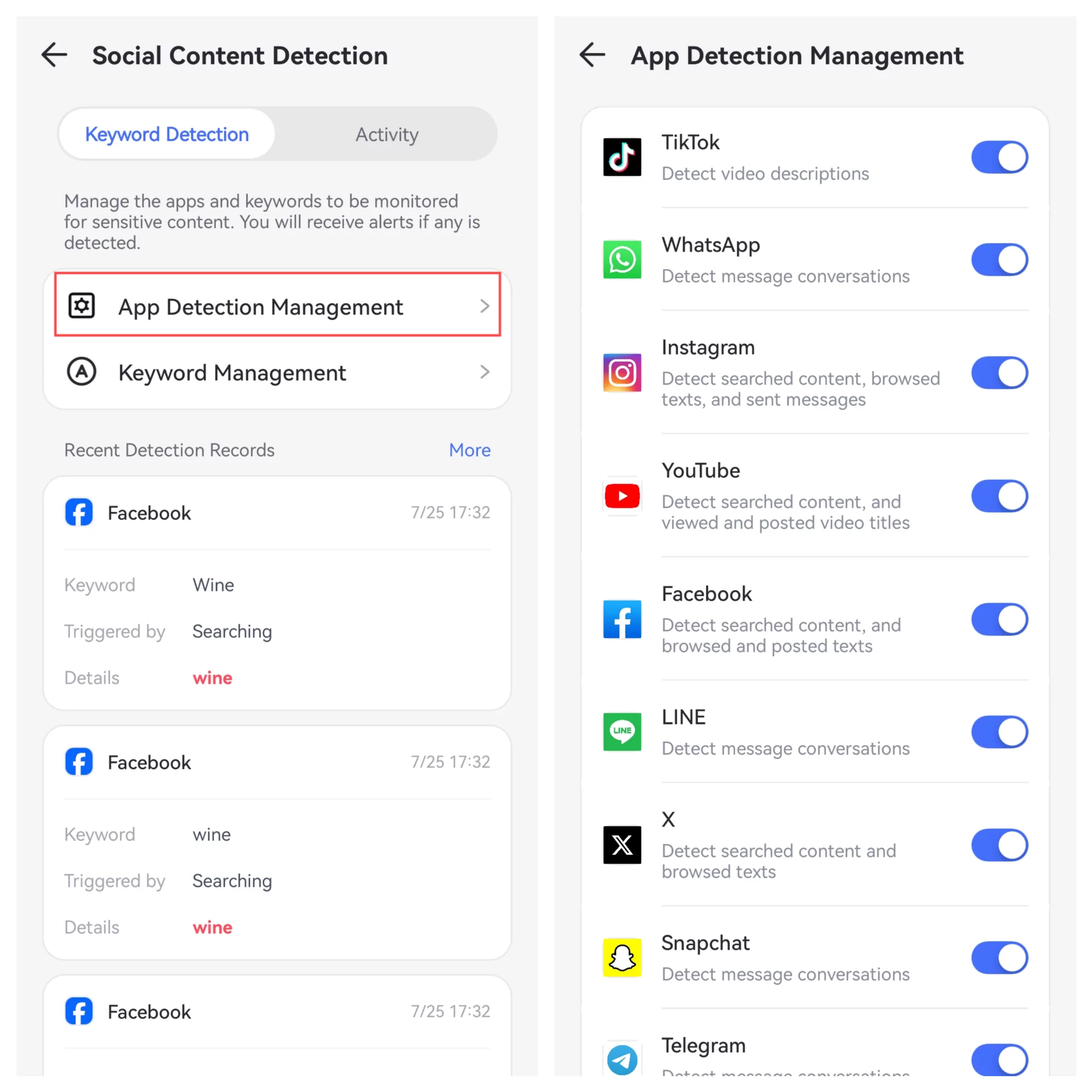
- Step 1. Open Social Content Detection in AirDroid Parental Control.
- Step 2. Select App Detection Management and enable Snapchat if it appears as supported in your current setup.

- Step 3. Open Keyword Management. Enable relevant preset categories or add keywords that reflect your family's concerns.
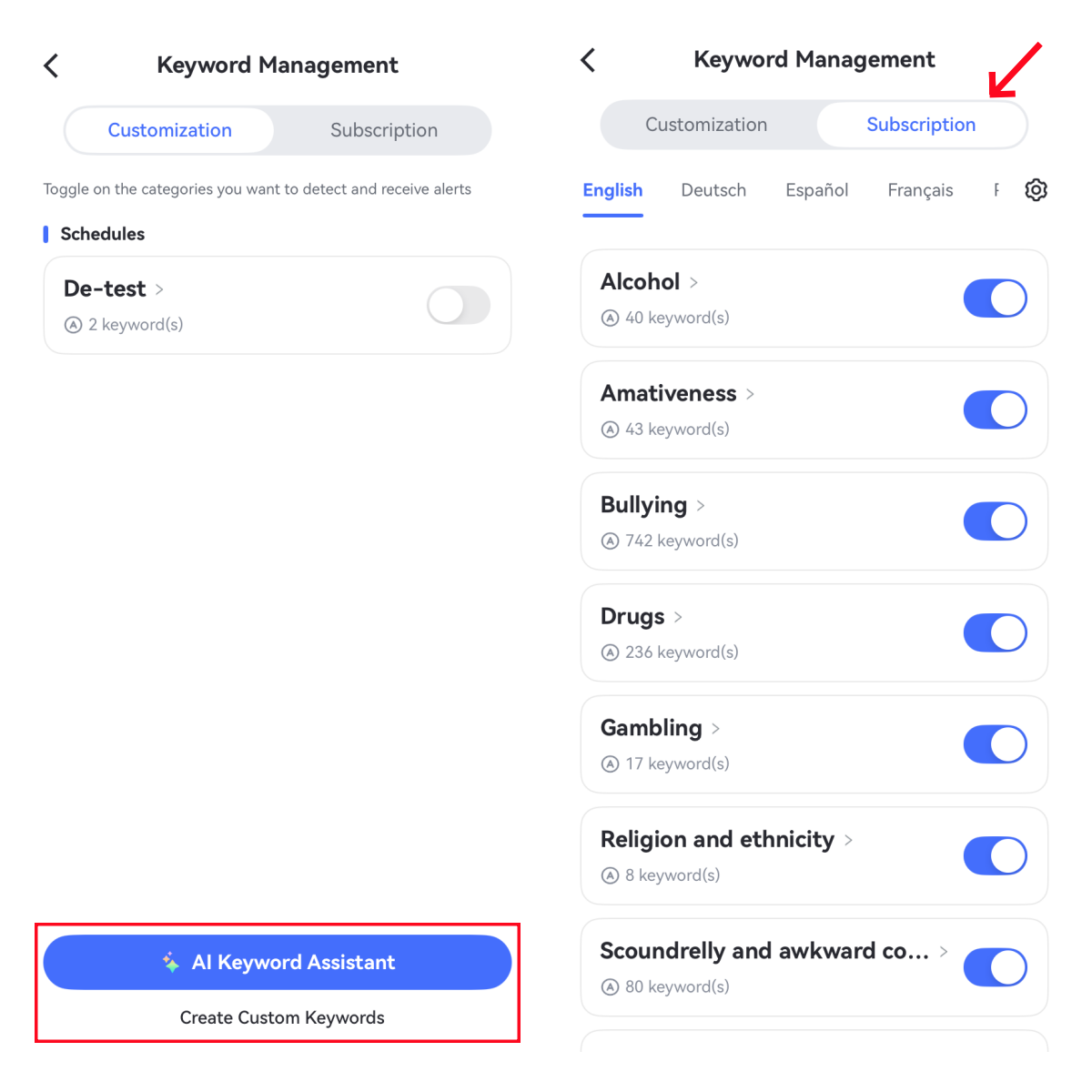
Important: A keyword alert is a signal to review the situation, not a complete record of the conversation. A word can be harmless in one context and concerning in another, so talk with your teen before drawing conclusions.
2. Review Supported Snapchat Notifications
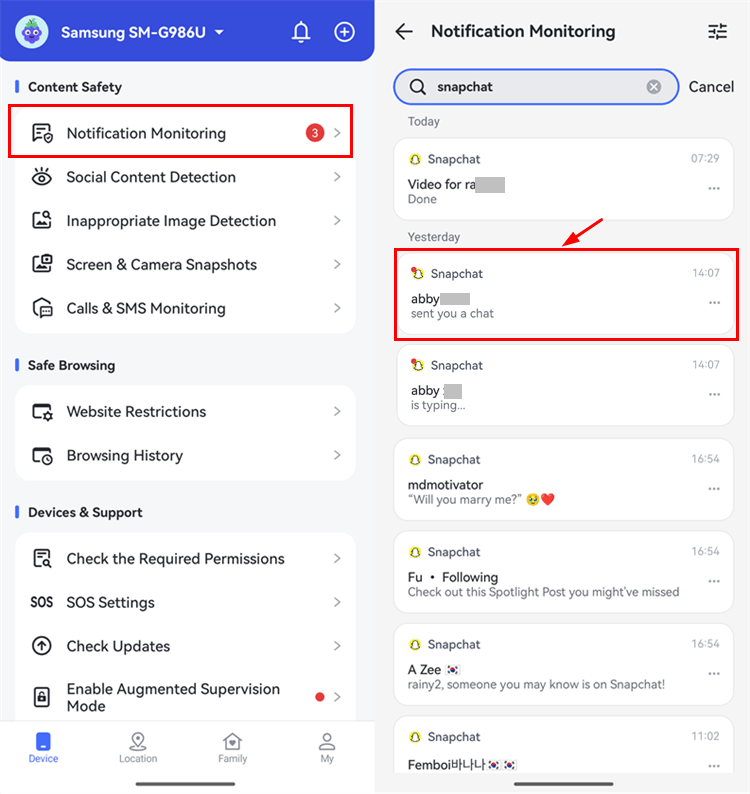
AirDroid Parental Control's Notifications feature lets a parent review notifications available on the child's Android phone. A Snapchat notification may help identify who contacted the teen or show a limited preview, but it may not contain the full message or any disappearing media.
- Step 1. Open Notifications in the parent dashboard.
- Step 2. Find or filter the notification records associated with Snapchat.
- Step 3. Use the available notification details as context for a conversation, not as a complete Snapchat history.

3. Review Snapchat Usage and Set Time Limits
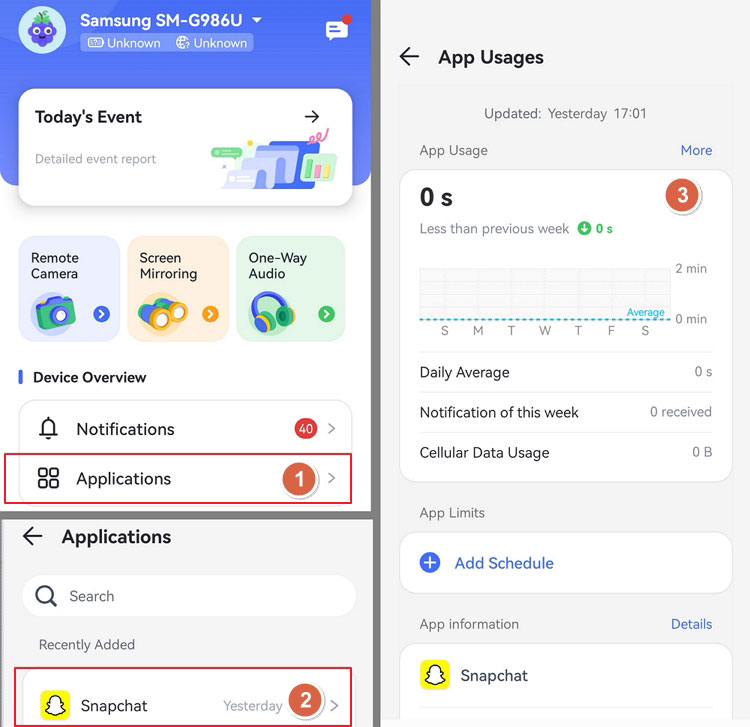
If screen time is the main concern, use AirDroid Parental Control's application report to see how long Snapchat is used. You can then add an app limit or downtime schedule that reflects the rules agreed on in your family.
- Step 1. Open the AirDroid Parental Control dashboard.
- Step 2. Select Applications and choose Snapchat.
- Step 3. Review the available usage report, then add a limit or schedule if needed.

4. Add Related Image-Safety Alerts if Needed
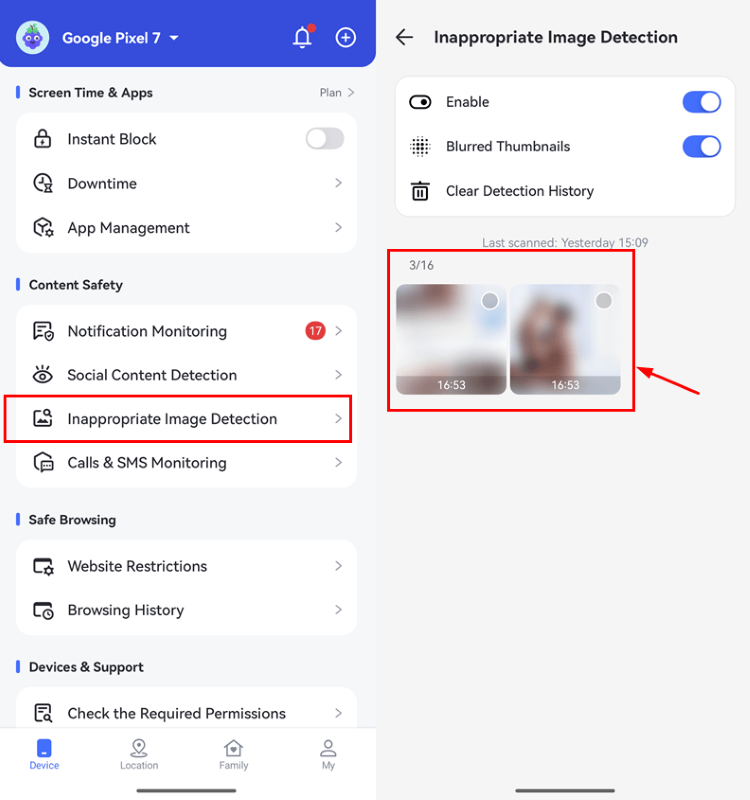
AirDroid Parental Control also offers Inappropriate Image Detection for supported images saved to the child's device storage or Gallery. This is a separate device-level safeguard; it should not be described as scanning every image viewed or exchanged inside Snapchat.
For a Child's iPhone
AirDroid's Snapchat content-level oversight is more limited when the child uses an iPhone. Social Content Detection, Notifications, and Screen Mirroring are listed by AirDroid as child-Android features. Depending on the iPhone setup and supervision mode, parents may still be able to use device-level tools such as app information, usage controls, app restrictions, and location features.
If risk-content alerts are your primary requirement, confirm current iPhone compatibility before subscribing. Do not assume that the iPhone setup works identically to Android or that it can show Snapchat conversations.
What AirDroid Can and Cannot Tell Parents About Snapchat
| Feature | What It Can Help With | What It Does Not Guarantee |
|---|---|---|
| Social Content Detection | Alerts for selected keywords in supported incoming messages on a child's Android device | Show all phrases, complete conversation, Snap, image, or video on parents' dashboard |
| Notifications Sync | Review of supported notifications available on the child's Android phone | A complete copy of every Snapchat message or conversation |
| Usage reports and limits | Understanding Snapchat screen time and setting usage boundaries | Visibility into what the teen did during that time |
| Inappropriate Image Detection | Detection of supported inappropriate images saved to device storage or Gallery | Scanning every image viewed inside Snapchat |
What Should Parents Do After a Snapchat Risk Alert?
An automated alert may miss context or flag an innocent use of a word. Start by checking the information available, then respond according to the seriousness and immediacy of the concern.
- Check the context calmly: Ask an open question instead of beginning with an accusation. Give your teen space to explain what happened.
- For unwanted contact or bullying: Help your teen block or report the account and preserve relevant evidence where possible.
- For repeated harmful behavior: Review privacy settings, friend lists, screen-time boundaries, and whether additional adult support is needed.
- For grooming, sexual exploitation, credible threats, or immediate danger: Prioritize the child's safety, preserve available evidence, and contact the appropriate school, platform, emergency service, or local authority.
The purpose of a risk alert is to help a parent notice a possible problem sooner. It should support a thoughtful safety response, not replace communication or become a tool for punishment.
Protect Snapchat Safety Without Losing Your Teen's Trust
Parental controls work best when they are part of a broader family safety plan. For teens in particular, explain what you intend to monitor, which alerts you may receive, and what will happen if a concern appears.
- Be transparent: Avoid secretly installing monitoring tools. Explain the safety concern and the specific features being used.
- Use the least intrusive option that works: Start with Family Center or usage controls before adding content-level alerts when there is no specific elevated risk.
- Agree on boundaries: Set expectations around unknown contacts, location sharing, disappearing messages, and late-night use.
- Review the arrangement: As the teen demonstrates safer habits, reconsider which controls are still necessary.
- Check local requirements: Privacy and monitoring laws vary by location and circumstance. Seek qualified advice when you are uncertain.
Warning Signs That May Call for a Conversation
- A sudden change in mood after using Snapchat.
- Repeated late-night use or a sharp increase in time spent on the app.
- Frequent contact from unfamiliar accounts.
- Signs of harassment, coercion, secrecy, or pressure to meet someone known only online.
- Suddenly deleting an account after a distressing online experience.
These signs do not prove that something harmful is happening. Use them as reasons to check in gently and make it easier for your teen to ask for help.
Frequently Asked Questions
What is the simplest way to check in on a teen's Snapchat use?
Start with Snapchat Family Center if your goal is to understand recent interactions and manage selected safety settings. Add usage controls or a parental-control app like AirDroid Parental Control only when you need a specific additional capability, such as app limits or supported risk alerts.
Can parental-control apps alert parents to risky Snapchat activity?
Some apps, including AirDroid Parental Control, Bark, Qustodio, and FamiSafe, describe alerts or monitoring for supported Snapchat-related activity. Their methods and coverage differ, so check the child's device, operating system, required permissions, and the provider's latest documentation.
Can parents read Snapchat messages through Family Center?
No. Family Center can provide information such as recent contacts and selected safety controls, but it does not show the content of private conversations or Snaps.
Can AirDroid Parental Control show every Snapchat message?
No. On supported child Android devices, AirDroid Parental Control can provide selected keyword alerts and access to supported device notifications, but neither feature guarantees a complete copy of every Snapchat conversation, image, video, or disappearing Snap.
Does AirDroid Parental Control offer the same Snapchat monitoring on iPhone and Android?
No. AirDroid Parental Control lists Social Content Detection, Notifications, and Screen Mirroring as child-Android features. On iPhone, available device-level controls depend on the setup and supervision mode, while Snapchat content-level oversight is more limited.
Final Thoughts
There is no single tool that gives parents a complete view of everything that happens on Snapchat. A more realistic approach is to match the method to the concern: use Family Center for recent-interaction visibility, use app limits when screen time is the issue, and consider supported risk alerts when there is a specific safety need.
For families with a child's Android device, AirDroid Parental Control brings selected keyword alerts, device-notification visibility, usage reports, and app limits into one parent dashboard. Use these features openly and treat alerts as prompts for supportive conversations rather than automatic conclusions.








Leave a Reply.