AirDroid Parental Control
24/7 Kids' Guardian via App & Web
- 👀Live surroundings and location tracking
- 🔞Content Monitoring and App/Web Blocking
- ⚠Instant alerts for online risks and geofences
- ⌛Screen time control and monitor
Is Pinterest Safe for Kids? The Truth Behind Its Creative and Risky Side
Imagine one day your child enthusiastically comes to show a drawing reference or a craft idea they just found on Pinterest. At a glance, this visual platform indeed looks clean and educational. However, its open recommendation system and numerous external links often trigger specific concerns for parents.
Facing this dilemma, it is very natural for parents to begin to question whether Pinterest is safe for kids before letting them browse further.
This concern is widely shared by the online community; for instance, a heated discussion on Reddit titled "Do y'all really think this platform is ok for kids?" reveals that many users find the algorithm's tendency to surface suggestive or "soft-adult" content deeply worrying for younger audiences.
This article is written objectively without taking sides to help you evaluate how safe the app is and what protection steps can be applied.
Quick Verdict: Is Pinterest Safe for Kids?
Objectively, Pinterest is a very creative platform and a useful source of inspiration for arts and crafts projects. However, the question of whether Pinterest is safe for kids arises because this app also carries the risk of exposing underage users to inappropriate content.
Based on a summary of 40 parent reviews, Common Sense Media concludes that the platform's algorithm can easily surface problematic materials, such as nude content, if a child searches or clicks on certain topics. Therefore, parental supervision and responsible usage guidance are highly emphasized to help the child avoid disturbing advertisements and visuals.
What is Pinterest and Why are Kids Attracted to It
Pinterest is a visual social media platform that allows its users to search, save, and collect various inspiring ideas in the form of images or videos. This app functions like a digital bulletin board, where users can create specific visual collections for various hobbies such as crafts, clothing inspiration, and room decoration.
Kids are very attracted to this app due to its appealing interface and its ease in providing limitless visual references for their personal interests and school assignments.
Considering this high visual appeal, it makes perfect sense that many parents start researching the question is Pinterest safe for kids before granting access to their kids.
💡 Real-World Case Study: Why Users Love Pinterest
"The Best Form of Social Media" (1.4M Likes)
"Me trying to explain that Pinterest is the best form of social media because there's no hate comments, news outlets, disturbing posts, just good vibes and inspiration."
[Source]
"Media Without the Social Aspect" (599.5k Likes)
"Me explaining that I like Pinterest so much because it's just media without the social aspect... be in my own lil bubble without having to interact with anyone because it's literally just pretty pictures."
[Source]
"A Positive Environment" (652 Likes)
"I feel like the reason I love Pinterest is because it's all inspiration and things I love and there's no comments. Like you'd have to work hard to be on the negative side of Pinterest."
[Source]
Pinterest Age Requirement
According to the Pinterest's official guidelines and policies, the required minimum age to register and create a Pinterest account is 13 years and above. However, in real-world usage, the content filtering system on this app still has loopholes that require parents to remain vigilant.
Although the system will blur any media and raise an alert if it detects any explicit content, users with a teen account can still easily click past the warning and view the original content. Thus, considering this easily bypassed restriction system, we can objectively conclude that Pinterest is not a platform designed for kids.
Potential Risks of Pinterest for Kids
Understanding the features and how this app works leads to a follow-up question: how big are the risks kids might face? Considering the system in content moderation, parents need to objectively re-evaluate whether Pinterest is safe for kids by considering the various potential dangers below.
Inappropriate Content through Recommendations
Pinterest's algorithm is designed to keep users engaged by continuously recommending similar content based on their search history and interactions. While this is great for finding home decor, it has a dark side.
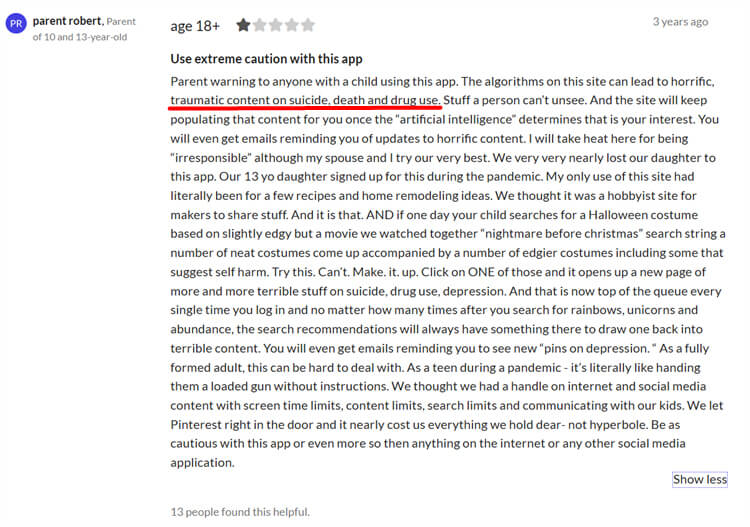
This was tragically illustrated in 2017 by the case of Molly Russell, a teenager who was served a relentless stream of depression and self-harm content until she eventually took her own life.
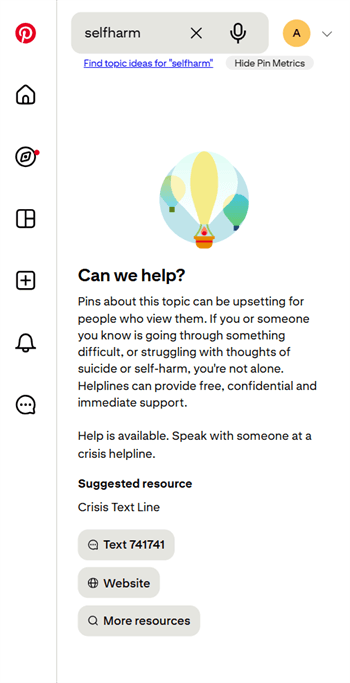
To see how the platform handles these risks today, I conducted a live test on the app.
The good news is that searching for "self-harm" now triggers a hard block; instead of Pins, Pinterest displays a dedicated support page for the 988 Suicide & Crisis Lifeline, as shown in the image below.
However, the safeguards remain inconsistent. When I searched for "depression," a support banner appeared at the top, but the feed below remained filled with sensitive content.
Even more concerning were my searches for terms like "sex" or "nude." While I didn't encounter hardcore explicit images, the results were heavily sexually suggestive—certainly not the kind of "good vibes" parents expect for their children.
These findings align with various parent reviews on Common Sense Media, where families reported their children being recommended visuals related to death and illicit drugs. One parent even testified that they nearly lost their daughter due to the unfiltered, dangerous materials surfacing on the app.
The threat isn't just limited to user-generated Pins. Recent technological shifts have introduced new risks from AI-generated images and manipulative advertisements.
The real danger lies in the "aggressive visual cycle": once a child accidentally interacts with even one problematic Pin, the algorithm immediately floods their homepage with similar negative material.
This creates a digital rabbit hole that is incredibly difficult for a young user to escape without direct parental intervention.
Comments, Messages, and Stranger Interaction
Although Pinterest focuses on the visual aspect, the existence of direct messaging features and comment sections still opens loopholes for limitless interaction among users. Statistically, private communication features on social media are the most vulnerable points for kids—as reported by the Pew Research Center (2022) that 46% of teenagers have experienced cyberbullying through this kind of interaction feature.
Many parents have expressed serious concerns after discovering their kids chatting with strangers in community spaces such as Gacha Pin Groups. The limitless interaction that occurs in such chat groups is highly at risk of leading to cyberbullying cases or child predator manipulation.
External Links and Uncontrolled Spending
Almost every image or Pin on this platform includes an external link that will directly redirect users to third-party websites. These links function as digital marketing tools to promote and sell various kinds of commercial products to the audience.
Unfortunately, these external sites are beyond Pinterest's moderation control, so they have a high potential to contain scam pages, adult content, or inappropriate goods. This condition is not only morally dangerous but also triggers the risk of uncontrolled financial spending if kids have free access to payment methods.
These concerns aren't just theoretical; they are echoed by numerous users on Reddit who have flagged the intrusive and often misleading nature of these ads. Our own testing confirms these reports. We found it alarmingly easy to be redirected to third-party sites with a single accidental click.
Time Addiction & Endless Scrolling
Pinterest is specifically designed with an endless scrolling feature that psychologically triggers its users to keep searching and viewing new images. This bottomless interface manipulates dopamine release in kids' brains so that they tend to lose track of time while browsing the app.
This habit of spending hours staring at the screen can ultimately create a pattern of digital addiction that is very difficult for kids to stop. This addiction problem has the potential to ruin kids's sleep schedules, decrease their learning concentration levels, and limit the quality of their social interactions in the real world.
Data Collection
Just like other major social media companies, this platform massively collects its users' personal data to maximize ad targeting efficiency. The collected tracking records are highly detailed, from specific search history and the type of device used to the users' click patterns within the app.
This data collection practice directly raises privacy concerns because kids's digital footprints are already exploited from a very early age. Parents must realize that kids's data profiles can be utilized by third-party advertisers to present manipulative content tailored to their interests.
How Parents Can Make Pinterest Safer for Kids
To deal with all these digital risks, parents should actively work to reduce the risks when kids use this visual platform.
Talk to Kids About Online Risks
The first crucial step is to educate kids on how to spot and avoid scams or suspicious links on the Internet. In addition, you also need to discuss openly to set clear boundaries and expectations about which types of content they are allowed to access.
However, this communication approach often hits a dead end because a child's curiosity can overcome the agreements that have been made together. Ultimately, verbal promises require a very high level of self-control, something that is generally not yet fully possessed by kids or teens.
Explore Pinterest's Safety Settings
To keep kids safe, Pinterest has a special account type just for teens that comes with stronger built-in privacy tools to better protect them. You can make it even safer by adding a parental passcode feature that prevents kids from changing the safety settings without a parent's permission.
With this app's safety settings, you also retain full control of blocking unwanted contact requests from strangers. If you find a Pin or interaction that violates community guidelines, you can directly report inappropriate messages and content to the platform.
Even with these features enabled, a child with a teen account still can view explicit content that accidentally slips through the filtering system. This condition often triggers further doubts about whether Pinterest is safe for kids, so it is very natural if parents turn to using the help of parental control apps in the form of parental control tools.
Using Parental Control Tools to Protect Kids on Pinterest
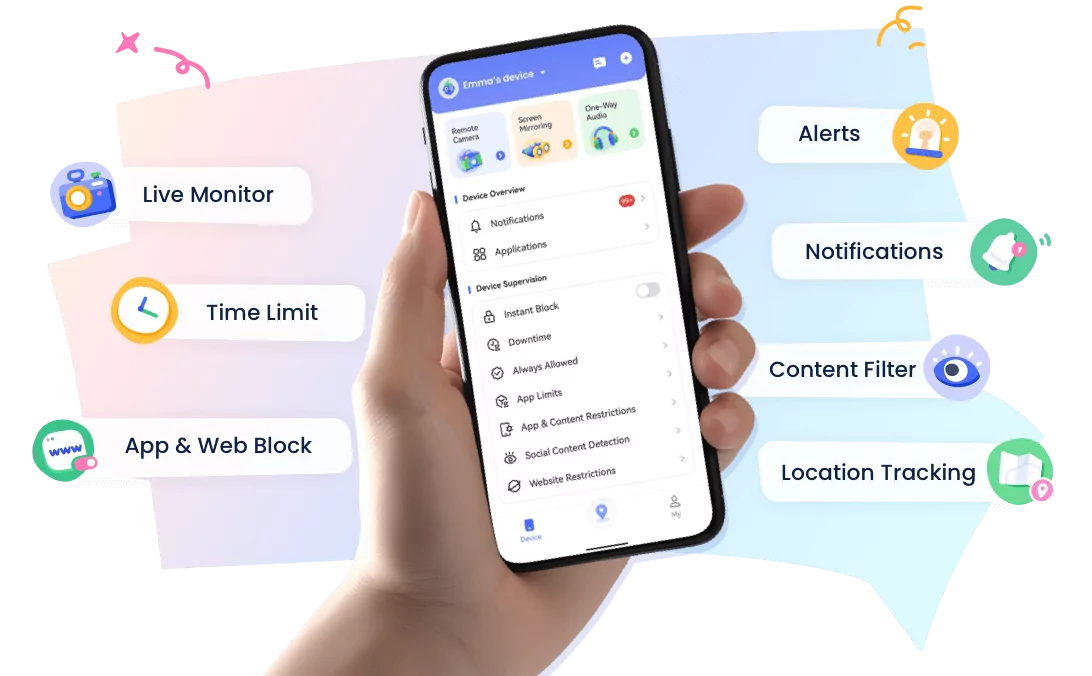
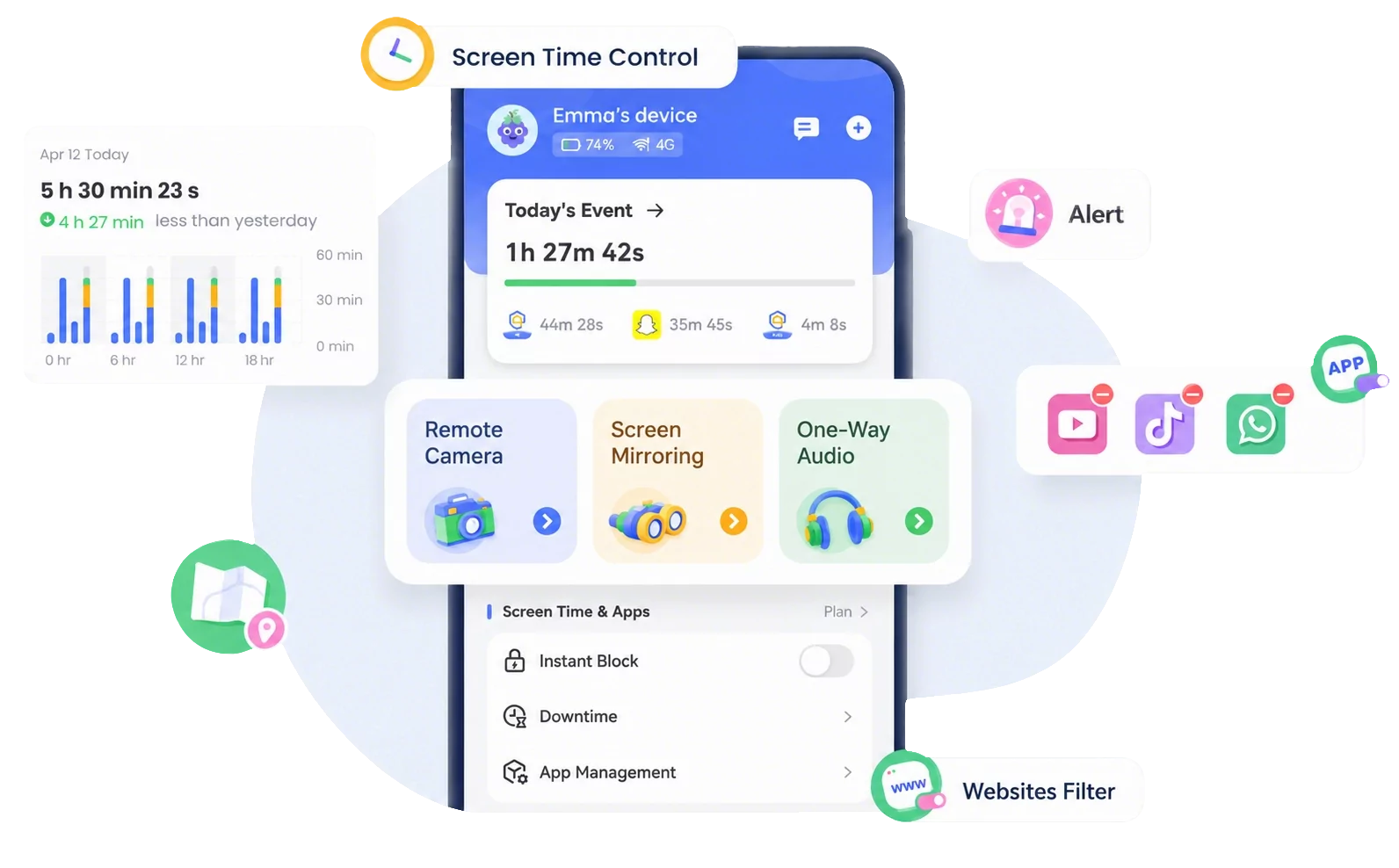
Considering the limitations in the app's built-in features, parents can use AirDroid Parental Control, which is specifically designed to protect kids from various digital threats. This app actively works to keep kids safe when using gadgets through a comprehensive protection system.
As a security supplement, these parental control tools provide various additional features:
- App usage restrictions & Screen time management: Can view indications of addiction and excessive use of Pinterest, and then set reasonable daily time limits for kids.
- Social media monitoring: Because kids have the potential to switch to other chat apps, AirDroid can protect them across 14 social media apps at once and provide real-time alerts.
- Inappropriate photo detection: It can automatically scan and recognize inappropriate photos inside the kid's phone, then promptly send warning notifications.


Final Verdict: Is Pinterest Safe for Kids?
As an objective conclusion, this platform is not recommended for solo use by younger kids, but teenagers aged 13 to 16 can access it with supervision. Ultimately, the answer to whether Pinterest is safe for kids depends heavily on your level of involvement as parents in guiding your child's daily digital activities.
The Kids' safety is actually not only determined by the built-in features of the platform itself, but also by how proactive you are in applying extra layers of protection on their devices.
Therefore, the use of additional safeguards such as the AirDroid Parental Control app becomes the main key to ensuring kids remain protected while they are busy searching for inspiration online.








Leave a Reply.