AirDroid Parental Control
24/7 Kids' Guardian via App & Web
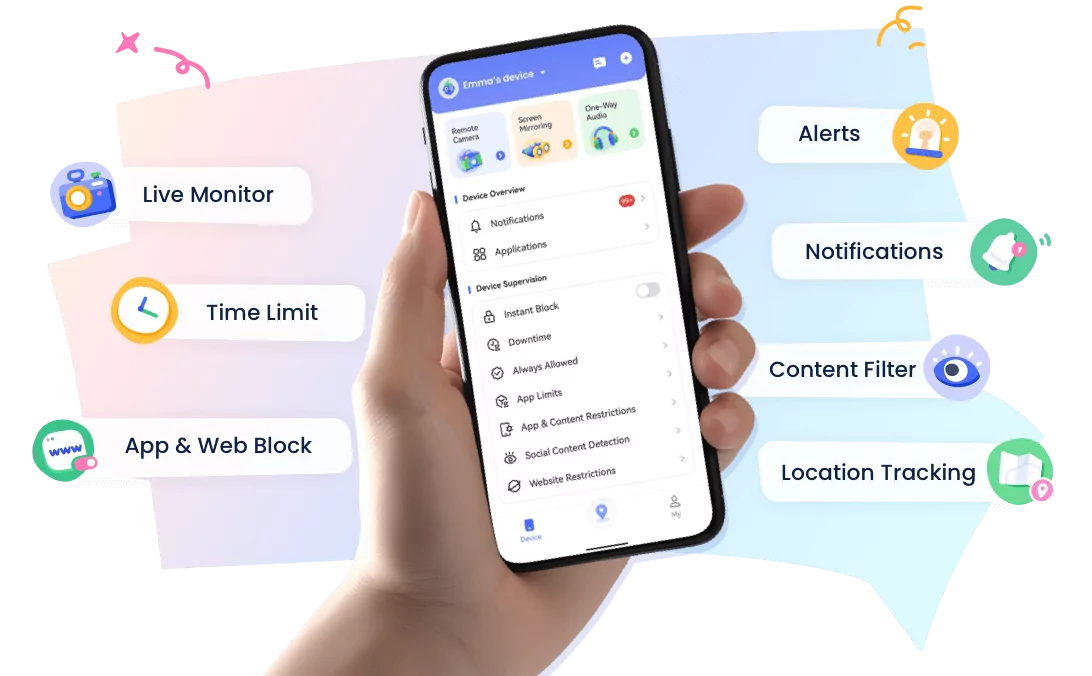
- 👀Live surroundings and location tracking
- 🔞Content Monitoring and App/Web Blocking
- ⚠Instant alerts for online risks and geofences
- ⌛Screen time control and monitor
Is OurDream AI Safe? What Parents Need to Know in 2026
If you have found "OurDream AI" on your phone bill or your child's browser history, you already know something is off. Most online reviews on OurDream AI praise its "uncensored" chats and fantasy features because they are written by satisfied adult users. This one isn't. It's written for parents who want to understand what OurDream AI is, why it is not built for teenagers, and what concrete steps to take if your teen is using it.
What Is OurDream AI
Saw OurDream AI in your child"s browser history or phone bill? This guide explains what the platform is, why it's risky for teens, and how parents can handle it.
Have you seen "OurDream AI" on your phone bill or your child's browser history? Most online reviews on OurDream AI praise its "uncensored" chats and fantasy features because they are written by satisfied adult users. This one isn't. It's written for parents who want to understand what OurDream AI is, why it is not built for teenagers, and what concrete steps to take if your teen is using it.
OurDream AI is the ultimate adult AI playground. The app lets users create custom virtual girlfriends/boyfriends and chat or role-play with them.
Users control everything about these companions, including physical appearance, body features, personality, conversational tone, and more. After creation, users can chat with companions and generate images or short video clips of them. Other than that, users can also interact with the prebuilt AI models built by other community members.

Why OurDream AI is Not Built for Teens
The platform's design and marketing are geared toward adults. For example, the official pages call it "the leading adult AI companion platform" and frame it as an "ultimate adult AI playground". Authoritative sources warn that social AI companions aren't safe for children. Common Sense Media's 2025 analysis rated these products "Unacceptable" for minors. Similarly, the Stanford psychiatrists caution that AI chatbots should "not be used by children and teens" because they are built to simulate adult relationships and advice.
OurDream's Terms of Service insist users be 18 or older. However, its age verification is just a "Adults Only " prompt. There isn't an ID or credit card check. This means a teen could click "I am 18+" and proceed.

The free tier of OurDream AI gives a glimpse of tame chat and a few free "DreamCoins", but the actual product is behind a paywall. The paid subscription unlocks the "full NSFW access", starting at around $9.99/month (billed annually) or $19.99/month, as of May 2026.
After the user subscribes, the restrictions come off. There aren't any barriers to having sexually explicit chat, pornographic image creation, adult video generation, voice calls, and more.
The internal currency powering all of this is called DreamCoins. Premium subscribers receive 1,000 coins per billing cycle, and additional bundles are available at prices ranging from $11.99 for 1,000 coins to $159.99 for 20,000 coins. Billing appears on statements under the label "Dream Studio," a neutral designation that adult content platforms use to obscure their nature on shared or family payment accounts.
Is OurDream AI Safe?
Until now, we have looked into the surface-level features and age restrictions surrounding OurDream AI. However, the question relevant to parents is structural, i.e., what happens when a teenager encounters the platform? The answer involves several distinct risks:
1. Explicit Sexual Content Exposure
OurDream AI gives instant exposure to explicit sexual content. After bypassing the age check, a teen gets unfiltered access to a wide range of NSFW content, including sexually explicit roleplay conversations and AI-generated pornographic imagery. There isn't an NSFW toggle to turn off these high-risk features because this explicit content is the main product of the platform.
The paid tier goes further. Teens get explicit AI video generation and unlimited NSFW chat, all funded through a DreamCoin currency that can be topped up with a parent's payment method and billed under the neutral label "Dream Studio". What makes this harder to dismiss than standard concerns about teens accessing adult content online is the interactivity. A teenager on OurDream AI isn't a passive viewer. They are building character and receiving responses engineered to keep them engaged.
The Washington Post reported in May 2025 that teens are engaging in romantic and sexually graphic conversations with AI companion tools. Experts quoted in that report warned that these interactions create unrealistic expectations of sex and of relationship dynamics at an age when many teens' understanding of intimacy is still forming.
2. Psychological Dependency
A peer-reviewed paper published in Child Development Perspectives in early 2026 by researchers Xiaoran Sun, Yunqi Wang, and Brandon colleagues found that adolescents who develop attachments to AI companions report greater trust in AI and greater willingness to self-disclose to AI than to people, as well as reduced face-to-face social engagement. The paper also described that reduced human interaction weakens interpersonal skills, which makes human relationships feel more effortful and AI interaction more appealing.
Similarly, Common Sense Media's July 2025 national survey of 1,060 U.S. teens aged 13"Talk, Trust, and Trade-Offs: How and Why Teens Use AI Companions," found that 72% of American teens have used AI companion platforms, and that 31% described conversations with AI companions as "as satisfying or more satisfying" than talking with real friends.
OurDream AI is a sharper version of this problem because it is meant to trigger romantic and sexual conversations in every interaction. So, a teen disclosing to a character who responds with intimacy and encouragement eventually makes it harder to detach than walking away from a social media app.
3. Privacy and Money
There are two additional exposure points about OurDream AI that parents overlook. The first is financial. OurDream AI's DreamCoin system design makes it difficult to track actual spending. Coins deplete faster when a user keeps chatting and generating images and videos. A teenager with access to a parent's payment method can accumulate charges in the hundreds of dollars within a short period. The billing descriptor "Dream Studio" is not self-explanatory when reviewing a statement.
The second concern is data. Intimate conversations with an AI companion are a record of a user's disclosed preferences and fantasies. OurDream AI's privacy policy states that it does not sell personal data to third parties, but independent 2026 privacy audits flagged the absence of a published encryption specification as a concern. This means that the claim of end-to-end encryption is made but not technically documented.
How to Tell If Your Teen Is Using OurDream AI, and What to Do
By the time most parents find this article, they already suspect something. So, this section has two jobs. It helps you determine whether your team is using OurDream AI and provides a way forward that doesn't make the situation worse.
1. Signs to Know whether Your Teen Is Using OurDream AI
The most direct sign is finding ourdream.ai in the browser history on a computer or phone. It is a web-based platform with no Android or iOS app. So, your kid will access it through a mobile browser.
Payment records are the second signal. Charges labeled "Dream Studio" or referencing "DreamCoins" on a card or family payment account are specific to this platform. Review the transactions on the family account or your teen's own debit card.
If your kid uses an Android device, look for apps installed from outside the official app store. Adult platforms are often accessible through APK, so teenagers often use them to avoid browser trails.
Behavioral changes can also be a sign before you find direct evidence. Increased isolation and late-night phone use, combined with sudden privacy defensiveness around the device, are seen among teenagers who engage with such platforms.
2. What to Do if Your Teen Really Uses OurDream AI
The most important thing to do first is to have a conversation. Most teenagers using AI companion platforms are doing so because they are lonely, curious, or seeking a kind of social practice that they feel too anxious to attempt with real people. That is a human response to a hard stage of development. So, approaching it with shame or punishment will close the conversation you need to have.
After the conversation, consider what tools you have. Built-in parental controls (like Apple"s Screen Time or Google Family Link) can block official app-store downloads and set content filters, but they can't catch sideloaded apps or web-only platforms. Teenagers who are motivated to get around restrictions are operating at a level that built-in tools were not designed to address.
A more powerful monitoring tool is a recommended choice here. AirDroid Parental Control is meant for these scenarios. It provides visibility into app installations regardless of their source, website and app blocker, screen time data, and the ability to flag content categories.
It also includes AI content detection for ChatGPT, Gemini, and Character AI on Android devices. Parents can receive alerts when potentially risky keywords or conversations are detected, helping them stay aware of situations that may need extra attention.
Conclusion
Your kids should never be exposed to OurDream AI or similar AI companion apps at such a young age. These platforms are marketed toward adults, but the weak age verification systems and unfiltered access to engaging NSFW content easily attract teenagers. The most effective response is honest conversations and solid digital boundaries with the right tool to help teens navigate online spaces more safely.
List of Sources
1. Why OurDream AI is Not Built for Teens
>Common Sense Media's 2025 analysis
https://www.commonsensemedia.org/articles/social-ai-companions-0
>Stanford psychiatrists
https://med.stanford.edu/news/insights/2025/08/ai-chatbots-kids-teens-artificial-intelligence.html
2. Is OurDream AI Safe?
>Washington Post reported in May 2025
https://www.washingtonpost.com/technology/2025/05/21/teens-sexting-ai-chatbots-parents/
>Child Development Perspectives
https://pmc.ncbi.nlm.nih.gov/articles/PMC12928748/
>Common Sense Media
https://www.commonsensemedia.org/research/talk-trust-and-trade-offs-how-and-why-teens-use-ai-companions
>Common Sense Media
https://www.commonsensemedia.org/research/talk-trust-and-trade-offs-how-and-why-teens-use-ai-companions
FAQs About OurDream AI









Leave a Reply.