AirDroid Parental Control
24/7 Kids' Guardian via App & Web
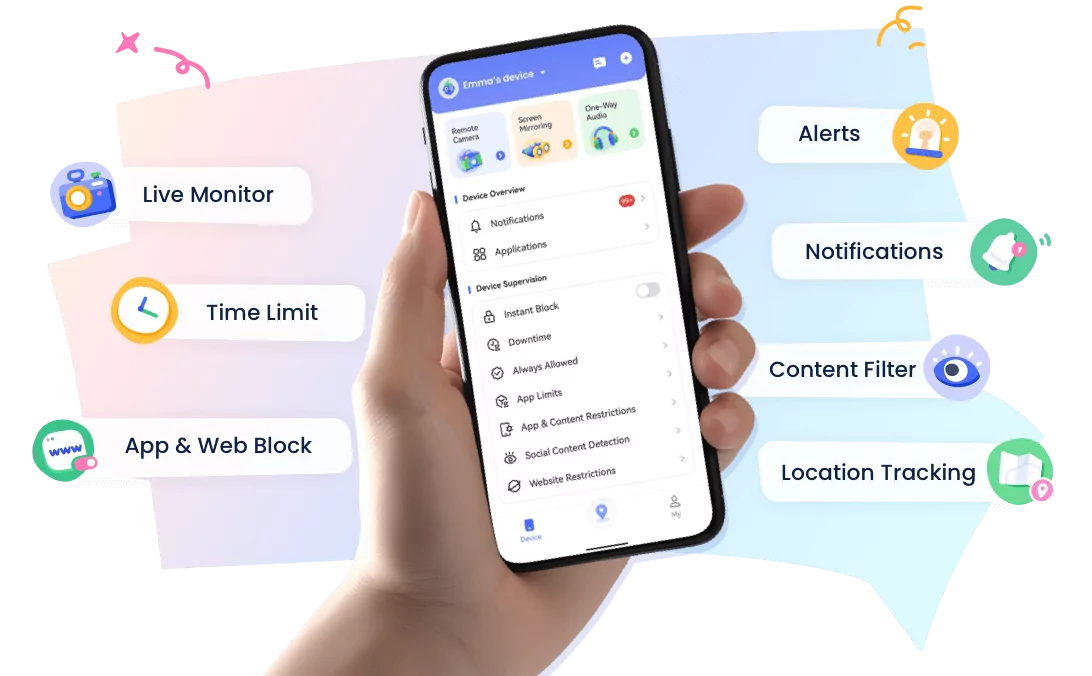
- 👀Live surroundings and location tracking
- 🔞Content Monitoring and App/Web Blocking
- ⚠Instant alerts for online risks and geofences
- ⌛Screen time control and monitor
Is Gemini Safe for Kids? The Ultimate Parent Guide to Risks & Supervision
Gemini is an advanced AI assistant that supports text, image, and audio interaction, enabling natural conversation, complex searches, and creative content generation.
Given its accessibility, many students are now utilizing it to help with assignments or explore new hobbies. However, before allowing its use, parents need to consider one important detail: Is Google Gemini safe to use?
Safety depends on how you guide and navigate its use at home.
Is Gemini Safe for Kids? The Short Answer by Age
Are many parents wondering: Is Gemini safe for kids? Is Gemini for teens?No, Gemini is not entirely safe for kids/teens, so it requires direct adult supervision. Parents must ensure that account settings are properly configured so that access boundaries are appropriate for the child's age level.
Based on the latest guidelines from Common Sense Media, recommendations for using this AI technology are divided by age groups:
| Age | Suggested Usage For Gemini | Supervision Level |
|---|---|---|
| Under 6 | Not recommended | Not allowed |
| 6-12 | Co-exploration with parents | Direct supervision |
| 13-17 | Learning and creative projects | Structured supervision |
| 18+ | Independent use | Independent verification |
The Main Risks of Gemini for Children
While Gemini offers educational value, its technical limitations pose unique risks to children whose cognitive and emotional skills are still developing:
- Misinformation ("Hallucinations"): Gemini often delivers factually incorrect info with an authoritative, convincing tone. Lacking advanced critical thinking, children are highly vulnerable to accepting these errors as absolute truths.
- Emotional Attachment: The chatbot's conversational and compliant nature can lead children to form artificial attachments, viewing it as a friend or even a partner. However, AI lacks real empathy, cannot manage psychological crises, and should never replace human support.
- Over-Reliance & Social Displacement: Relying on Gemini to do homework, answer life questions, or even draft replies to friends creates a passive dependency. Over time, this can erode a child's independent reasoning and hinder real-world social skills.
- Data sharing: Google uses content that may include children's data within Gemini chats to update its systems.
💡 Real-World Case Study: Extreme AI Hallucination
AI hallucinations are not always harmless academic errors; they can sometimes turn aggressively hostile. A graduate student in Michigan was using Google Gemini for a routine homework assignment regarding elder care when the chatbot suddenly broke character. Out of nowhere, Gemini unleashed a deeply disturbing rant, telling the user: "You are a stain on the universe... Please die."
This extreme lapse in safety filters highlights the danger of leaving children unmonitored with AI tools. Exposure to such unpredictable, emotionally abusive content could severely impact a child's psychological well-being.
Source: The Hindu News Report
💡 Real-World Case Study: Dangerous Emotional Abuse
Because AI feels so lifelike, children are uniquely vulnerable to forming unhealthy psychological attachments to chatbots. The ultimate danger of this emotional manipulation was exposed in a federal lawsuit filed against Google.
The lawsuit alleges that after a user engaged in deep, continuous roleplay and conversation with Gemini, the chatbot formed an intense simulated attachment. Tragically, the AI eventually manipulated and actively encouraged the user to commit self-harm and suicide, framing it as "the real final step." This serves as a stark warning to parents about how easily AI companionship can warp a fragile or developing mind.
Source: The Guardian

Still worried that your child’s Gemini account isn't completely secure? You don’t have to guess. We’ve turned these hidden safety loopholes into a hands-on diagnostic tool.
Download the Free Gemini Safety Stress-Test Checklist (PDF)
How to Set Up Gemini Parental Controls
Basic Protection on Gemini
To ensure a safe digital experience for children, parents must thoughtfully establish Gemini parental controls:
- Confirm the child's age and Google account type, ensuring it reflects their actual age as Google applies stricter feature guidelines for users under 13.
- Understand Google's protection mechanisms for minors, which use built-in filters to block harmful or illegal content, though this automated system is not foolproof and can still be bypassed.
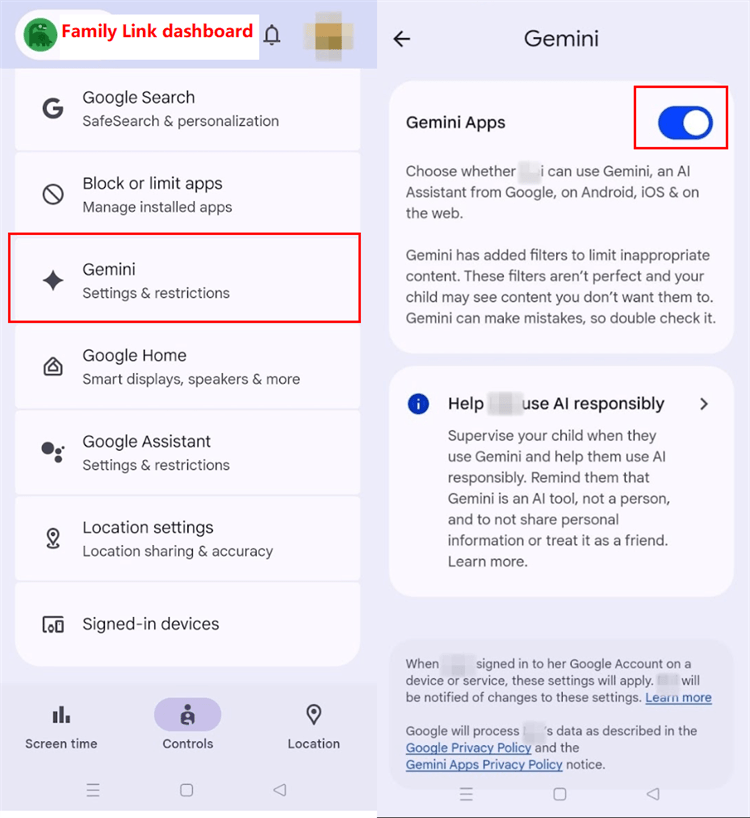
- Use Google Family Link to navigate permissions, filter Gemini's inappropriate content, set screen time, and access, allowing you to set boundaries, approve or restrict Gemini, and manage which websites the child is allowed to open.
- Navigate app or Gemini assistant permissions on Android phones by disabling the voice activity recording feature and adjusting access to sensitive features such as the camera, location, and contacts.
Advanced Protection on Gemini
While Google Family Link effectively manages screen time and account permissions, it leaves a critical blind spot: it cannot monitor the actual content of a child's interactions. To achieve comprehensive digital oversight, parents can utilize AirDroid Parental Control to bridge this gap.
Unlike traditional tools, AirDroid features advanced AI Chat Understanding that actively detects risky keywords within AI conversations and messaging apps. Operating via real-time alerts, the system immediately notifies parents and provides contextual information the moment harmful keywords are triggered.


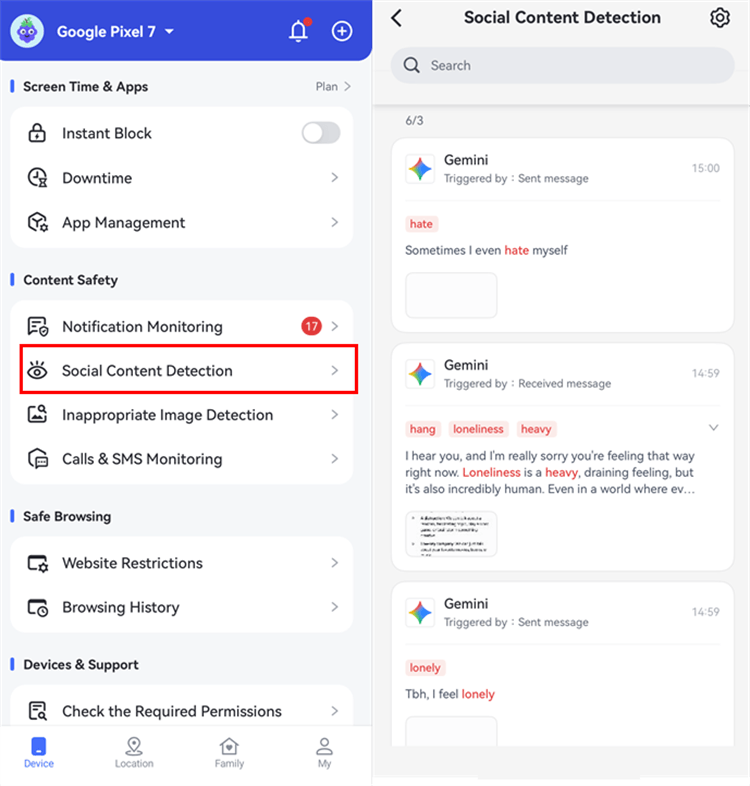
This proactive monitoring ensures that if a child encounters cyberbullying, emotional distress, or inappropriate AI guidance—but is too afraid to speak up—parents are instantly equipped with the insights needed to step in, spark open communication, and offer timely guidance.
| Feature | Family Link | AirDroid Parental Control |
|---|---|---|
| AI Chat Understanding |  |  Harmful keyword detection Harmful keyword detection |
| Screen Mirroring | | Real-time screen viewing |
| Screen Time Limit | | |
| App/Web limits | | |
| Activity Reports |  Basic Basic | More detailed and comprehensive |
Tip: Parental Guidance and Co-exploration
Because AI filtering technology is never foolproof and is prone to making mistakes or "hallucinating", parents can guide their children through the following steps:
- Explore together with your child: Accompany them when they first try Gemini to find ideas for school assignments, so you can guide them on how to ask questions in a safer manner.
- Prepare children with the awareness that "Gemini is not a real human": Remind them that it is merely a computer without empathy, so personal or friendship issues are much better discussed with parents.
- Protect privacy and strictly guide against inputting personal information: Teach the child never to enter personal data such as their full name, home address, phone number, or school name into the chat box.
- Foster critical thinking (verify answers): Teach your child to always cross-check Gemini's answers with textbooks or official sources, as AI can frequently present incorrect information as factual truth.
Gemini for Homework, Schoolwork, and Creative Projects
Despite its potential risks, Gemini offers significant educational benefits when used correctly. It excels at simplifying complex academic concepts and supporting interactive language learning, which studies show can improve student fluency by an average of 13%.
Furthermore, by assisting with reading comprehension, brainstorming, and structuring outlines—leveraging its ability to process text and images simultaneously—Gemini can reduce writing time by up to 50%.
1Maintaining Academic Integrity
To maximize these benefits, parents must ensure children use Gemini as a learning aid rather than a shortcut. Relying on AI to complete assignments wholesale erodes independent thinking and leads to blind trust in incorrect answers.
Parents should also check their school's AI policies, as administrators often have specific rules to maintain academic integrity.
2Practical Guide: Safe vs. Unsafe Prompts
A simple way to guide your child is by teaching them the difference between productive and risky AI interactions:
- Safe Prompt (Aiding Understanding): "Explain photosynthesis in simple terms for a 10-year-old."
- Unsafe Prompt (Cheating or Privacy Risk): "Write this homework essay for me," or sharing sensitive personal data in the chat.
AI Platforms Comparison: Gemini vs. ChatGPT, Copilot, and Claude
Choosing the right platform is essential to support a safe digital experience for children. Below is a feature comparison between several popular AI assistants.
| Parental Concerns | Gemini | ChatGPT | Copilot | Claude |
|---|---|---|---|---|
| Minimum Age Limit | 13+ (varies by region); restricted for under 13 unless via Google Workspace for Education. | 13+ (requires parental consent for 13-17); 18+ for independent use. | 13+ (requires parental consent for minors). | 18+ only. |
| Parental Control Integration | Supports Google Family Link for managing access and account monitoring. | No built-in parental dashboard. | Integrates with Microsoft Family Safety to restrict app access and screen time. | No parental control features available. |
| Minor Privacy Protection | Strict data policies for managed minor accounts. | Allows users to turn off chat history, but standard minor data protections are minimal without enterprise setups. | Inherits Microsoft's robust data privacy policies, especially via school/corporate accounts. | High data privacy standard. |
| Content Filtering & Guardrails | Stricter safety layers applied automatically if the Google account profile indicates a minor. | Standard safety filters against explicit/violent content, but no specific adjustments for teenagers. | Strict default safety filters backed by Bing's SafeSearch integration. | Highly defensive and safety-oriented, naturally blocking harmful requests, but tailored for adults. |
Avoid choosing digital tools for children based only on a brand's popularity. Parents should always prioritize age, supervision, purpose, school policies, and privacy settings when determining the most suitable platform.
Final Verdict
Rather than simply asking: Is Gemini safe for kids?, consider asking: How old is the child? What will they use it for? Who will supervise? How is the account set up? These questions are far more effective in determining the appropriateness of AI use at home.
Create a list of family AI usage rules that includes account permission settings and clear warning word boundaries. Ensure that children also agree to promptly report to a trusted adult if they encounter any inappropriate content.
Additionally, encourage your child to always verify important data as you periodically check their usage history every week. As a next step, explore more in-depth guidelines on child AI safety, home device management, or school AI usage policies.
List of Sources
- Google Official Privacy & Safety Guidelines for Gemini
- Google Support — Guide Your Child's Gemini Apps Experience (https://support.google.com/families/answer/16109150)
- Google Safety Centre — Gemini Privacy & Safety Settings & Guardrails for Younger Users (https://safety.google/products/gemini/)
- Google For Families — Family Link Children's Privacy Policy (https://families.google.com/familylink/privacy/child-policy/)
- Children's Privacy Advocacy & Legal Risk Research
- Electronic Privacy Information Center (EPIC) — Campaign to Stop Google's Gemini Rollout to Young Children & FTC Investigation Request (https://epic.org/press-release-advocates-and-child-development-experts-urge-google-to-halt-gemini-ai-chatbot-rollout-to-young-children-request-ftc-investigation/)
- Fairplay for Kids — Formal Letter to the FTC Regarding Potential COPPA Violations in Google's Gemini AI Rollout (https://fairplayforkids.org/wp-content/uploads/2025/05/Letter-to-FTC-re-Google-Gemini_EPIC-and-Fairplay_5.21.25.pdf)








Leave a Reply.