How to Remove Google Family Link (2026 Guide): When, Why, and What to Do Next
Your child just turned 13. Then, an email from Google lands in your inbox: "Is your child ready to manage their own account?" A wave of mixed emotions hits you at once. "If I turn off Family Link supervision, will they just scroll on TikTok and YouTube all night? What about adult content?" but also, "Am I holding on too tightly and hurting our relationship?" This isn't just another dry tech tutorial.
It's a digital parenting crossroads that almost every modern family faces. Looking through discussions from local parenting groups to Reddit’s ParentingTech, you see two extremes: parents who deeply regret removing it too quickly, and parents who are terrified to touch the button at all. If you are wondering how to remove Family Link supervision safely without inviting digital chaos, you are in the right place.
In this guide, we'll walk you through the whole journey step by step:
- ✅ When is the right time to stop supervision?
- ✅ The latest official removal steps (with a 2026 update)
- ✅ Quick fixes for the 6 biggest headaches parents face
- ✅ How to protect your teen after turning off Google controls
1. Understanding Family Link's Strengths and Limits: Why Do Parents Choose to Remove It?
Before hitting that "remove" switch, it helps to look back at why you installed Family Link in the first place—and why it’s suddenly causing friction in your home.
When Google Family Link first launched, it felt like a total lifesaver for parents. It's 100% free, baked right into Android, and lets you manage app downloads, bedtimes, and device locations from one simple screen. For younger kids, it does the job brilliantly.
However, as children get older, parents run into a major roadblock:
Family Link isn't poorly made—it's just too rigid.
What felt like safety for a 10-year-old feels like unfair surveillance to an eighth grader. Here is what real parents frequently report in tech communities:
| Feature | What Works Well | Hidden Drawbacks (Parent Feedback) |
|---|---|---|
| Setup & Removal | Easy to start up | ❗ All-or-nothing design. You cannot turn off web filters while keeping location tracking. Once supervision stops, everything disappears at once. |
| App Approval | Direct Google Play integration | ❗ Once your child turns 13, they can opt out on their own device. The approval requirement simply dissolves. |
| Location Tracking | Accurate GPS with no fee | Teens can bypass it instantly by toggling Airplane Mode or turning off location permissions. |
| Screen Time Limits | Clean, simple schedules | Switching to a new device requires setting everything up again. Older kids often rebel strongly against hard lockouts. |
| Cross-Platform | Deep Android integration | ❗ It barely works on iPhones. If your teen gets an Apple device, Family Link becomes almost useless. |
| Privacy Dynamic | Transparent supervision | Teens feel micromanaged. Instead of building self-discipline, many kids simply learn how to hide burner accounts. |
The core problem with Family Link isn't a lack of tools. It's the binary choice: total control or total freedom. Growing teenagers don't need an on/off switch; they need digital training wheels that loosen up as they mature.
That brings us to the next critical question: How do you know if your teen is actually ready for this freedom?
2. When Is the Right Time to Remove It? Start with This Parent Self-Check
Now that you know Family Link's limitations, you shouldn't rush to turn it off just because an automated birthday email tells you to.
Many parents assume that turning 13 automatically means supervision should end. But chronological age and digital maturity are two very different things. While Google legally allows children in the US to take over their accounts at 13, you decide what happens in your home.
Take two minutes to run through this quick self-assessment before making changes:
Score each statement from 0 to 10 based on your teen's everyday habits (0 = Never, 10 = Consistently).
- Can your child spot online scams, reject friend requests from strangers, and avoid clicking shady links?
- Do they understand basic online boundaries (e.g., never sending private photos or personal info) and react appropriately?
- Can they put down their phone after 1–2 hours without an argument or repeated reminders?
- If they encounter cyberbullying, hate speech, or explicit content, will they come to you and talk about it openly?
- Do they handle real-life priorities first (homework, sleep, chores) before disappearing into their screens?
What Your Score Means:
- 0–25 points: Keep supervision active. Your child still needs clear digital guardrails and daily structure.
- 26–35 points: Gradual transition. Ease back on restrictive app locks, but keep basic oversights in place while watching how they handle it.
- 36–50 points: Ready for independence. You can safely remove Family Link supervision, provided you establish clear ground rules together first.
If you're not fully confident yet, consider having a relaxed conversation first. Ask them: "What kind of guidance feels helpful to you, and what feels like micromanagement?" Opening this dialogue builds far more trust than any software setting ever will.
3. Latest Steps to Remove Family Link Supervision (2026 Official Guide)
If your child is ready and you have agreed on house rules, follow these official steps to remove supervision smoothly without breaking their Google account.
Good news before you begin: Stopping supervision does not delete your child's Google account. Their emails, photos, YouTube history, and Google Drive files will stay completely intact.
Scenario 1: Your Child Is 13 or Older (Standard Method)
- 1. Open the Google Family Link app on your parent phone. Make sure it is updated to the latest version.
- 2. Select your child's profile at the upper-left corner, tap Controls > Stop supervision (or select Account settings > Account info depending on your app version).
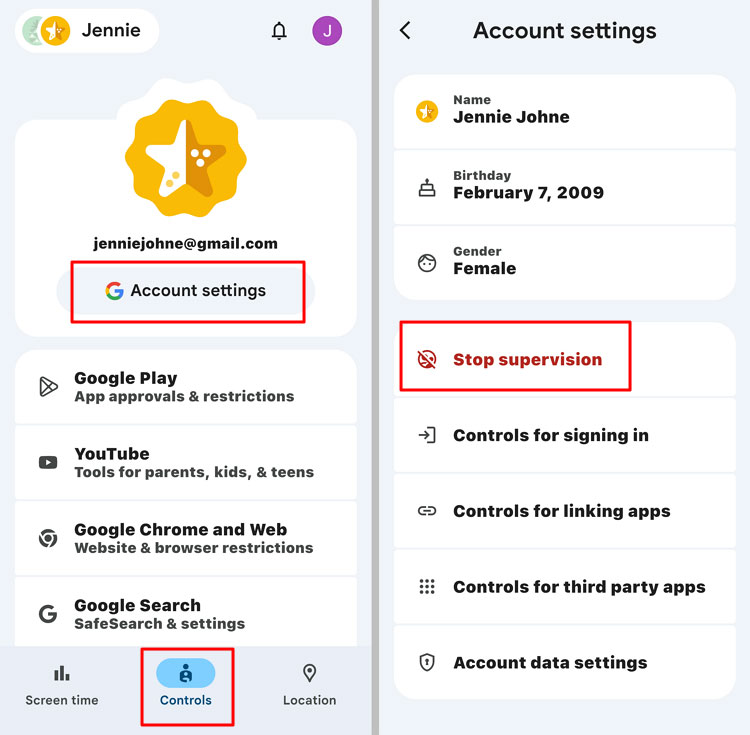

- 3. Scroll down, check the required confirmation boxes, and tap Stop supervision.
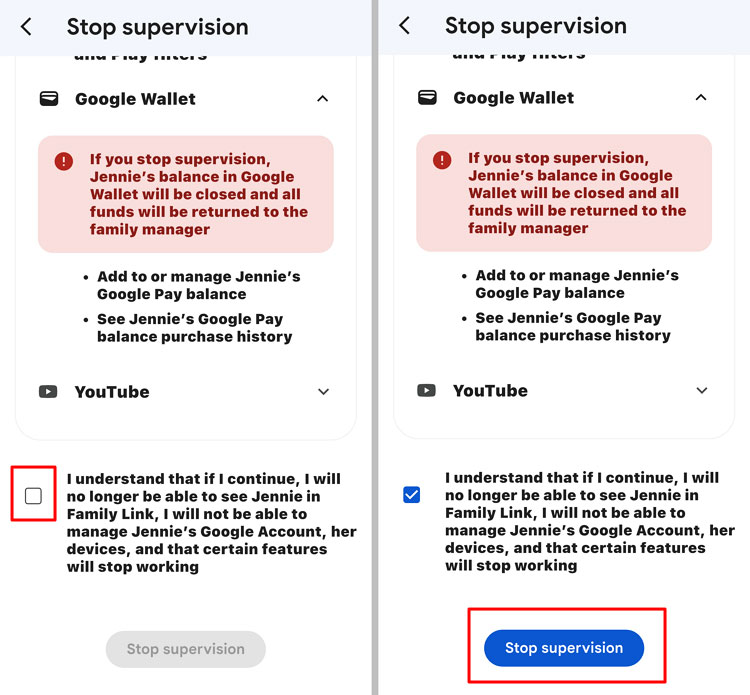

- 4. Both you and your child will receive a confirmation email. The changes usually take effect across all connected devices within 5 minutes.
⚠️ Quick Troubleshooting: If you don't see the "Stop supervision" option, verify that the birthdate on your child's profile actually shows 13+, or update your Family Link app via the Play Store/App Store.
Scenario 2: Your Child Is Under 13
Under Google's official child privacy terms (COPPA/GDPR), you cannot simply "turn off" supervision for an account under 13.
Your only options are:
- Wait until their 13th birthday when the option unlocks automatically.
- Completely delete the child's Google account and create a fresh standard account (not recommended, as this deletes all their data and purchases).
Scenario 3: Your Child Initiates the Request (From Their Phone)
Once a teen turns 13, Google actually gives them the option to stop supervision from their own device settings. If your teen does this without talking to you first, you will receive an immediate email alert, and their device may lock temporarily for 24 hours unless you approve it.
What Changes Right Away After Removal?
- ❗ All app limits, bedtimes, web filters, and Google location tracking turn off instantly.
- 📱 Your child can download any app directly from the Google Play Store without your permission.
- 📩 Both parties receive an official email confirmation from Google.
- 🔄 Your previous limit settings are erased and cannot be restored with a single click.
4. The 6 Most Common Parent Questions (Answered)
Even with step-by-step instructions, unexpected glitches happen. Here are straight, practical answers to the problems parents ask about most often:
5. What Comes After Removal: 4 Digital Parenting Habits That Actually Work
Removing Family Link from your child's phone solves the technical issue, but it does not mean your guidance is no longer needed.
In fact, the opposite is true: this is where real, trust-based digital parenting actually begins. Without automated app locks, use these four proven strategies to keep things balanced:
- Create a Simple "Family Tech Agreement"
Sit down together and write out clear, non-negotiable family standards. Examples include: charging devices outside bedrooms overnight, keeping phones off during family meals, and maintaining honest conversations about online experiences. - Schedule a Weekly Casual "Tech Check-in"
Don't wait until something goes wrong to talk about their phone. Bring it up naturally during a drive or over snacks: "Found any funny YouTubers lately?" or "Any weird spam accounts messaged your group chat?" Normalizing these chats makes them comfortable coming to you if something feels off. - Rely on Nudges Rather Than Sudden Lockouts
Help your teen set up their own built-in screen time timers or bedtime reminders through Android's "Digital Wellbeing" or iOS "Screen Time." When they manage their own limits, they build long-term self-control. - Review Monthly Freedom Together
At the end of each month, do a quick two-minute review. If they handled their screen time and schoolwork responsibly, praise their maturity. If things slipped, adjust your family rules accordingly.
6. If You Don't Want to Remove It Completely, There's a Better Way
While establishing offline habits is essential, many parents find themselves in a tough spot: they want to give their growing teen more privacy, but turning off all protections at once feels too risky.
You might be thinking:
- "I don't need to approve every single school app, but I still want to know they are safe walking home."
- "I don't want to read every text message, but I want an alert if they run into explicit keywords or online predators."
- "My teen switched to an iPhone, and Family Link just won't work properly anymore."
Because Family Link is an all-or-nothing system, it cannot handle this middle stage. This is why many families transition to dedicated, flexible alternatives like AirDroid Parental Control.
Instead of locking a teenager out of their device, a flexible parental control app lets you step back gradually while keeping essential safety nets active:
At a Glance: Google Family Link vs. AirDroid Parental Control
| Safety Feature | Google Family Link | AirDroid Parental Control |
|---|---|---|
| Platform Support | Android-centric (extremely limited on iOS) | Full cross-platform support across Android and iOS |
| Management Flexibility | All-or-nothing shutdown at age 13 | Selective supervision (grant app freedom while keeping safety alerts active) |
| Proactive Safety Alerts | Basic app install notices | Instant keyword alerts for cyberbullying, dangerous social messages, and suspicious activity |
| Location & Safety Zones | Basic point-in-time GPS map | Real-time location, route history, and geofenced arrival/departure alerts |
| Teen Privacy Balance | Rigid and visible; often causes friction | Customizable oversight that respects teen privacy while keeping essential safety nets in place |
| Cost | Free | Free trial available with comprehensive tiered safety plans |
The takeaway: You don't have to choose between hovering over your teen or leaving them completely unguarded. Modern tools allow you to step into the background while keeping a reliable digital lifeline open.
7. Conclusion: Removing Supervision Is a Milestone, Not an End
Returning to our opening question: "Should I remove Family Link or keep it on?"
The answer is never a simple yes or no. It comes down to honest communication: How much freedom has your teen shown they can handle, and how ready are you to guide instead of restrict?
Taking off Google Family Link's supervision isn't quitting as a parent. It's simply upgrading your role from a digital gatekeeper to a trusted coach.
Common Parent Q&A
Your Immediate Next Steps
If you're still on the fence, here is what you can do today:
- ✔ Complete the 5-question maturity self-check above with your partner.
- ✔ Sit down with your teen this week to discuss house rules before touching any settings.
- ✔ If you need a flexible middle ground during their teenage years, explore how a balanced tool like AirDroid Parental Control can bridge the gap.
Have you already turned off Family Link, or are you preparing to take that step? Drop your questions and stories in the comments below—let's support each other through these digital parenting milestones!








Leave a Reply.