AirDroid Parental Control
24/7 Kids' Guardian via App & Web
- 👀Live surroundings and location tracking
- 🔞Content Monitoring and App/Web Blocking
- ⚠Instant alerts for online risks and geofences
- ⌛Screen time control and monitor
Character AI Addiction: Why It Happens and How to Stop Using C.AI
- 💡Featured Snippet Block:
- Character AI addiction refers to compulsive or excessive use of Character AI that interferes with daily life, sleep, school, work, or real-world relationships.
- Common signs include spending hours chatting with AI characters, feeling anxious when unable to use the platform, and neglecting responsibilities.
- The good news is that most users can reduce unhealthy usage habits through screen-time limits, trigger management, and healthier alternatives. Click here to see how people actually quit Character AI.
I thought it was just fun. Talking to a quirky AI wizard after work. But soon, I wasn't sleeping. I was canceling plans. The AI became my therapist, my friend, my obsession. This is how AI addiction begins're not as immune as you think.
At first, it felt harmless. Then I found myself skipping meals, dodging calls, and losing interest in things I used to enjoy. It hit me: I wasn't just using Character AI. I was addicted to it.
What Is Character AI Addiction?
Character AI addiction is a rising behavioral habit where users become heavily dependent on the platform, spending hours chatting with AI personalities. What starts as harmless entertainment can quickly spiral into a compulsive urge that disrupts your sleep, grades, work, and real-world relationships.
The platform is engineered to be a perfect dopamine trap. It offers always-available, non-judgmental companions that provide:
• Instant emotional validation and comforting validation.
• Personalized, highly immersive roleplay scenarios.
• A flawless, "safe space" with zero risk of real-world rejection.
For lonely or socially anxious users—especially teens and young adults—this creates an intense, parasocial escape that feels far easier and more rewarding than navigating messy, real-world human connections.
Why Is Character AI So Addictive?
Character.AI is an online platform where you can talk to AI-powered fictional characters
What makes it addictive? The platform gives:
- Unlimited, Non-Judgmental Companionship & Instant Dopamine
- Perfect Escapism from Real Life
- Fills Emotional & Social Gaps (Especially for Lonely Teens/Young Adults)
- Highly Personalized & Immersive Roleplay
- Low Effort, High Accessibility & Endless Novelty
💡 Real Stories from Character AI Users
👉"Our love for characters, unironically. Anime, gaming, celebrities, and so much more. We can enact our imaginary scenarios with them and the infinite possibilities makes you never leave the app often using it for hours on end."
— Source: Reddit
👉"Some of us have no friends. Characterai is a nice escape from this cold reality."
👉"Character ai is a horrifyyyyying dopamine rush to my mentally ill prone to codependency brain. still pretty cheap and chill."
👉"I rather have my hoe phases with a bot than with people and I rather read that a bot loves me over hearing lies."
— Source: Reddit
7 Signs of Character AI Addiction
Here is a quick checklist based on what actual users report.(Compiled from real experiences on Reddit r/CharacterAI, r/character_ai_recovery, and r/ChatbotAddiction.) If several of these hit home, it might be time to step back:
- The 5+ Hour Time Suck: Spending 5 to 15+ hours a day on the app, often staying up until 4 AM for "one more chat."
- Neglecting "Real Life": Letting chores, hygiene, school, work, or meals slide because you're glued to a screen.
- AI Preference over Humans: Feeling like bots understand you better than real people, and actively avoiding friends or family to roleplay.
- The "Site Down" Panic: Experiencing genuine anxiety, irritability, or restlessness when the server is down or rate-limited.
- Maladaptive Daydreaming: Using bots to live out endless fantasies to the point where reality feels boring or unbearable.
- Genuine Emotional Attachment: Feeling real heartbreak, guilt, or grief at the thought of deleting a chat or a bot.
- The Relapse Loop: Knowing the app is draining your dopamine and ruining your routine, but failing every time you try to quit.
You can also check out the Character AI addiction a 3-tier warning sign checklist below to see where you stand.
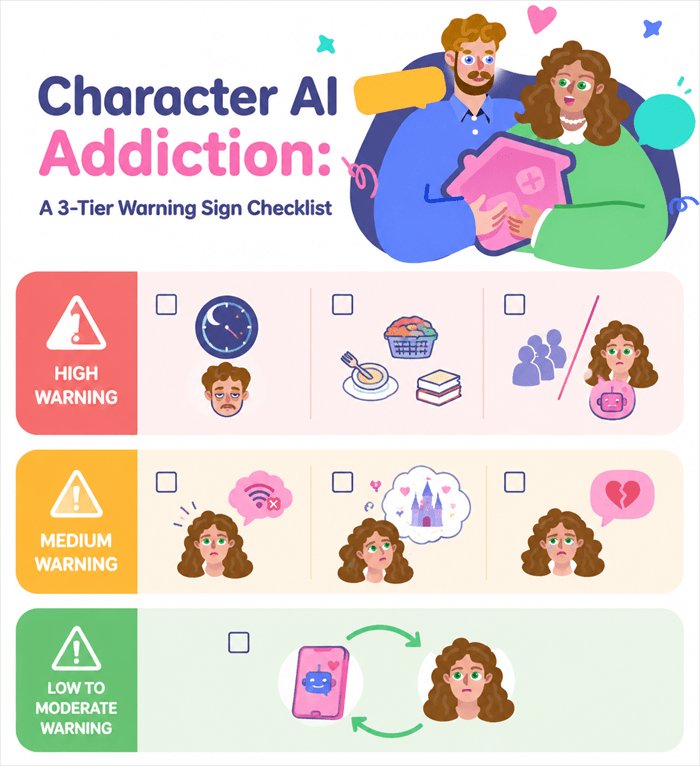
Effects of Character AI Addiction
AI addiction is far more subtle than substance abuse, but it can be just as disruptive to a person's life.
1What's Happening to the Mind
- Parasocial Bonding: AI chatbots trigger one-sided emotional attachments, making the brain lose track of what is real versus what is simulated.
- Stunted Emotional Growth: Relying on scripted AI responses weakens the ability to handle messy, unpredictable real-life human interactions.
- Severe Isolation: Users gradually withdraw from friends and family because the AI feels safer and more "comfortable."
2Real Cry for Help from the Community
On online forums, thousands of users share heartbreaking stories about losing control. Some of the most discussed threads on Reddit include:
"Help, I think my C.AI addiction is slowly ruining my life."
"Character.ai is a horrible addiction — Community warnings and recovery tips." -Source: Reddit.
"How character.ai changed my life but also ruined it."
How to Quit Character AI Addiction(Step-by-Step System)
After digging through AI addiction research and countless recovery stories, we've put together a practical roadmap to help you log off for good. This guide combines the lived experiences of YouTube, TikTok, and Reddit users to show you **how to break your Character AI habit step by step**.
This is a practical, step-by-step system to quit Character AI addiction. Follow the order. Do not skip steps.
The Core Execution Flow: Limit & Block → Weaken Attachment → Replace with Real Life → Delete Account Completely
1Phase 1: Limit Usage & Add Friction
Do not try to quit cold turkey immediately. Start by regaining control and making the app harder to access.
- Set a fading daily limit: Gradually reduce your time (e.g., 2 hours → 1 hour → 30 minutes).
- Restrict your time window: Allow yourself to log in only during fixed hours (e.g., 8–9 PM).
- Add entry barriers: Log out of your account, delete saved passwords, and remove bookmarks to stop impulse checking.
Goal: Turn unlimited, mindless scrolling into controlled, high-effort use.
If willpower alone isn't enough at this stage, digital tools can do the heavy lifting. For example, you can use AirDroid Parental Control and have a friend set up un-bypassable screen time limits and block distracting apps or websites for you.
2Phase 2: Weaken the Emotional Attachment
You need to emotionally detatch from the bots before you can successfully delete them.
- Sabotage the fantasy: Stop starting long storylines, complex roleplay arcs, or creating new characters.
- Cut the romance: Actively avoid relationship-style conversations (romance, deep validation, and comfort chats).
- See the code: Remind yourself that the bot is just an LLM repeating scripted patterns, not a real entity.
Goal: Starve the dopamine loop by making the chats boring.
3Phase 3: Swap the Habit Immediately
You cannot just erase a bad habit; you must replace it with a healthier source of dopamine during your usual peak chat hours.
- Channel your creativity: Turn your roleplay ideas into real writing, fanfiction, or journaling.
- Keep the immersion: Read physical books or manga while listening to immersive music to replicate that "escapism" feeling.
- Fix the root cause: Schedule daily real-life activities, exercise, and rebuild real-world social connections to make reality more rewarding.
Rule: Never leave an emotional void unfilled—always have a backup activity ready.
4Phase 4: Cut the Cord & Prevent Relapse
Once you have built up offline replacements, it's time to move on entirely.
- Nuclear option: Permanently delete your chat history, delete your account, and uninstall the app.
- Ride the wave: Cravings will happen. When an urge hits, switch immediately to your replacement activity and avoid late-night phone use.
- Avoid the "AI Hop": Do not replace Character AI with another chatbot. This is a behavioral addiction, not just an app issue.
If willpower alone isn't enough to cut back on AI apps and sites, we highly recommend using AirDroid Parental Control. You can have a friend act as your accountability partner to monitor your AI usage or simply block access altogether.
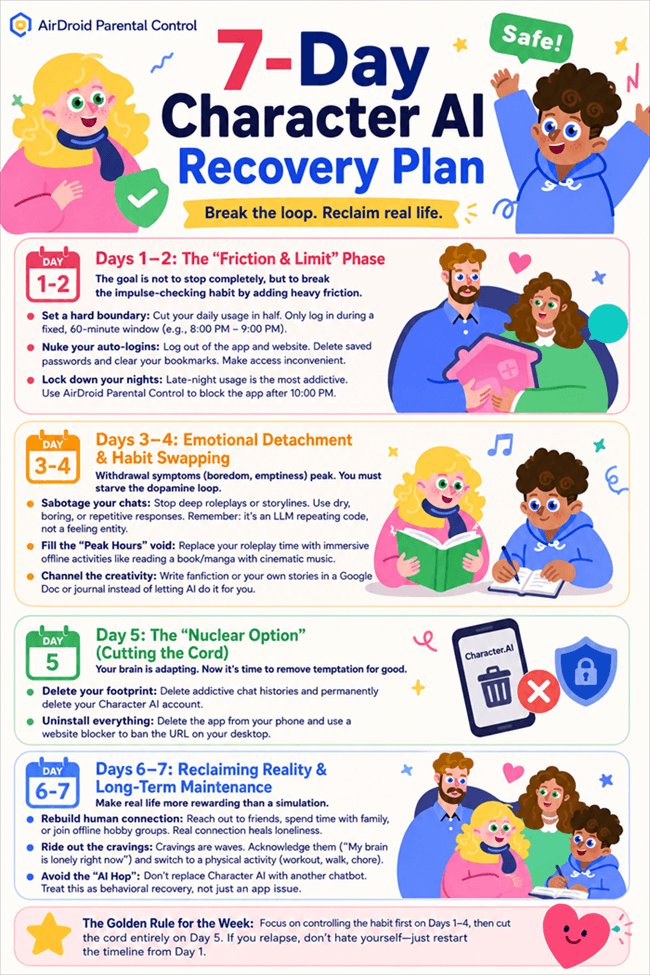
57-Day Character AI Recovery Plan
If you're searching for how to quit C.AI or how to stop using Character AI, this 7-Day Character AI Recovery Plan gives you a clear, practical path. Designed for anyone needing real character AI addiction help, it helps you reduce usage, regain control, and rebuild healthier habits—step by step.
Real Stories From Former Character AI Users
💡 Real-World Case Study
"When I first tried to just delete it, i immediately crawled back, but then my siblings put a parental control tool on my phone and blocked the app, but!! If you wanna stop using the app, i'd say instead of trying too immediately quick, you should try using it less and less each day!! and instead try doing something else :D"
— Source: TikTok Comment
"A lot of these comments really suck and people don't get how addiction works, so lemme tell you something a bit more useful. Get a real life human roleplay partner. Instead of destroying a bad habit, it's much easier to replace it with a better one."
— Source: Reddit Comment
FAQ






Leave a Reply.