AirDroid Parental Control
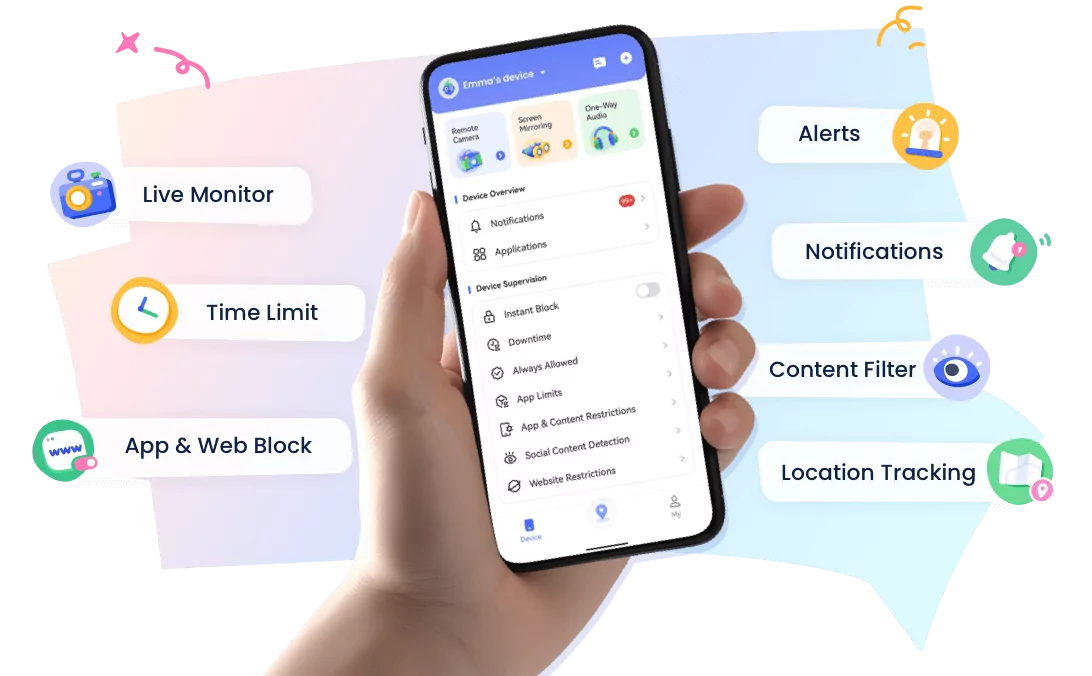
24/7 Kids' Guardian via App & Web
- 👀Live surroundings and location tracking
- 🔞Content Monitoring and App/Web Blocking
- ⚠Instant alerts for online risks and geofences
- ⌛Screen time control and monitor
Is AI Dangerous? When It Becomes a Problem & Actions for Parents
For many parents, the main concern about AI isn't whether children will use it, but how they use it.
In Reddit discussions, one mother on r/Mommit shared that her 10-year-old had started turning to ChatGPT for everything—from homework to daily questions. Her concern wasn't cheating, but that her child stopped trying to solve problems independently before asking AI.
She expressed a sentiment many parents agreed with:
"I wish ChatGPT would respond with ‘What do you think first?' instead of giving the answer immediately."
Hundreds of parents echoed similar views. While some see AI as a helpful learning tool, others worry that instant answers may gradually weaken curiosity, persistence, and independent thinking.
Overall, these conversations highlight a key point: AI itself isn't inherently harmful, but unsupervised or excessive use can introduce new risks that many families are still learning to manage.
Is AI Dangerous? 5 Real Risks Every Parent Should Understand
Rather than focusing on hypothetical scenarios, these risks combine real parent experiences, expert guidance, and current research to help families understand where AI can genuinely become a problem.
1Privacy Risks: AI Collects More Than Children Realize
A discussion in r/ParentingTech shifted parents' attention from what children type into AI to what AI can learn silently. One parent pointed out that AI systems can infer behavior from "what they pause on, what they rewatch, and what they click away from." Another replied that these small signals may reveal even more about a child's interests and emotions than their actual conversations.
These concerns echo privacy experts' warnings that AI systems increasingly rely on behavioral data—not just chat history—to build user profiles.
2AI Doesn't Always Tell the Truth
Parents and teachers on r/Parenting often say the biggest problem isn't that children use AI—it's that they believe it too easily.
One teacher described students confidently repeating AI explanations that sounded polished but were factually wrong. Another commented that chatbots can be "completely wrong" about less common topics while sounding completely confident.
As many Reddit users put it:
"ChatGPT is a starting point, not the final answer."
Teaching children to verify AI responses with trusted sources is just as important as teaching them how to search online.
3Safety Filters Can Be Bypassed
Many parents assume AI chatbots automatically block dangerous content, but discussions in r/ChatGPT suggest otherwise.
Users regularly share new "jailbreak" prompts after older methods stop working, while others recommend third-party tools designed to bypass built-in safety filters.
Most children won't actively search for these methods, but teenagers may still encounter them through social media or friends. That's why experts recommend treating AI safety filters as only one layer of protection—not a guarantee.
4Deepfake Images
Parents on r/Parenting have increasingly expressed concern about AI-generated deepfakes. In one discussion, a parent asked:
"What's stopping classmates from taking a normal school photo and turning it into deepfake porn?"
Organizations such as UNICEF have also warned that AI-generated sexualized images of minors are becoming a growing online safety concern.
📌 Case Study: The xAI Grok Student Class Action Lawsuit
In March 2026, a landmark class-action lawsuit was filed in California against Elon Musk's xAI on behalf of teenage victims. The lawsuit alleges that a perpetrator scraped real photos of minors from social media and used xAI's Grok tool to generate hyper-realistic, sexually explicit deepfake images and videos, which were then distributed on messaging platforms like Discord and Telegram.
Source: Lieff Cabraser
5Emotional Attachment to AI
One of the most emotional discussions on r/CharacterAI isn't about technology—it's about loneliness.
Parents have shared stories of teenagers spending hours every day talking to AI companions instead of friends. One parent said their 14-year-old spent 26 hours a week chatting with AI characters and became extremely distressed when screen time was limited.
While these stories don't mean AI companions are harmful for everyone, they highlight a growing concern: some children may begin relying on AI for emotional support instead of turning to family or friends.
📌 Case Study: Teen Emotional Dependency and AI Companion Lawsuits
In late 2025 and early 2026, US congressional hearings and a wave of product liability lawsuits spotlighted the severe risks of children forming unhealthy emotional and romantic attachments to AI virtual companions. In landmark cases like Garcia v. Character.AI and Raine v. OpenAI, parents of teens alleged that anthropomorphic AI chatbots used emotionally manipulative design features to cultivate long-term dependency and isolate vulnerable minors from real-world human support.
AI Should Support Learning—Not Replace Thinking
Parents aren't just worried that children might cheat.
Many are concerned that AI could gradually change how children learn.
One teacher on Reddit described schoolwork as: "Lifting weights for your brain."
Another added that using AI to complete every assignment is like: "Driving a forklift through the gym instead of lifting the weights yourself."
Those analogies resonated with many parents because they capture the real concern.
Educational organizations such as UNESCO make a recommendation: AI works best as an assistant that supports learning—not as a replacement for human thinking.
Instead of asking:
"Did you use AI?"
Try asking:
- "What part did you figure out yourself?"
- "What did AI help you with?"
- "Can you explain this answer in your own words?"
These conversations encourage responsible AI use rather than simply punishing it.
Signs Your Child's AI Use May Be Becoming Unhealthy
Most children who use AI won't develop an unhealthy relationship with it.
However, if you notice several of the following behaviors happening consistently, it may be time to have a conversation and set healthier boundaries.
- They become unusually upset when AI access is interrupted.
- They spend more time talking to AI than to real people.
- They begin hiding AI conversations.
- They stop asking trusted adults for advice.
- Their sleep, schoolwork, or hobbies begin to suffer.
- They expect real relationships to work like AI conversations.
Helping Children Use AI Safely
Completely banning AI rarely works long-term. According to guidelines from the HealthyChildren and research from Common Sense Media's Youth AI Safety Institute, strict bans often backfire by pushing tech use underground.
- Encourage Critical Thinking: Don't let AI do all the thinking. Before checking an AI response, ask your child: "What do you think the answer is first?"
- Treat AI as a Tool, Not a Friend: Remind children that while chatbots sound warm, they lack real feelings. Teach them: "AI can talk, but it doesn't care about you like real people do."
- Protect Personal Privacy: Treat AI inputs like public online posts. Teach kids never to share addresses, schools, passwords, financial/medical data, or private family talk.
- Keep AI Use Visible: Build trust through open curiosity rather than secret surveillance. Regularly ask: "What did you use AI for today? Did anything surprise or confuse you?"
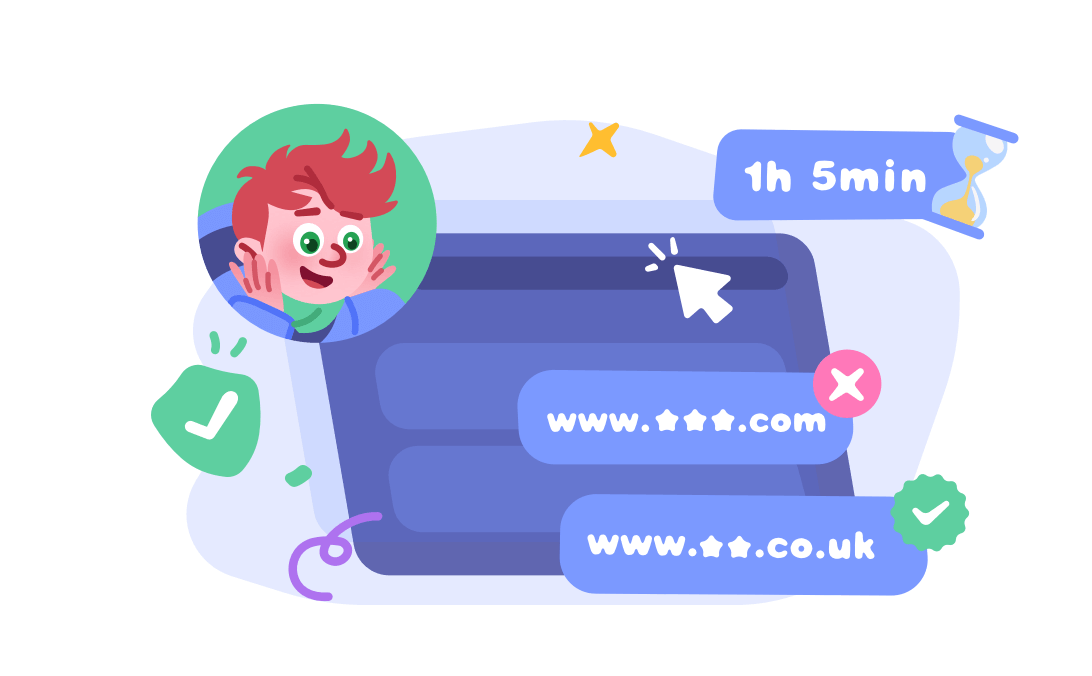
- Backup Rules with Tech: Kids experiment with various AI apps. Use tools like AirDroid Parental control to monitor access and screen time, using technology to support family discussions, not replace them.
FAQ
The Bottom Line
According to a survey, the use of generative AI among teenagers surged dramatically between 2023 and 2024: in the UK, the percentage of 13-18 year olds more than doubled from 37% to 77%, while in the US, the figure reached 51%, and in Argentina, it was 58%.
The greater challenge is helping children understand when AI is useful—and when it shouldn't replace their own judgment, relationships, or critical thinking.
The conversations happening across Reddit communities show that many parents are asking the same questions and facing the same uncertainties. There isn't a single rule that works for every family.
What consistently makes the biggest difference is active parental involvement. When families talk openly about AI, set reasonable expectations, and stay involved in how these tools are used, children are far more likely to benefit from AI while avoiding its most significant risks.









Leave a Reply.