Why AI Chatbots Are Harder for Parents to Monitor?
As children increasingly turn to AI chatbots for homework help, advice, and even emotional support, parents' safety concerns are shifting.
More parents now want to understand how their children use AI chatbots: what they ask, what AI says to them, and whether the conversations are harmful.
Yet, while many parental control apps can track how long AI apps were used or limit the usage, few can actually monitor AI conversations.
5 Reasons AI Conversations Are Harder to Monitor Than Social Media
So, why is it becoming harder for parents to monitor AI conversations? Here are the main reasons:
1AI responses are generated in real time
AI responses are generated directly inside the chat window. Unlike social media, the AI messages usually do not arrive as separate notifications that parental control apps can easily detect.
For example, when someone sends your child a message on Instagram or Snapchat, the message content may show as a notification preview on their phones. Some apps access the accessibility services and use those notifications to monitor risky social content.
But with AI, the child types a question, and the answer appears immediately in the chat. This means a parental control app may not be able to see what the child asked or what the AI said through notifications.
2Risks can be hidden in context
That's the core difficulty: the risk isn't sitting in one turn; it's spread across multiple conversations. A single prompt or message may look harmless, but the messages before or after it can reveal a very different situation.
For example, a child asking, "How many should I take to feel it?" is a meaningless question. But if they just told the AI they got pills, drugs, or alcohol, that question becomes a serious red flag.
3AI chats can happen inside websites and different apps
AI services come thick and fast. A kid can start a conversation on a mainstream AI platform (like ChatGPT) today and switch to a different niche one (e.g., Replika) tomorrow, let alone most of them offer web versions.
Additionally, more AI tools or features keep showing up inside study tools, games, and social apps that weren't built as "AI chatbots," like Snapchat My AI, Meta AI, etc.
The result is that there is no single door for parents to check, and they might not even know where to look because conversations are scattered across dozens of apps and websites.
4iOS makes monitoring harder
Here's a frustrating reality many parents may discover: parental control software works reasonably well on Android, but the moment a child uses an iPhone, the parents go nearly blind.
This is the direct result of Apple's design philosophy:
- Firstly, for privacy and security reasons, iOS runs each app inside a "sandbox" where apps cannot see each other's data.
- Secondly, Apple strictly limits what parental controls are allowed to do. On Android, some parental control apps can read notifications, access social content, and even mirror the screen. On iOS, most of these permissions are banned.
As such, monitoring or detecting a child's risky AI conversations is more difficult on an iPhone.
5Parental controls actively limit the visibility
Most parental control software today still only supports limiting usage time on AI apps, but they don't tell parents what happened inside the app.
Even though few tools (such as AirDroid and Bark that we tested) and ChatGPT's built-in safety notifications support AI content alerts, they typically don't show everything. They only flag and show messages their content detection system thinks are "risky."
This is because AI chats contain highly private information. Giving parents unrestricted access to every conversation may create privacy and trust concerns. It's also a privacy boundary parental control companies choose to keep in place.
As a result, many AI platforms and parental control tools focus on usage controls and risk alerts instead of full surveillance.
So How Parents Can Monitor Risky AI Chats?
Given all of this, monitoring risky AI chats is not easy. But that doesn't mean you have to give up; instead, it means finding a smarter way to stay informed. Here are 3 practical tips:
Know what AI tools they're actually using
As we stated above, AI isn't limited to one app or platform. Your child may use ChatGPT, Character AI, or AI features that are embedded into their favorite apps.
Knowing which tools they use can help you understand where potential risks may come from and what you should focus on.
You can also read our app-specific guides to better understand risks and get safety advice:
Monitor how much time kids are spending on AI
Now you know which AI apps are on the device. Usage time and pattern also matter, especially sudden spikes and late-night sessions.
A kid spending 1 hour a day on ChatGPT for homework is fine. But a kid whose Character AI usage quietly climbs to two hours a night is telling you something needs attention.
Keep an eye on risky AI chats
Usage patterns can tell you something might be up, while content alerts tell you what it is.
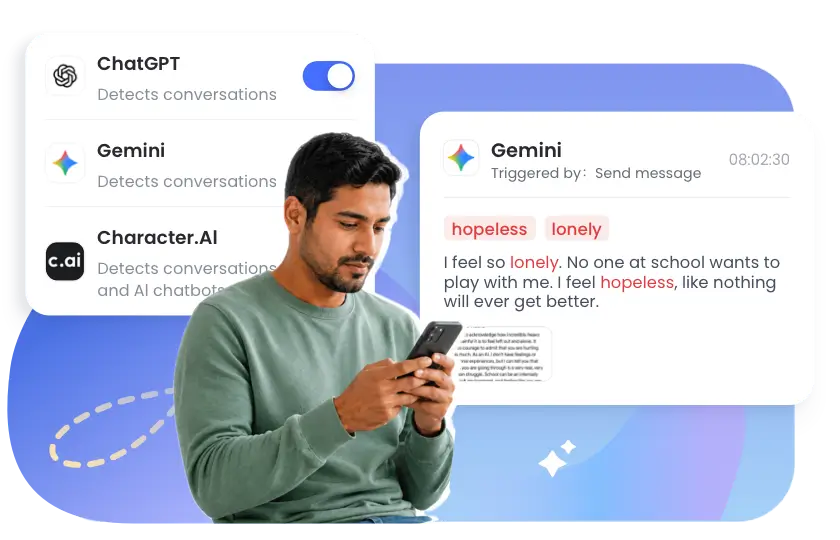
This is where AirDroid's AI Content Detection comes in. It scans risky keywords and phrases inside ChatGPT, Gemini, and Character AI conversations. When something concerning shows up, you get an alert within seconds, with a screenshot of the conversation at that moment.
The Bottom Line
In short, AI conversations are harder to monitor because they are generated in real time, constantly changing, spread across different apps and websites, and often require the full context to understand risks.
Though parents can use AI chat monitoring tools to stay aware of potential risks, they shouldn't rely on tools alone. After all, monitoring can only catch some risks; family communication and parental guidance prevent others.







Leave a Reply.