AirDroid Parental Control
AI-powered content monitor and alerts
- 👀Social Apps & Messages content monitor
- ⚠ Instant Alerts for potential online risks
- 🔞Inappropriate apps and websites blocking
What Is Looksmaxxing? A Parent's Guide to the Online Rating Trend
You're such a mog.
I'm probably sub-5 without a jaw filter.
If your teen has started talking about appearance — their own or their friends' — like it's a stat sheet, you're not imagining it. A whole rating vocabulary has spread through group chats, TikTok comments, and Discord servers, part of a broader online trend called looksmaxxing.
For most teens, it stays at the level of slang. But it doesn't always stop there. One parent on Reddit described watching their 15-year-old son go from ordinary self-consciousness to asking about HGH and anabolic steroids after weeks in online looksmaxxing communities — a reminder that behind the slang is a culture that ranges from harmless jokes to genuinely dangerous advice.
This guide breaks down the rating language your teen might be using, why it caught on, and what to watch for.
30-Second Summary:
- Looksmaxxing has given rise to a whole "rating" vocabulary — mog, sub-5, PSL — that started nearly a decade ago in incel forums and exploded on TikTok in 2022-2023.
- Looksmaxxing content can worsen self-esteem, depression, and social anxiety in teen boys through harsh comparison and rating scales.
- Parents can help by having open conversations about what their teen sees online, watching for these warning signs, and knowing what monitoring tools can and can't catch.
Part 1. What Is Looksmaxxing?
Looksmaxxing is an online self-improvement trend focused on "maximizing" physical attractiveness. It includes everyday habits such as skincare, grooming, exercise and clothing, as well as more extreme practices involving severe dieting, unregulated supplements, steroids or cosmetic procedures.
The term emerged in online lookism and incel forums during the 2010s, where appearance was often treated as a measurable form of social or romantic value. It later spread into mainstream teen culture around 2022–2023, when it took off on TikTok before reaching YouTube, Instagram, Reddit and Discord, where serious advice now mixes with jokes, transformation videos and memes.
Online, these practices are commonly divided into "softmaxxing" and "hardmaxxing." Not every teen who uses the term is engaging in something dangerous, but understanding this distinction can help parents recognize the type of content their child may be seeing.
Part 2. Softmaxxing vs. Hardmaxxing: What's the Difference?
Within looksmaxxing, the actual practices split into two camps — and the gap between them is where most of the real risk sits.
1 Softmaxxing
Softmaxxing means improving your appearance through non-surgical, reversible habits and grooming. It's the lower-risk side of looksmaxxing, and includes things like:
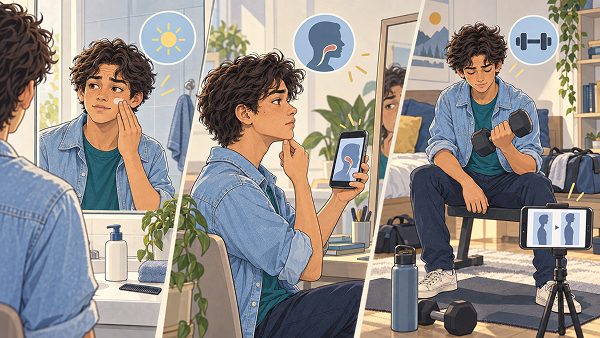
- Skincare and grooming: sometimes described as skinmaxxing or hairmaxxing — including cleansing, moisturizing, sun protection and changing hairstyles.
- Mewing: resting the tongue against the roof of the mouth in the belief that it can reshape the jawline over time. There is no solid evidence that it produces this result, and applying excessive or uneven pressure may affect the teeth, bite or jaw. More on mewing.
- Diet and workout changes: sometimes called gymmaxxing — aimed at achieving a particular look, such as a leaner jawline or broader shoulders.
- "Glow-up" videos: before-and-after photos or clips posted over weeks or months to document a transformation.
2 Hardmaxxing
Hardmaxxing means trying to change your appearance through invasive, medically risky or potentially irreversible methods. It's the higher-risk side of looksmaxxing, and includes things like:
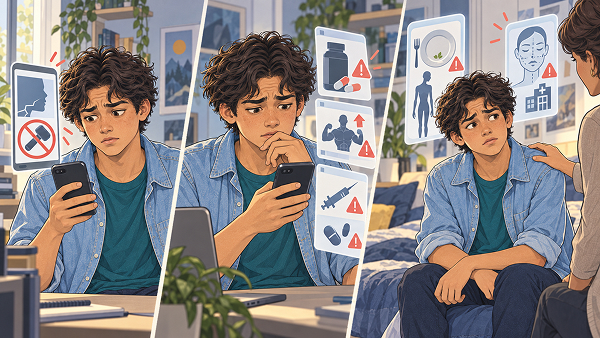
- Bone smashing: hitting the face with a hard object, sometimes a hammer, in an attempt to reshape the jawline. Doctors call it one of the most dangerous practices in the trend.
- Roidmaxxing: using anabolic steroids, HGH or peptides without appropriate medical supervision to increase muscle mass or alter height, facial structure and other physical traits.
- Starvemaxxing: severely restricting calories or fasting for long periods to achieve a leaner face, hollow cheeks or very low body fat.
- Cosmetic procedures and extreme heightmaxxing: researching fillers, implants, jaw surgery or limb-lengthening procedures, sometimes through online forums or clinics offering limited medical oversight.
Most teens who talk about hardmaxxing online are joking or just curious — they're not actually doing any of this. But if a teen is seriously looking into it, or has already tried something on this list, that's worth a direct conversation.
Part 3. The Rating Language Teens Are Using
Beyond specific practices, your teen may also be picking up a whole vocabulary for rating and comparing appearance — words that show up in comments, captions, and group chats, whether or not they're actually doing anything about how they look.
- PSL Score: stands for a 1-to-10 scale used to rate physical attractiveness — someone might be described as "a PSL 8" or having "low PSL."
- Sub-5: A label for someone considered below average in appearance, usually based on a numerical rating. Teens may use it as an insult or apply it to themselves, as in "I'm a Sub-5"
- LTN, MTN and HTN: Short for "low-tier normie", "mid-tier normie" and "high-tier normie". These labels divide people considered average-looking into additional ranks.
- Chad: refers to a man seen as naturally possessing the highest tier of physical attractiveness — used as the benchmark against which others are rated in looksmaxxing culture.
- Mogging: means visibly outclassing someone else in looks, height, or presence — enough that the other person seems to fade by comparison.
- Looksmatch: is the idea that people should only date others who rank at a similar attractiveness level — treating relationships as a kind of transaction based on rating rather than connection.
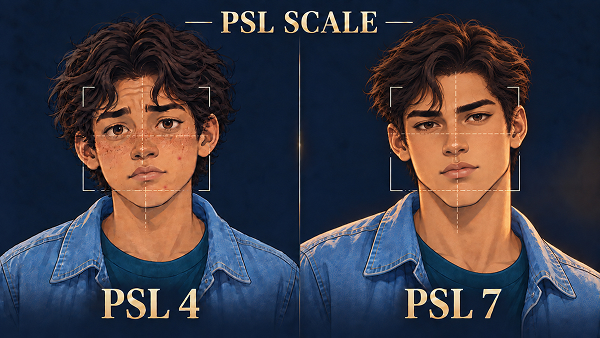
Whether it's a joke or not often comes down to one thing: how seriously your teen talks about their own face — which is exactly what the next section digs into.
Part 4. Why Is Looksmaxxing So Popular Among Teens?
The slang above isn't just vocabulary — it's a window into something most teens quietly wonder: "Am I attractive enough?" So why does this worry take hold so easily during the teen years? Two forces are driving it: how social platforms spread this content, and a broader shift in how boys are learning to see themselves.
Start with the platforms. When a teen watches a jawline analysis, glow-up or face-rating video, the platform may treat that interest as a signal and recommend more of the same.
The U.S. Surgeon General notes that recommendation algorithms, autoplay and infinite scroll are designed to maximize engagement. In the same advisory, 46% of teens aged 13–17 said social media made them feel worse about their bodies.
A few videos can become a feed filled with ratings, transformations and an increasingly narrow definition of what "attractive" means. Products, supplements, coaching programs and cosmetic treatments can then appear alongside the insecurity as possible solutions.
Then there's the deeper shift. Sociologists Jillian Sunderland and Jordan Foster argue that looksmaxxing "reframes structural barriers as individual shortcomings." A teen isn't thinking about the job market or the economy while watching a glow-up video — but he can still feel uncertain about what makes a man respected, successful, or desirable, especially as the paths that used to answer that question get harder to reach. Looksmaxxing offers a simple, appealing answer: if you feel overlooked, the problem might just be your face — and your face can supposedly be fixed.
That doesn't mean every teen who jokes about "mogging" is struggling. But it explains how a slang term, a grooming tip, or a PSL score can gradually become a way of judging themselves — and everyone around them.
Part 5. How Parents Can Respond to Looksmaxxing
Caring about appearance is normal during adolescence — and it's worth admitting that looks really do carry more social weight than we'd like. The goal isn't to convince your teen that appearance doesn't matter. It's to make sure it doesn't become the only thing they think matters. A few places to start:
1 Ask before giving advice
Instead of dismissing looksmaxxing as silly, ask what your teen has been watching and how it makes them feel. Questions like Do these videos make you feel better or worse about yourself? can reveal more than a lecture
2 Take care of the basics that are easy to overlook
Some of the biggest appearance-related insecurities in teens trace back to things a dentist or doctor can actually help with — crooked teeth, acne, posture. A cleaning, an orthodontist visit, or a dermatology appointment often does more for a teen's confidence than any online routine, and it's something you can act on directly.
3 Support health without turning it into a project
Exercise can genuinely improve strength, mood, and confidence — but avoid commenting on your teen's weight or promising that working out will get them the "right" body. That framing reinforces the exact appearance anxiety you're trying to ease.
4 Help them build confidence outside appearance
Sports, music, art, gaming communities, volunteering, a part-time job — anything that gives a teen a sense of progress and belonging. The more ways a teen has to feel capable and valued, the less power an online attractiveness score is likely to hold.
5 Set social-media boundaries together
Ask your teen to show you what's actually in their feed. Unfollow appearance-rating accounts together, use "Not interested," and set reasonable time limits on Instagram, YouTube, or TikTok — especially at night.
Some families want more structure than conversation alone can provide, especially with younger teens or a feed that's already spiraled. Tools like AirDroid Parental Control can help manage app use and screen time.
On supported Android devices, its Social Content Detection feature can also alert parents when selected keywords appear in supported social content. Monitoring should be explained to your teen and used as a safety net for conversation, not as secret surveillance or automatic proof of wrongdoing.

If appearance worries start affecting your teen's eating, sleep, schoolwork, friendships, or willingness to leave the house — or if they're actively researching bone smashing, steroids, HGH, or unregulated cosmetic treatments — that's no longer something to handle with conversation alone. That's the point to bring in a pediatrician or mental health professional.










Leave a Reply.