AirDroid Parental Control
AI-powered content monitor and alerts
- 👀Social Apps & Messages content monitor
- ⚠ Instant Alerts for potential online risks
- 🔞Inappropriate apps and websites blocking
Emo: The Origins, Meaning & Definition, Use Cases and More
Emo is both a music genre and a youth subculture that values emotional honesty and self-expression. It first emerged from the 1980s Washington, D.C. hardcore punk scene as "emotional hardcore", and later became mainstream in the 2000s through bands that brought it into pop culture.
It's important to understand that "emo" refers to an identity and an aesthetic—not a mental health condition. Dressing in black or enjoying emo music doesn't mean a teen is depressed or struggling emotionally. At the same time, like any adolescent, emo teens can still experience real emotional challenges, and it's always worth staying attentive to how they're doing.
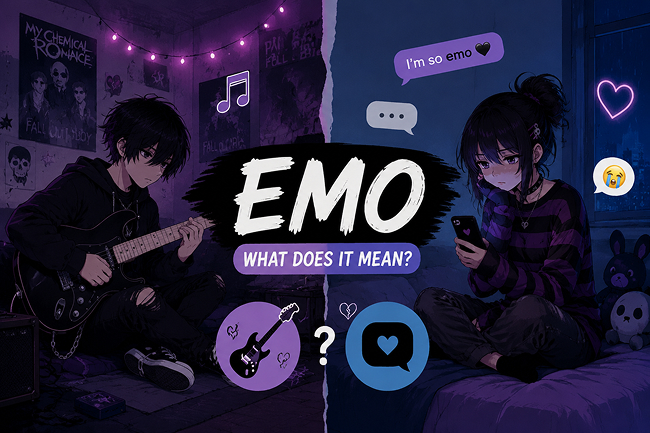
1What Does Emo Mean Today?
Today, "emo" is used in two main ways.
1. As a music genre and subculture (the main meaning). Emo describes a music-based subculture and the people who identify with it—built around emotional honesty and a recognizable look: dark clothing, expressive hairstyles, band tees, and a love of emo and emo-adjacent music. Calling someone "an emo" or an "emo kid" points to this identity.
2. As casual slang for a mood. More recently, "emo" has also become everyday slang for feeling emotional, sad, or moody—often half-jokingly, as in "I'm feeling so emo today."
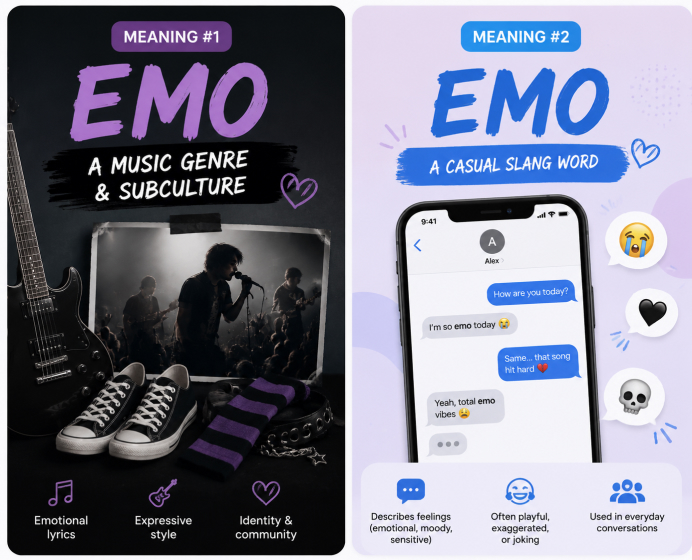
So "emo" can describe who someone is—their style and music—or just how they're feeling in the moment. Either way, it's about emotional expression: not a mental health condition, and not an insult.
2Where Did Emo Come From?
Emo originated in the mid-1980s Washington, D.C. hardcore punk scene. At the time, some punk bands began shifting away from aggressive, politically charged music and started writing more personal, emotional lyrics.
Music journalists labeled this emerging style "emotional hardcore," eventually shortened to "emo." Early bands like Rites of Spring and Embrace are often credited as pioneers of the sound—even though they weren't fans of the label itself.
The Evolution of Emo
- 1st Wave (1980s) - "Emocore"
- Raw, fast, and emotionally intense, still closely tied to hardcore punk.
- Key bands: Rites of Spring, Embrace
- 2nd Wave (1990s) - "Midwest Emo"
- A softer, more melodic version that developed in the Midwest U.S., blending indie rock with emotional lyrics.
- Key bands: Sunny Day Real Estate, Jawbreaker, The Get Up Kids, American Football
- 3rd Wave (2000s) - Mainstream Emo
- Emo entered pop culture through MTV, MySpace, and mainstream radio. This is when the iconic "emo look" became popular—black clothing, side-swept bangs, and eyeliner.
- Key bands: My Chemical Romance, Fall Out Boy, Paramore, Dashboard Confessional
- Today - Revival & Emo Influence
- In recent years, emo has returned in new forms:
- "emo revival" indie bands
- emo rap artists like Lil Peep and Juice WRLD
- TikTok nostalgia built on 2000s emo aesthetics
A Common Misunderstanding About Emo
In the 2000s, media coverage and cultural panic linked emo to depression and self-harm. But that stereotype came from media simplification, not from the music or its community—at its core, emo has always been about expressing emotions honestly, not a measure of anyone's mental health.
3How Is Emo Used in Teen Conversations?
Because "emo" can describe both an identity and a passing mood, it shows up in a few different ways online and in texts—usually casual, and often a little playful. Here's how teens actually use it:
Describing someone's style or identity:
- She's so emo—black everything and a My Chemical Romance playlist on repeat.
- He's been emo since middle school..
Describing a feeling or mood:
- I'm so emo today. (feeling emotional or low-energy)
- That song is so emo. (a melancholic, in-your-feelings vibe)
As light teasing:
- Don't be emo. (joking, not a literal label)
Emo Emojis: How the Aesthetic Shows Up in Texts: There's no official "emo" emoji in Unicode, so people borrow existing ones to capture the mood and look:
- ❤ Black heart — the signature emo emoji: moody, a little melancholy.
- 🥀 Wilted rose — beauty and sadness in one symbol, very on-theme.
- 💀/ ☠️ Skull — the darker, edgier side of the aesthetic (though it's also general slang for "I'm dead 😂")
- ⛓️ / 🕷️ / 🕸️ Chains, spiders, webs — gothic-leaning emo visuals.
These signal a vibe or aesthetic—not a diagnosis. Someone using a black heart is showing a style, not necessarily how they feel.
4Emo vs Goth vs Scene: What's the Difference?
Emo, goth, and scene get mixed up constantly—they're all "alternative," they overlap in fashion, and they share punk roots. But each has its own origin, sound, and look. Here's how they compare:
| Emo | Goth | Scene | |
|---|---|---|---|
| Origin | Mid-1980s hardcore punk; peaked in the 2000s | Late 1970s–80s post-punk | Mid-2000s, an offshoot of emo |
| Music | Emo, pop-punk, post-hardcore | Gothic rock, darkwave, industrial (Bauhaus, The Cure) | More a look than a genre (metalcore, crunkcore, electro-pop) |
| Look | Mostly black, band tees, skinny jeans, side-swept bangs | All-black, lace, Victorian touches, dramatic pale-and-dark makeup | Bright neon, bold patterns, teased and colorfully dyed hair |
| Vibe | Introspective and emotional | Dark, romantic, drawn to the macabre | Playful, high-energy, and social |
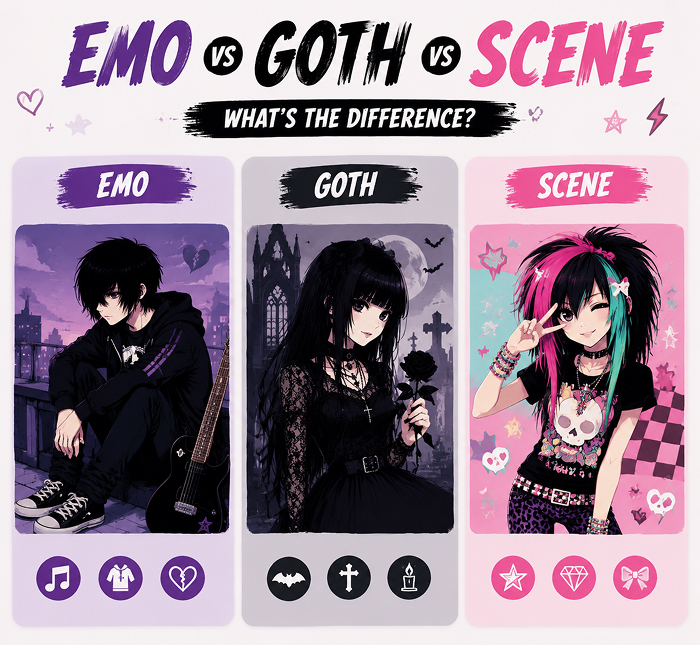
The quickest way to tell them apart is by mood and color. Goth is the oldest and darkest—elegant, romantic, and almost entirely black. Emo is more introspective and emotionally expressive, leaning black but with a more casual, streetwear feel. Scene is the bright, hyper, neon-colored cousin of emo—so much so that scene kids were sometimes nicknamed "neon emos."
5Is Emo Something Parents Should Be Concerned About?
Short answer: not on its own. For most teens, emo is a healthy form of self-expression—a way to connect with music, find community, and make sense of their emotions. Liking emo music, wearing black, or relating to emotional lyrics is normal identity-building, not a warning sign.
More than any label, what supports a teen's wellbeing is staying genuinely involved in their life—online and off. Alternative teens, including emo kids, can sometimes be targets of teasing or online bullying, so having a sense of their digital world can help you notice if something's wrong and step in. A parental-control app like AirDroid Parental Control can give you that visibility—but it works best alongside open conversation and trust, not as a replacement for them.
Final Thoughts
Emo is, at its core, a music and fashion subculture built on emotional honesty—and these days, also a casual way to say you're "in your feelings." Either way, it's a form of self-expression, not a sign that something is wrong.
For parents, the takeaway is simple: emo isn't a red flag. What matters far more than the music or the black clothes is staying connected and leading with curiosity instead of judgment. A teen who feels understood at home is in the best place to thrive—emo or not.
EMO FAQs








Leave a Reply.