AirDroid Parental Control
Track mobile live location and ensure safety around
- Locate an Android or iPhone in real-time and check routes history
- Remotely see, hear & record phone surroundings
- Set geofence zones and get instant alerts.
Driving Tips for New Drivers: Essential First-Time Advice
Your first independent drive can feel exciting and uncomfortable at the same time. Prepare the car before moving, choose a familiar route, and avoid adding unnecessary pressure with passengers or a tight schedule.
The three principles to remember are: stay alert, leave enough space, and be prepared for other drivers to make mistakes. These habits give you more time to notice a problem and respond safely.
Want the full printable Driving Tips With Your Teen?
Driving Tips for New Drivers
First Time Driving Tips: Get Ready Before You Start
A safe first drive begins while the vehicle is still parked. Complete the following checks before entering traffic.
1Adjust Your Seat, Mirrors, and Controls
Position the seat so you can fully press the pedals while keeping a slight bend in your knees. Sit upright, fasten your seat belt, adjust the head restraint, and set the mirrors to reduce—but not eliminate—blind spots.
Confirm that every passenger is buckled before moving. If you cannot comfortably reach a control or clearly see around the vehicle, stop and readjust.
2Put Away Your Phone and Other Distractions
Set navigation and music before the car moves, silence notifications, and place the phone where you cannot reach it. The National Highway Traffic Safety Administration recommends pulling over and parking in a safe location before reading or sending a message.
In a Reddit discussion about advice for new drivers, drivers repeatedly emphasized removing phone distractions before starting. Their experiences reinforce the official guidance: a message can wait until the vehicle is safely parked.
3Know Your Route and Basic Vehicle Controls
Review your route before leaving and allow extra time. If you miss a turn, continue safely and let navigation recalculate instead of making a sudden lane change.
Learn how to operate the headlights, high beams, turn signals, hazard lights, windshield wipers, defroster, parking brake, and climate controls while parked. Check the fuel or battery level and understand important dashboard warning lights.
These practical preparations also appear throughout the Reddit discussion, but your vehicle owner's manual is the correct source for model-specific controls.
The Most Important Driving Tips for New Drivers
Good driving is less about reacting at the last second and more about creating enough time and space to avoid an emergency.
1Drive Defensively—Expect Other Drivers to Make Mistakes
Do not assume every driver will signal, yield, stop, or choose the correct lane. Scan ahead, watch vehicle movement, and keep an escape option whenever possible.
A recurring lesson in this Reddit thread for new drivers is to never rely completely on another driver's expected action. Professionalized into one rule: anticipate mistakes without becoming fearful or aggressive.
2Keep a Safe Following Distance
Under normal conditions, use the three-second rule: choose a fixed point ahead, wait for the vehicle in front to pass it, and count until your car reaches the same point. The California Driver's Handbook recommends this method to provide time to react.
Increase the gap at night, in rain, snow, fog, heavy traffic, or whenever traction and visibility are reduced. More speed also requires more stopping space.
3Leave Yourself Enough Space to React
Avoid becoming boxed in beside other vehicles. Do not remain in another driver's blind spot, and leave extra space around motorcycles, cyclists, large trucks, and buses.
The Federal Motor Carrier Safety Administration warns that trucks and buses have large blind spots, longer stopping distances, and wide turns. If you cannot see the truck driver in a mirror, the driver may not be able to see you.
4Be Predictable and Plan Ahead
Signal early, brake progressively, maintain a steady lane position, and plan turns or exits well in advance. Avoid sudden braking and last-minute lane changes unless an immediate hazard requires them.
Predictability helps other road users understand your intentions. A turn signal communicates a plan, but it does not give you the right-of-way or remove the need to check that the movement is safe.
5Check Your Blind Spot Before Changing Lanes
Check the rearview and side mirrors, signal, then briefly look over your shoulder toward the lane you plan to enter. The California DMV specifically advises checking blind spots for vehicles, motorcycles, bicycles, and pedestrians before merging or changing lanes.
Keep the steering steady while checking. If the space is not clearly safe, remain in your lane and wait for another opportunity.
6Stay Calm When Other Drivers Make Mistakes
Do not retaliate against tailgating, cutting in, or aggressive gestures. Avoid eye contact, create space, let the other vehicle pass when safe, and focus on reaching your destination.
Frustration narrows attention and encourages rushed decisions. If you feel overwhelmed, pull into a safe location and take a short break.
How Parents Can Help Keep New Drivers Safe
New drivers need time to build reliable habits. The CDC recommends extensive supervised practice over at least six months and experience on varied roads, at different times, and in changing traffic and weather conditions.
Before allowing a teen to drive independently, parents should check whether their teen is ready to drive alone by evaluating safe judgment, vehicle control, and responsible decision-making in different driving conditions.
Families should also set clear rules in a parent-teen driving agreement before handing over the keys. The agreement can cover seat belts, passengers, nighttime driving, phone use, speeding, and what happens when those rules are broken.
Stay Connected When Your Teen Is on the Road
AirDroid Parental Control is a child-safety solution that combines parental controls with Teen Driving Safety. In addition to managing location, screen time, and app use, it can help families identify driving patterns and discuss safer habits.
- Trip details. Review the route, starting and ending points, speed, distance, and duration of supported trips.
- Driving risk alerts. Receive real-time speeding alerts and review hard-braking or rapid-acceleration events after a trip.
- Daily and weekly summaries. Look for repeated patterns and review progress together instead of judging a single event.
- Family safety tools. Use live location, route history, geofences, SOS alerts, screen-time limits, and app controls as part of a broader child-safety plan.


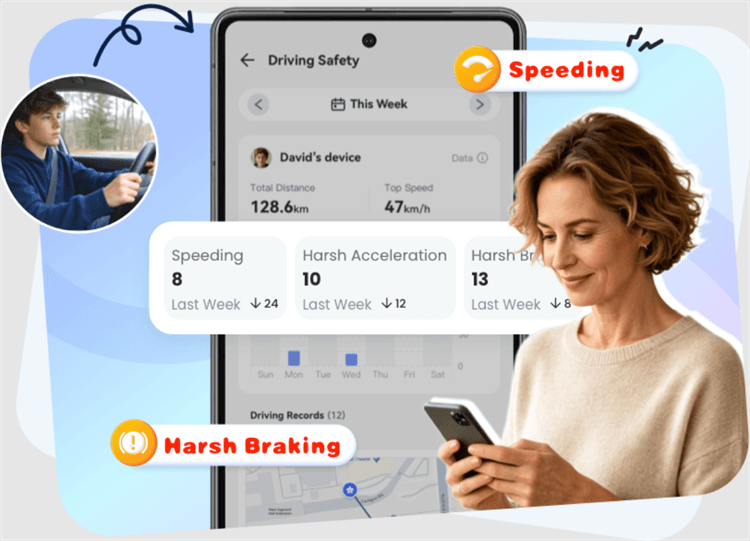
Use these features transparently. Driving detection relies on device movement and may also record trips when the child is a passenger, riding a motorcycle, or using an electric bike. Treat each alert as a safety signal for a calm conversation—not proof that the child drove unsafely.
Learn more about AirDroid Parental Control Teen Driving Safety and confirm current device, permission, and feature requirements before setup.
Tips for Driving in Different Situations
Practice unfamiliar situations with an experienced, licensed driver before handling them alone. Always follow local traffic laws and posted signs.
1Highway Driving and Merging
- Build speed on the ramp. Enter at or near the speed of traffic when conditions and posted limits allow.
- Find a safe gap. Signal, check mirrors and blind spots, and adjust your speed instead of forcing another driver to brake.
- Limit lane changes. Stay in an appropriate lane and change only when necessary.
- Give large vehicles room. Do not linger beside trucks or merge closely in front of them.
- Accept a missed exit. Continue to the next safe route rather than braking or crossing lanes suddenly.
The California DMV advises merging at or near traffic speed, using signals and mirrors, checking over the shoulder, and crossing lanes one at a time.
2Intersection Safety
Before entering, scan for vehicles, pedestrians, cyclists, and anyone who may run a red light or turn across your path. A green light does not make it safe to proceed if the intersection is blocked.
Avoid changing lanes inside an intersection when possible. When turning left, do not rely only on an approaching vehicle's turn signal; wait until its movement confirms the turn.
Nighttime Drive Tips for New Drivers
The CDC identifies nighttime driving as particularly risky for inexperienced teen drivers. Practice after dark with an experienced driver before taking longer nighttime trips alone.
1Slow Down When Visibility Is Reduced
Drive at a speed that allows you to stop within the distance you can clearly see. Reduce speed on dark, unfamiliar, wet, or winding roads, even when the posted limit is higher.
2Increase Your Following Distance
Leave more than the normal three-second gap because darkness can delay hazard recognition. Increase it further in rain, fog, glare, or heavy traffic.
3Use Your Lights Correctly
Confirm that the headlights and tail lights are actually on; an illuminated dashboard does not always confirm this. Use high beams only when legal and safe, and switch to low beams for approaching traffic or when following another vehicle.
4Watch Carefully for Pedestrians, Cyclists, and Other Road Users
Scan road edges, intersections, crosswalks, and areas near parked vehicles. Pedestrians, cyclists, motorcycles, animals, and unlit objects can be difficult to detect at night, so keep your eyes moving and avoid staring into oncoming headlights.
Tips for Driving in the Snow
Snow, sleet, and ice reduce traction and can make stopping or steering difficult. The safest decision may be to postpone a non-essential trip.
1Check Road and Weather Conditions Before Leaving
Review official weather and road reports, plan the route, and make sure windows, mirrors, lights, and cameras are clear. The NHTSA winter driving guide recommends delaying non-essential travel when roads are in poor condition.
2Slow Down and Leave More Stopping Distance
Reduce speed and create a much larger gap from the vehicle ahead. A normal following distance may not provide enough time to stop on snow or ice.
3Brake, Accelerate, and Steer Smoothly
Make gradual inputs to preserve traction. Look where you want the vehicle to go, avoid unnecessary lane changes, and allow extra time for every turn and stop.
4Avoid Driving in Conditions Beyond Your Experience
If visibility is poor, roads are untreated, or you do not feel able to maintain control, delay the trip or ask an experienced driver for help. No appointment is worth taking on conditions you are not prepared to handle.
FAQs About Driving Tips for New Drivers
Parents who want additional support between supervised practice sessions can explore the Best Teen Driving Apps for Parents. These tools may offer location sharing, trip insights, driving reports, and safety alerts that help families discuss driving habits and gradually build independence.









Leave a Reply.