Teen Driving Safety for Parents: Assess Risks, Set Rules, and Build Safer Habits
- Assess Your Teen's Current Driving Safety
- Why Teen Drivers Face Higher Safety Risks
- Prioritize the Driving Risks That Matter Most
- Set Family Rules That Match the Risk
- Build Safer Driving Habits Through Practice
- Use Technology as a Safety Support
- Reassess and Increase Independence
- A Simple Teen Driving Safety Roadmap
Teen driving safety is not only about teaching a young person to operate a car. Parents also need to consider readiness, risk, family rules, daily habits, and how much independence a teen can handle.
A practical approach is: Assess → Prioritize → Set Rules → Build Habits → Use Technology → Reassess. Start with the most important current risk, then add freedom as safe decisions become consistent.
1. Assess Your Teen's Current Driving Safety
Before adding new rules, monitoring tools, or driving privileges, first identify the type of problem your family is trying to solve. Your teen may need more driving practice, stronger safety habits, clearer family expectations, or less independence until their judgment improves.
1 Is Your Teen Ready for Independent Driving?
Readiness means more than passing a driving test. A teen should be able to drive safely and make responsible decisions without frequent reminders from a parent.
Before allowing more independent driving, consider whether your teen can consistently:
- 🟠Follow traffic laws and agreed family driving rules.
- 🟠Maintain attention without becoming distracted by a phone, passengers, food, or media.
- 🟠Control speed, braking, acceleration, lane position, and following distance.
- 🟠Handle unfamiliar roads, heavier traffic, nighttime driving, and difficult weather.
- 🟠Make safe decisions without waiting for a parent to provide instructions.
- 🟠Recognize when fatigue, stress, emotions, weather, or other conditions make driving unsafe.
If several of these abilities are still inconsistent, your teen may need more supervised practice before receiving additional driving freedom.
For a more detailed assessment, use Is My Teen Ready to Drive Alone? A Parent Readiness Checklist.
2 What Driving Behaviors Should Parents Watch For?
Focus on repeated behavior rather than isolated mistakes. One rough stop may be part of the learning process, while frequent hard braking may indicate poor anticipation, excessive speed, or distraction.
- Distraction. Using a phone, adjusting music or navigation, eating, interacting with passengers, or repeatedly looking away from the road.
- Speed and vehicle control. Speeding, following too closely, braking hard, accelerating rapidly, drifting between lanes, or entering turns too quickly.
- Difficulty in complex situations. Struggling with unfamiliar roads, heavy traffic, passengers, nighttime driving, construction zones, or bad weather.
- Poor decision-making. Ignoring agreed rules, taking unnecessary risks, driving while tired or upset, or failing to adjust to unsafe conditions.
When a behavior happens repeatedly, identify when and where it occurs. A clear pattern makes it easier to choose the right response and measure whether the behavior improves.
3 Does Your Teen Need More Skill, Structure, or Independence?
The same driving concern can have different causes. Before deciding on consequences or new restrictions, determine which of the following best describes the problem.
- Skill problem. Your teen does not yet know how to handle a situation safely or has not had enough supervised practice.
- Habit problem. Your teen understands the correct behavior but does not apply it consistently.
- Structure problem. Family driving rules, expectations, or consequences are unclear, inconsistent, or not regularly discussed.
- Independence problem. Your teen currently has more driving freedom than their skills, habits, or judgment can safely support.
Once you identify the primary problem, match it with the appropriate response: teach and practice a missing skill, reinforce a safer habit, clarify a family rule, or temporarily reduce driving independence.
The goal is not to restrict driving indefinitely. It is to provide the level of support your teen needs now and gradually increase independence as safe behavior becomes consistent.
Before adding rules or tools, identify the type of problem your family is trying to solve.
2. Why Teen Drivers Face Higher Safety Risks
1Limited Experience Affects Driving Decisions
New drivers have had less time to recognize hazards, judge closing speed, choose safe gaps, and predict what other road users may do. These decisions improve through varied, supervised practice.
2Distraction Is Harder to Manage for New Drivers
Driving already uses much of a beginner's attention. A message, passenger conversation, navigation change, or dropped object can leave too little capacity for the road. NHTSA's distracted driving guidance explains that phones, food, passengers, and navigation or entertainment systems can all divert attention from safe driving.
3Speed Can Reduce a Teen Driver's Margin for Error
Higher speed gives a driver less time to notice and respond to danger. It can also make braking, steering corrections, and crash outcomes more severe.
4Passengers, Nighttime Driving, and Difficult Conditions Add Complexity
Young passengers can add distraction, while darkness, rain, heavy traffic, and unfamiliar roads reduce visibility or demand faster judgment. CDC's overview of teen driver risk factors identifies nighttime driving and driving with teen or young adult passengers as important risks for newly licensed teens. Introduce these conditions gradually.
5A License Does Not Mean a Teen Has Finished Learning
A license confirms a minimum legal standard, not mastery of every situation. Continued guidance matters as teens encounter highways, poor weather, long trips, and unexpected hazards.
For evidence-based parent guidance, see the CDC's teen driver danger zones and the NHTSA parent guide.
3. Prioritize the Driving Risks That Matter Most
Do not try to correct everything at once. Match the main risk to one clear family action.
| Risk | What Parents Should Focus On |
|---|---|
| Distracted driving | Remove distractions and create a phone-free routine |
| Speeding | Set clear speed expectations and review driving behavior |
| Poor vehicle control | Practice smoother braking, acceleration, and following distance |
| Passenger distraction | Set passenger limits and behavior boundaries |
| Nighttime driving | Build experience gradually with supervised practice |
| Repeated rule breaking | Revisit family expectations, consequences, and current independence |
1Start With the Risk You Can Address Now
Prioritize behavior that could cause serious harm, happens repeatedly, or appears beyond your teen's current control. One focused change is easier to practice and measure.
2Turn Each Risk Into a Specific Action
Replace a vague concern with an observable action. For frequent speeding, set a clear speed expectation and discuss why it happens. For phone distraction, agree that the phone stays out of reach. For low confidence at night, practice together before allowing solo nighttime trips.
4. Set Family Rules That Match Your Teen's Risk Level
1Set Clear Rules for High-Risk Behaviors
Cover phone use, speed, passengers, seat belts, car access, curfew, nighttime driving, and difficult weather. Rules should reflect local graduated licensing laws as well as your teen's experience. CDC's guidance on graduated driver licensing explains how supervised learning, nighttime restrictions, and passenger limits help new drivers gain experience under lower-risk conditions.
2Make Rules Specific and Consistent
“Drive safely” is difficult to follow or enforce. “Keep your phone out of reach while driving” defines the expected behavior. Apply the same rule every trip.
3Agree on Consequences Before Rules Are Broken
Choose proportionate, predictable consequences while everyone is calm. Connect them to safety: a repeated nighttime violation might mean returning to supervised nighttime practice.
4Adjust Rules as Your Teen Gains Experience
Review the rules at agreed intervals. Families that want to put expectations, privileges, and consequences in writing can use a Parent-Teen Driving Agreement.
5. Build Safer Driving Habits Through Practice
1Practice Before Giving More Independence
Let the teen demonstrate a skill repeatedly with supervision before using it alone. Practice should include calm feedback and more than one route or condition.
2Teach One Skill or Situation at a Time
Work separately on highway driving, parking, nighttime driving, heavy traffic, bad weather, and unfamiliar roads. Combining every challenge at once can overload a new driver.
3Create a Simple Pre-Drive Routine
Seat belt → Mirrors → Phone away → Route ready → Drive. A short repeated sequence reduces last-minute distractions and makes safe preparation automatic.
4Review Patterns Instead of Criticizing Every Mistake
After a drive, choose one useful point: what went well, what needs practice, and what the teen will try next time. Frequent criticism can make honest discussion harder.
5Increase Independence Gradually
Expand distance, road types, passengers, or driving hours one step at a time. For more practical techniques, see Safe Driving Tips for New Teen Drivers.
6. Use Technology as a Safety Support, Not a Replacement for Parenting
Technology is most useful when a family explains what is collected, why it matters, and how it will be used. The purpose should be safer habits and constructive discussion, not secret or constant surveillance.
1When Can Technology Help?
It may help when a teen begins driving independently, parents cannot observe every trip, or the family needs objective information about repeated driving patterns. NHTSA's review of electronic monitoring for young drivers notes that these tools can provide information about driving behavior, performance, and trip context.
2What Driving Data Can Tell Parents
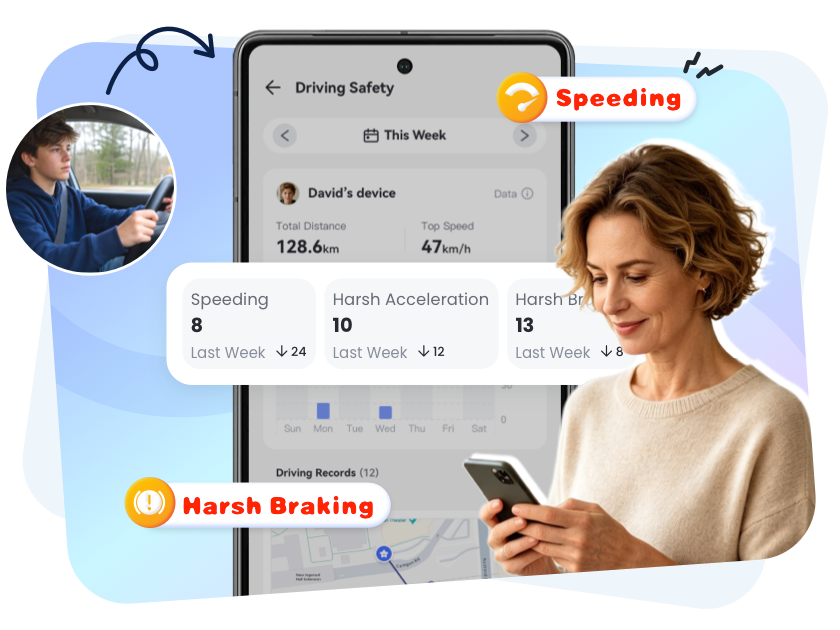
Beyond daily online protection—such as location awareness, geofencing, and app time limits—AirDroid Parental Control extends its family safety coverage to the road. Its specialized Driving Report functionality turns raw driving data into actionable insights for parents and teens to review together:
- Trip details. Review driving routes, speed, distance, and duration to gain context for everyday journeys.
- Driving events. Parents can receive real-time alerts when speeding is detected. Highlight key moments—such as speeding, hard braking, or rapid acceleration—that offer valuable coaching opportunities.
- Longer-term patterns. Use weekly summaries to celebrate progress, spot trends, and build safer habits together.
A single event does not prove unsafe intent. Road conditions, traffic, device permissions, network status, and detection limits can affect the data, so parents should ask for context before reaching a conclusion.
The useful sequence is See → Understand → Discuss → Improve. Explain the feature to the teen, use the least information needed for a real safety concern, and treat the data as a starting point for a calm conversation—not as a complete account of what happened.
3When Technology Cannot Replace Parenting
No app can replace driver education, supervised practice, clear rules, communication, judgment, or personal responsibility. For a trust-focused approach, read How to Monitor Teen Driving Without Breaking Trust. To compare tools, see Best Teen Driving Apps for Parents (2026).
7. Reassess and Gradually Increase Independence
1Review Your Teen's Progress
Ask whether risky behaviors are becoming less frequent, rules are followed consistently, and the teen can manage more situations without prompts.
2Adjust Rules as Skills Improve
Keep rules connected to current risk. Relax one boundary when the teen demonstrates the related skill, and restore more practice or structure if a serious pattern returns.
3Give More Freedom When Responsibility Is Demonstrated
The goal is not permanent control. It is to help a teen make safe decisions without supervision. Independence should grow from demonstrated responsibility, not age or time alone.
8. A Simple Teen Driving Safety Roadmap
Assess: Identify your teen's biggest current safety concern.
Prioritize: Focus on the most important risk first.
Set rules: Create clear expectations and predictable consequences.
Practice: Turn each rule or skill into a repeatable habit.
Support: Use technology only when it adds useful safety context.
Reassess: Increase independence as responsibility grows.
Start with one risk, one clear rule, and one practice goal. Small, consistent improvements are more useful than trying to control every part of every trip.
Choose Your Next Step
Choose the resource that best matches your family's current driving safety concern.
- Unsure about readiness? Read Is My Teen Ready to Drive Alone?
- Need practical driving habits? Read Safe Driving Tips for New Teen Drivers.
- Need clearer family rules? Use the Parent-Teen Driving Agreement.
- Comparing technology? See Best Teen Driving Apps for Parents (2026).
- Concerned about trust? Read How to Monitor Teen Driving Without Breaking Trust.
FAQ
List of Sources
- Government and Road Safety Authorities
- National Highway Traffic Safety Administration (NHTSA) — Distracted Driving Guidance (https://www.nhtsa.gov/risky-driving/distracted-driving)
- Centers for Disease Control and Prevention (CDC) — Teen Driver Risk Factors (https://www.cdc.gov/teen-drivers/risk-factors/index.html)
- Centers for Disease Control and Prevention (CDC) — Teen Driver Danger Zones (https://www.cdc.gov/teen-drivers/parents-are-the-key/danger-zones.html)
- National Highway Traffic Safety Administration (NHTSA) — Parent Guide to Teen Driving Safety (https://www.nhtsa.gov/teen-driving/parents-talk-your-teen-driver-about-safe-driving)
- Centers for Disease Control and Prevention (CDC) — Graduated Driver Licensing Guidance (https://www.cdc.gov/phlp/php/publications/graduated-driver-licensing-motor-vehicle-injuries-1.html)
- National Highway Traffic Safety Administration (NHTSA) — Electronic Monitoring for Young Drivers (https://www.nhtsa.gov/book/countermeasures-that-work/young-drivers/countermeasures/other-strategies-behavior-change-1)

Leave a Reply.