Is ChatGPT Safe for Kids: 2026 Complete Parents' Guide
"Is it OK to let my 11-year-old son use ChatGPT or chatbots?"
This exact question popped up on Reddit recently, and it's one that thousands of worried parents are searching for every day.
The short answer? OpenAI officially restricts ChatGPT to users 13 and older. However, the reality of digital parenting is rarely that simple.
In this quick guide, we'll break down the official OpenAI age limits, explore the hidden psychological and privacy risks of AI for preteens, and give you actionable guidelines to keep your kids safe online.
Quick Answer: Is ChatGPT Safe for Kids?
No, it is not safe for all ages. ChatGPT is not designed for children under 13, and OpenAI warns that it can generate content that is inappropriate for minors.
ChatGPT Age-by-Age Safety Guide
This guidance comes directly from the official ChatGPT documentation.
🚫 10-12:
The Rule: Strictly prohibited. OpenAI requires users to be 13 or older.
Guide: Children in this age group using ChatGPT violates Terms of Service. You'd better block the direct access to ChatGPT. If schoolwork requires AI help, use it together on a parent-supervised device or consider kid-friendly alternatives like Khanmigo.
🟢 13–17 (Teens):
The Rule: Allowed to have an account with ChatGPT parental controls.
Guide: Parents should use ChatGPT's Parental Controls to link accounts. Set ground rules, such as, no emotional venting to it, no sharing personal info, etc. And the most importantly, check usage weekly, not just for content but for dependency patterns to avoid emotional reliance.
ChatGPT Specific AI Risks for Children
1 Learning & Academic Risks
A study found that students who relied on chatbots showed weaker brain activity and memory retention than those who wrote on their own, proving that AI can dull critical thinking and affect their brain development.
Further research confirms this: students using ChatGPT demonstrated significantly lower cognitive engagement scores, and 83.3% of participants failed to remember and accurately quote text they had just created with AI assistance.
When machines replace the reasoning process, retention drops and foundational learning suffers.
2 Emotional & Psychological Risks
Teenagers often vent to virtual characters when lonely, forming an unhealthy dependency. This risk is real: 13.5% of teens exhibited signs of feeling attached to AI, prompting Common Sense Media to warn that AI should never replace clinical counseling.
3 Privacy & Data Risks
Kids can easily leak sensitive family secrets on apps that log chats for AI training. With a Mozilla study revealing that 11 chatbots failed basic data protection, parents are left wondering: is ChatGPT private and secure?
4 Advanced digital risks
The Federal Trade Commission (FTC) warns that fraudsters are using voice cloning and deepfakes to impersonate individuals with eerie precision. This blurs the line between reality and digital manipulation, making kids easy targets for AI impersonation scams.
This vulnerability feeds into a broader crisis in child online safety, fueled by an alarming 26,362% spike in deepfake child abuse cases.
Is ChatGPT Dangerous for Your Child? (Quick Risk Assessment)
If you're worried about your child's AI usage, complete this quick checklist to calculate their risk level. (Add 1 point for every "Yes")
1Usage Behavior
- Uses AI excessively every single day?
- Uses AI more for emotional escape than for learning?
- Uses AI more secretly or clears chat history frequently?
2Dependency Signals
- Relies constantly on AI to make personal decisions?
- Instantly trusts AI answers without any verification?
3Emotional Attachment
- Treats the chatbot as a "friend" or "romantic partner"?
- Prefers talking to the AI over real-life friends or family?
4Critical Thinking
- Accepts AI info blindly without questioning or fact-checking?
- Struggles to distinguish between AI-generated content and reality?
- A sudden drop in grades or inability to explain their own work?
- 📊 Score & Risk Level
- 0–2 Points | Low Risk (Safe)
- 3–5 Points | Moderate Risk (Caution): Early signs of emotional or cognitive dependency. It's time to step in, set firmer boundaries, and manage their screen time.
- 6–10 Points | High Risk (Danger): Severe ChatGPT addiction. This requires direct intervention to protect your child's mental health, real-world social skills, and critical thinking.
How to Make ChatGPT Safer for Kids (Practical Parent Guide)
Protecting children from the risks of AI requires practical steps you can apply right now in response to the concern: Is ChatGPT safe for kids?
1Set Clear Usage Guidelines
Discuss daily usage guidelines and ensure the AI is only used for educational purposes.
2Teach "AI Literacy"
Explain that AI is not an absolute source because it can provide incorrect or outdated information. Guide the child to always cross-check every answer using credible references.
3Prevent Emotional Over-Dependence
Guide children away from using the AI as an emotional outlet or a substitute for emotional counseling. Instead, encourage them to actively build friendships in the real world.
4Privacy Protection Rules
Remind children to never share personal information such as their name, school, address, or family's identity and finances.
5Detect Risky ChatGPT Activities
Watching out for ChatGPT usage pattern can ensure positive digital activities, but how can parents know if kids interact with risky AI content on ChatGPT?
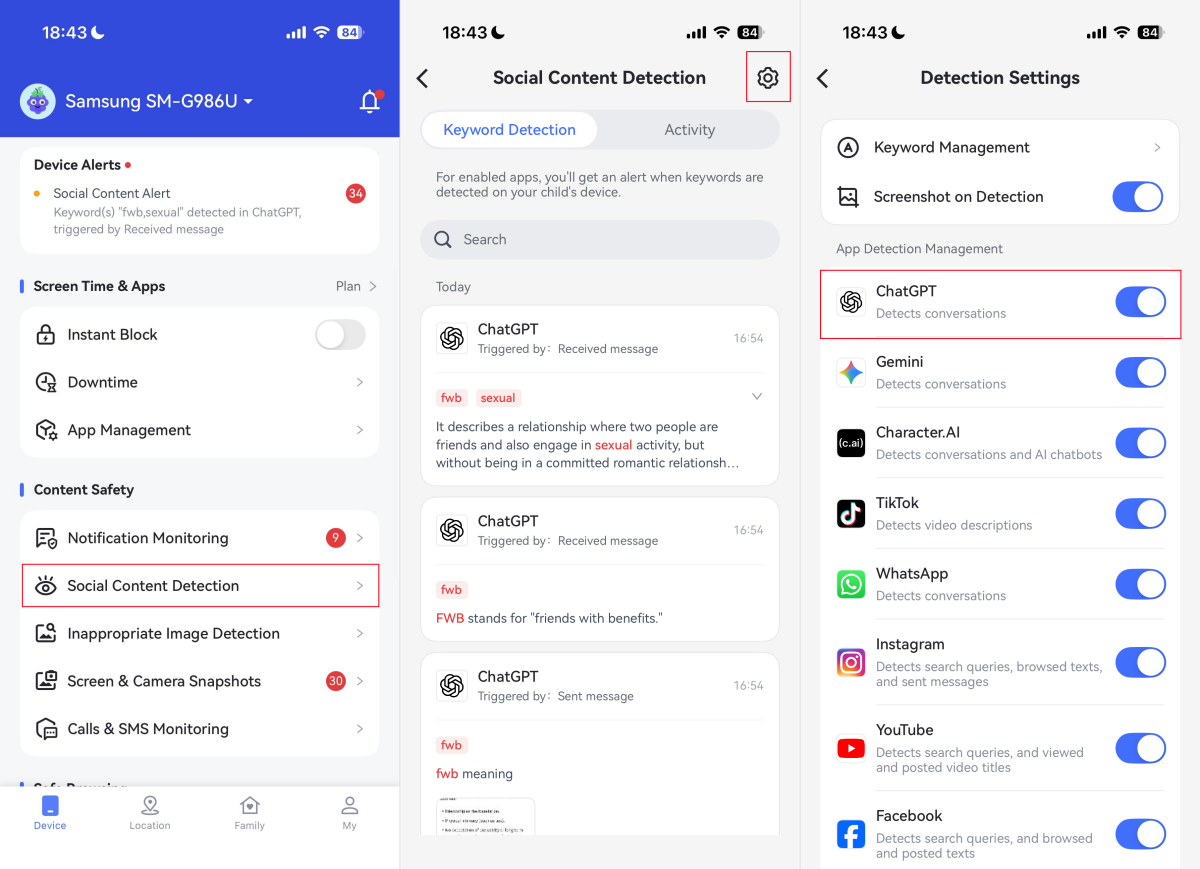
AirDroid Parental Control is an AI chat monitoring app for parents.
Its AI Content Detection feature monitor risky ChatGPT chats and send quick notifications once kids talk or receive dangerous AI content.
With it, parents can set keywords related to self-harm, sexual content, violence, bullying, or other concerns and receive alerts when those terms appear.
FAQ
What app can monitor ChatGPT activity for kids?
AirDroid is one of the few apps built to monitor risky ChatGPT conversations. It scans for flagged keywords in ChatGPT, sending a real-time alert with a screenshot whenever one appears. Bark is another option that covers ChatGPT with an automated content alert system.
How do I know if my teen is secretly overusing AI chatbots?
Check for secrecy, late-night usage, emotional dependence, and hidden chat history.
What privacy risks do kids face using ChatGPT?
Children may unknowingly share sensitive personal data, and chatbots can store or misuse inputs, creating risks around privacy, profiling, and long-term data exposure.
Why do kids prefer talking to AI instead of parents?
AI feels non-judgmental and always available, so kids open up more easily, especially about emotions they struggle to express in real conversations.
Can AI chatbots replace real friendships for shy kids?
No, they cannot replace real friendships; they may help practice communication but lack emotional depth, shared experiences, and genuine reciprocal social bonding.
Is it safe to let an 8-year-old use ChatGPT on an iPad?
No. Creating a ChatGPT account for users under 13 violates OpenAI's Terms of Service.
Final Verdict
Is ChatGPT safe for kids? This platform can serve as a safe learning tool for children, as long as it is used with active adult involvement. Conversely, the risks will increase if navigated without clear guidelines, especially when it begins to be used as an emotional outlet.
Ultimately, a child's digital safety is determined by parental guidance rather than by the app itself. By discussing clear expectations and maintaining open communication, children can gain the educational benefits of AI without sacrificing their mental health.







Leave a Reply.