Can You Track Someone's Location on Instagram? What Parents Can Actually See
You need to find someone's location on Instagram—maybe your teen hasn't come home, maybe you're verifying a friend's story, or maybe you suspect your own account was accessed from elsewhere. Here's what Instagram actually lets you see, what it doesn't, and what to use instead.
Quick Guide: Which Method Fits Your Situation?
| Your Situation | What to Use | Control Level |
|---|---|---|
| They agreed to share location with you | Live Location Sharing (Map & Messages) | Real-time, opt-in |
| Checking where they've been recently | Location Tags in Posts/Stories | Historical, manual |
| Suspicious account activity or VPN use | Account Region Data | Country-level only |
| Need automatic safety check-ins | Family Location Tools (with consent) | Continuous, transparent |
Note: Methods 1-3 use Instagram's built-in features. Method 4 requires dedicated tools and open communication with the person you're locating.
What You Can Actually See on Instagram
1Live Location Sharing (Map & Messages)
If your child has enabled Instagram's location-sharing features, these are the most direct ways to see where they are — but only if they've chosen to share it with you. These options are typically used for check-ins during travel, after school, or coordinating meetups.
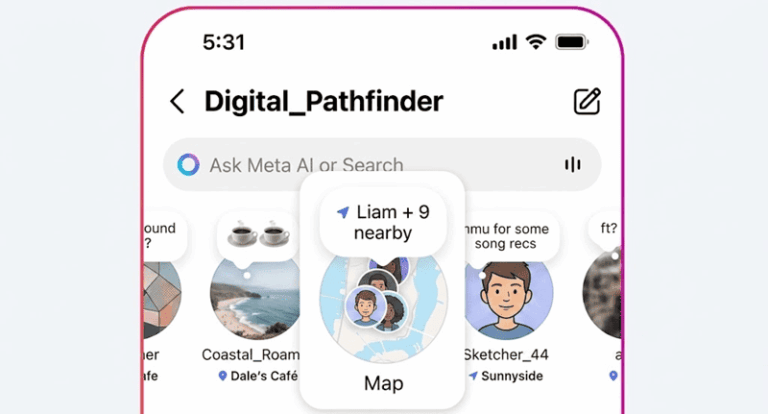
Option A: Instagram Map (ongoing sharing)
For continuous location sharing with selected contacts:
- Step 1.Open the Instagram app on your phone.
- Step 2.Tap the Messages icon at the bottom.
- Step 3.Tap the "Map" option at the top of your messages list.
- Step 4.Look for your child's location marker.
Option B: DM Location (one-time, 1-hour)
For temporary location sharing in a specific conversation:
- Step 1.Open your DM thread with your child.
- Step 2.Look for a location card in the chat history (they must send it).
- Step 3.Tap "View" under the location card to see their real-time location on a map.
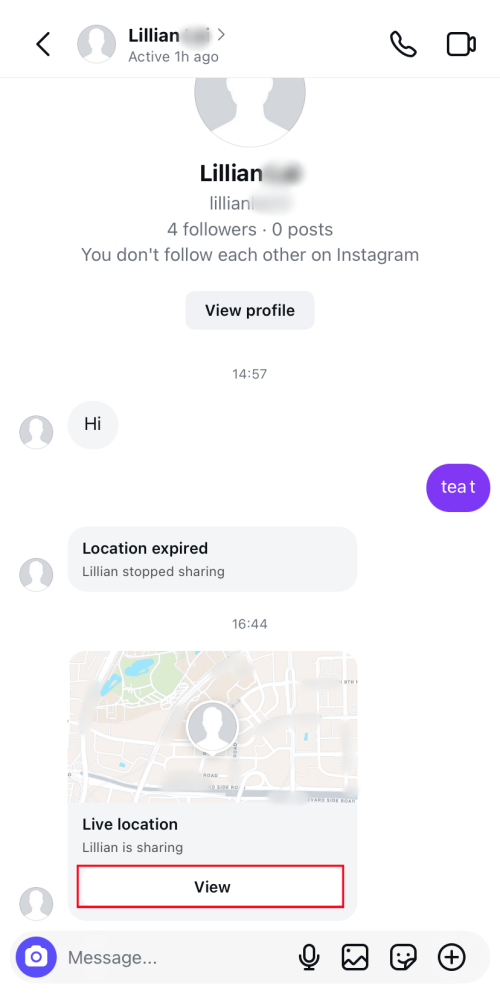
Time limit: DM location sharing automatically expires after one hour. Your child must initiate sharing for you to see anything.
What you will see: Your child's live location (if they have enabled sharing with you), plus stories and posts from people you follow in that area.
Important: You will only see your child here if they have actively selected you as someone who can view their location. This cannot be accessed without their permission.
For parents with Meta Family Center: Even with parental supervision set up, you can only control whether your teen can use location sharing — you'll get a notification if they turn it on, but you still can't see their location unless they actively choose to share it with you.
2Location Tags in Posts & Stories (Historical Only)
Users can manually tag locations in posts and Stories. These show where someone has been, not where they are right now.
Check their profile for:
- Post tags: Above the image or under username. Tap to see map and other posts from that location.
- Story tags: Location sticker in Stories (disappears after 24 hours unless saved to Highlights).
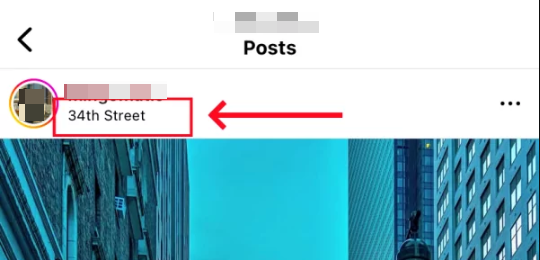
Critical limitation: These are manually added and easily fabricated. A user can tag "Paris" while sitting at home. Instagram notes tags are user-selected, not GPS-verified. Use for general context, not proof.
3Account Region Data (Detecting Anomalies)
Instagram shows the country/region associated with an account—useful for detecting VPN use or suspicious activity.
Find it: Profile → Three dots → About this account → "Account based in"
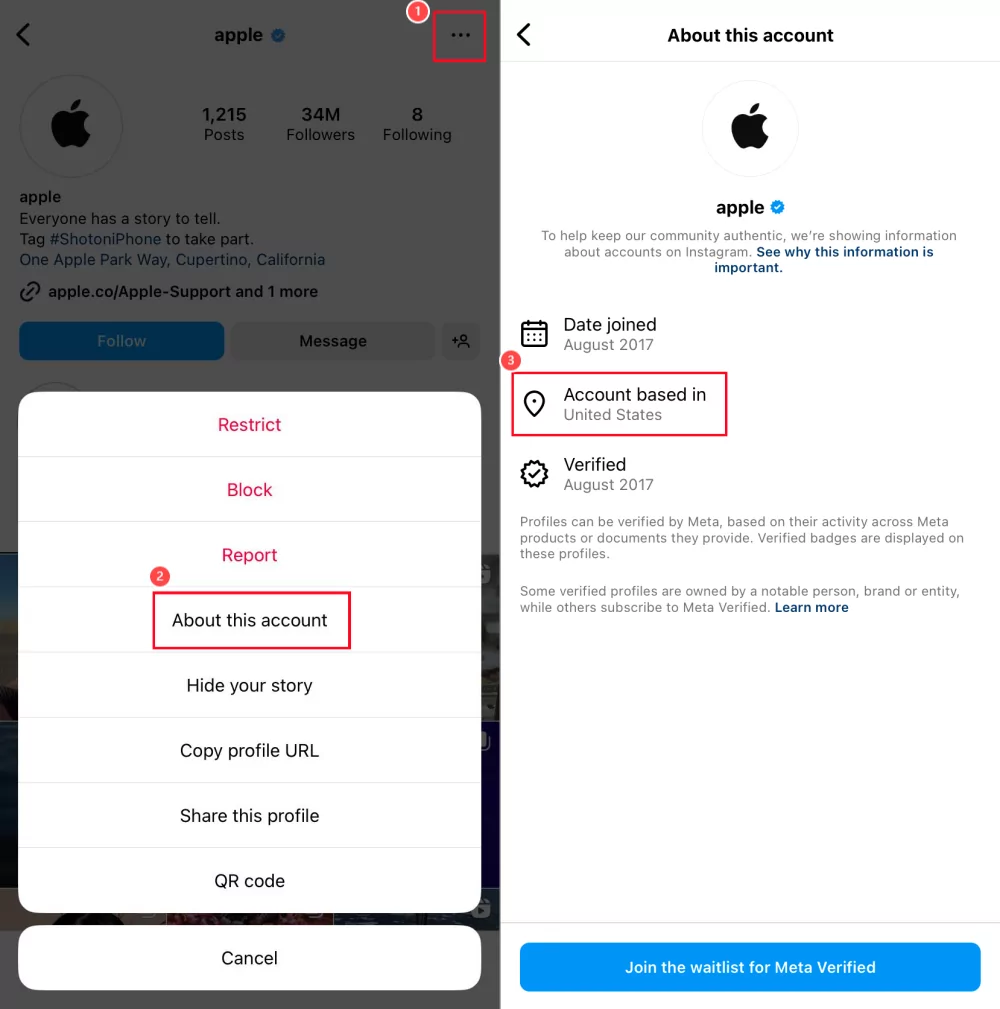
What this reveals:
- Which country Instagram associates with the account based on recent activity
- Potential VPN use (if it shows an unexpected country)
Limitations:
- Only country-level, not city or precise location
- Hidden for accounts with fewer than 1,000 followers (confirmed by users)
- VPNs and travel affect accuracy
Use case: If the account shows a different country than expected, the user may be using a VPN—use this as a conversation starter, not evidence.
Why "Instagram Location Tracker" Tools Are Scams
Search "instagram location tracker" and you'll find dozens of sites promising to reveal any user's exact coordinates using their username, profile URL, or "IP tracking technology." These are fraudulent. Here's why they can't work:
Claim 1: "Track by Username or Profile URL"
Instagram's API doesn't expose precise location data to third parties. When you enter a username on these sites, they either:
- Show you publicly available info (profile bio, posts) that you could see yourself
- Harvest your information and payment, deliver nothing
Claim 2: "IP Tracking through Instagram"
Instagram doesn't reveal user IP addresses to other users or third-party apps. IP addresses are visible only to Instagram's internal systems and law enforcement with legal process. The FTC has prosecuted companies claiming otherwise.
Claim 3: "Secret Tracking without Them Knowing"
Instagram's architecture doesn't allow this. Location features require explicit user opt-in. Any app claiming to bypass this would need to:
- Compromise Instagram's servers (criminal hacking)
- Install malware on the target's device (illegal access)
- Exploit a zero-day vulnerability (temporary, quickly patched)
What actually happens when you use these sites:
- You pay for a "report" that contains publicly available data or nonsense
- You install malware that steals your own Instagram credentials
- Your payment information is harvested for fraud
The technical reality: Instagram uses end-to-end encryption for messages and doesn't embed precise GPS in posts unless the user explicitly tags a location. Even Instagram itself cannot show you a user's real-time location unless that user has actively chosen to share it with you specifically.
When Instagram's Features Aren't Enough
Instagram's location tools work for specific moments—coordinating meetups, occasional check-ins. But they fail for scenarios where safety depends on knowing location without the user remembering to share:
- Verifying a child arrived at school after they forget to text
- Checking in during late-night outings without interrupting
- Confirming safety during emergencies when they can't respond
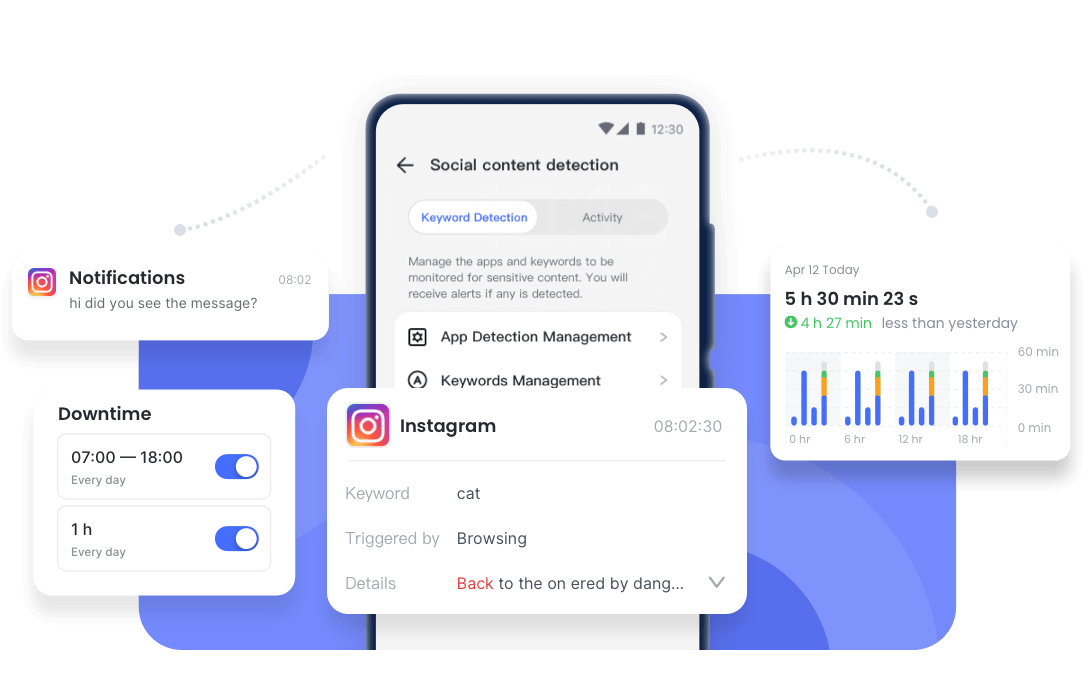
In these cases, parents need dedicated family location tools that operate independently of Instagram and don't require the child to initiate sharing each time.


Provides real-time location from the child's device to the parent's dashboard. Unlike Instagram:
- Works across apps (not dependent on Instagram usage)
- Automatic updates (no need for child to remember)
- Cross-platform (Android and iPhone)
Critical requirement: Only use with the child's knowledge. EFF emphasizes that secret monitoring violates trust and potentially laws. The most effective safety tools are ones your child understands and accepts—not ones they discover and circumvent.
Start With What's Possible, Then What's Necessary
Check Instagram Map if they've shared location. Review their recent posts for location tags. Verify account region if something seems inconsistent. For each, use what you find as a conversation starter, not surveillance evidence.
If Instagram's opt-in features don't cover your safety needs, use dedicated family location tools—with your child's knowledge, not secrecy. The goal isn't tracking their every move; it's ensuring you can help when something actually goes wrong.







Leave a Reply.