Why Traditional MDM Alerts Are No Longer Enough?
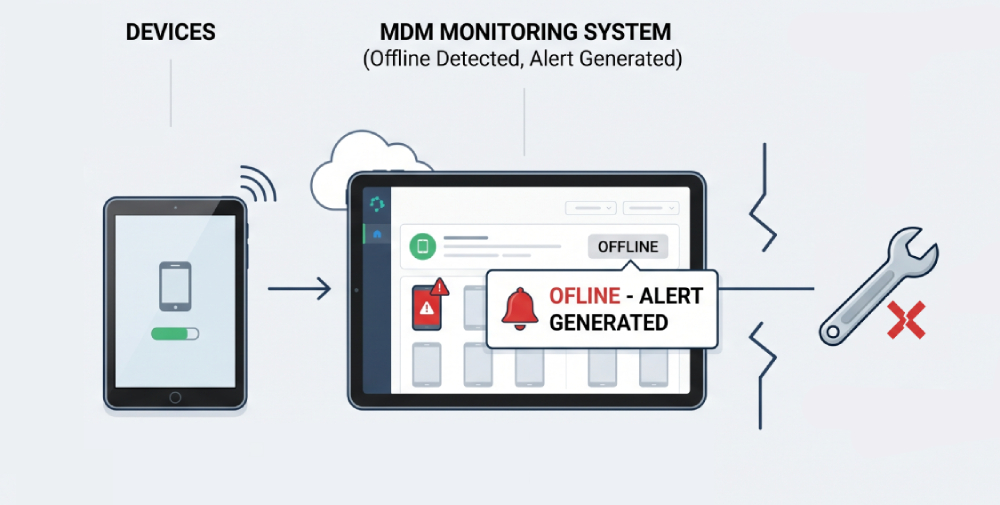
It's Monday morning, and an IT team starts the week by checking alerts from its MDM platform. Several devices across different locations went offline. The system identifies them and sends alerts, but that's where the process stops. Those devices remain offline, waiting for someone to take action.
For teams managing hundreds or thousands of devices, this is where things get difficult. Which device matters most, and what should the team do about it? Answering that means moving between dashboards, checking device details, contacting local staff, and recording what happened. That's the routine for every alert, every day.
Traditional MDM alerts help teams find device problems, but finding a problem is only the first step. As fleets grow, organizations need a better way to understand alerts, decide what to do, and manage the whole process from detection to resolution.
This is where AI-enhanced MDM is changing the way teams approach device operations.
How Traditional MDM Alerts Help IT Teams Monitor Devices
Traditional MDM has played an important role in helping organizations manage growing device environments. For many IT teams, the first challenge was simply not knowing what they had. Devices were purchased, assigned to employees, or deployed across locations, with no clear view of their current status.
MDM platforms solved this by giving teams a central place to manage device inventory, monitor status, and identify issues, without relying on scattered spreadsheets or waiting for users to report problems.
A traditional MDM platform helps IT teams:
- Maintain an up-to-date inventory of managed devices
- Monitor device status and connectivity
- Detect abnormal conditions and compliance issues
- Apply security configurations across the fleet
When conditions fall outside expected ranges, the platform sends an alert. Common triggers include devices going offline, low battery levels, outdated operating systems, or compliance violations. These alerts let teams identify device issues earlier and respond before small problems become larger disruptions.
These capabilities remain essential, but as organizations deploy more devices across more locations, visibility alone is no longer enough. Knowing a device has a problem is only the first step. Teams also need to understand the impact, determine the right response, and confirm the issue is resolved.
Why Managing More Devices Makes Alerts Harder to Handle
As device fleets grow, alert management shifts from pure detection to decision-making. Teams need to identify failures, but also understand why they happened, how critical they are, and what to do next.
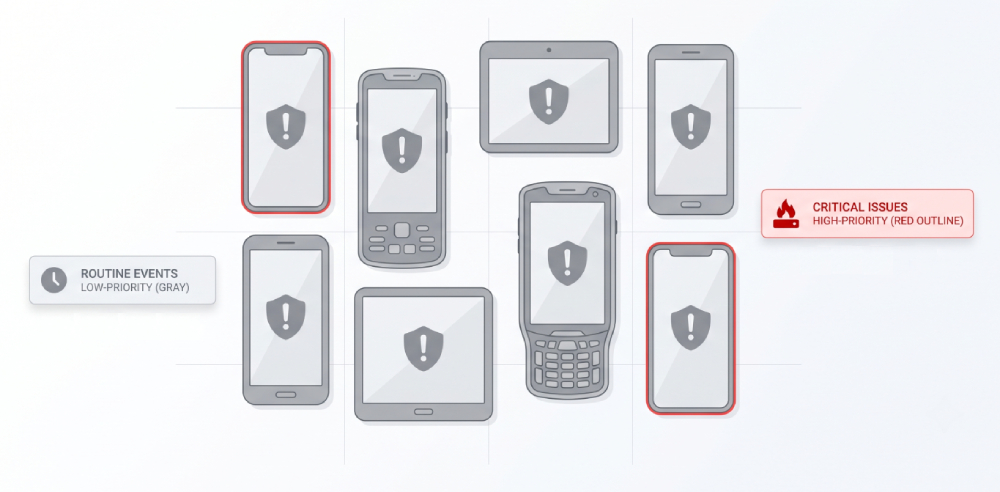
With a small number of devices, individual alerts are easy to handle. At scale, fleets of hundreds or thousands generate a continuous stream of alerts, and not all of them carry equal business impact. An offline alert from a warehouse device may demand immediate response, while the same alert from a testing device might be entirely non-urgent. Without sufficient context, teams are forced to manually sift through alerts and decide where to focus first.
This creates three challenges that become more difficult to solve as fleets scale.
1. Too many alerts, not enough context
As alert volume increases, important issues get lost in the noise.
Most alerts answer only one question: What happened? They usually do not tell teams:
- Why it happened
- How serious the impact is
- Whether this has occurred before
- What action makes sense next
Without that context, teams spend more time investigating each alert than resolving the issue behind it.
2. Manual investigation slows response
After an alert arrives, IT teams often need to work through a series of manual steps:
- Check additional device details
- Review recent changes or activity logs
- Contact users or local staff for more information
- Decide whether a remote action is possible
- Document what was done
That's manageable with a handful of devices. But when multiple alerts arrive from different locations at once, the same approach doesn't scale, and the time spent gathering context delays the actual fix.
3. Resolving issues is not the same as closing alerts
Another common challenge is that teams end up focused on clearing alerts rather than understanding the full incident.
A device might reconnect and the alert disappears, but the team may still not know:
- What caused the issue
- Which action actually resolved it
- Whether the problem is likely to repeat
- If the response process can be improved for next time
This gap between "the alert is gone" and "the problem is solved" is well documented beyond device management too. A 2026 survey of 1,039 SRE, DevOps, and IT operations professionals found that 44% of organizations experienced an outage directly linked to a suppressed or ignored alert in the past year, and 78% had at least one incident where no alert fired at all, leaving teams to discover the failure only after it had already caused impact.
Clearing an alert queue and resolving the underlying issue are not the same task. Treating them as one is what lets the same problem come back unnoticed.
Quick self-check: Is your alert process ready to scale?
Sign | Yes | Not yet |
|---|---|---|
| We spend significant time reviewing alerts that turn out to be low priority | ||
| Most alerts tell us what happened, but not why or how urgent it is | ||
| After an alert, we need to check multiple places to understand the device context | ||
| We rely on calls, messages, or manual checks to decide what action to take | ||
| Some alerts are closed without understanding the root cause | ||
| We cannot easily track who handled an issue and whether the fix worked over time |
When several of these feel familiar, it usually means the alert process was built for a smaller device footprint than the one it's running today.
Why Modern Device Management Requires More Than Monitoring
The previous section outlined why alert volume becomes unmanageable as fleets scale. The deeper issue is what those alerts are designed to answer in the first place. Traditional MDM platforms focus on a specific set of questions about device state:
- What devices are under management?
- Where are they located?
- Are they currently online?
- Are they running an expected operating system version?
- Are they compliant with security policies?
These questions describe device state, not operational outcomes. Monitoring isn't obsolete, but it's incomplete for distributed device environments (multiple offices, retail locations, warehouses, or field sites), where what matters after an alert is impact, priority, and action instead:
- Is this device critical to current business operations?
- How many devices or users are affected?
- Has this problem occurred before, and what was done last time?
- Who is responsible for responding?
- What action is appropriate: remote fix, on-site visit, or further investigation?
- Has the issue been fully resolved, or only temporarily cleared?
This is the core difference between device monitoring and device operations. Visibility is the starting point. Operational reliability is the outcome teams need.
Building a Complete Process Around Device Issues
Moving from seeing problems to resolving them requires a process that carries each issue from detection through to a confirmed outcome. Without one, what happens after an alert depends on who receives it and what they happen to know about the device. That variability becomes harder to manage as fleets scale.
A device operations approach treats each issue as part of a continuous workflow:
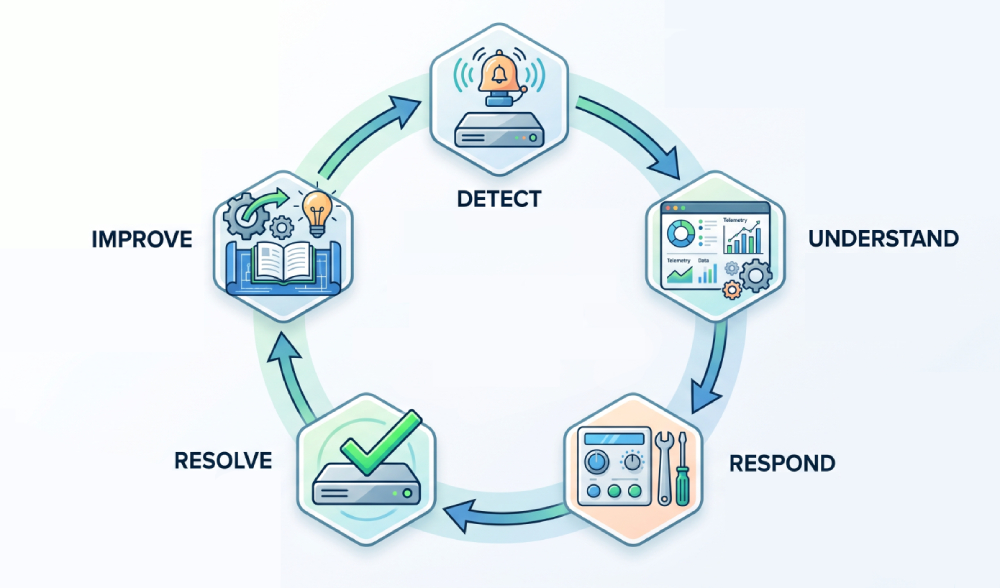
- Detect: something abnormal is identified, such as a device going offline, a battery dropping low, or a compliance violation. Detection is what traditional MDM does well, but an alert is a signal, not yet a diagnosis.
- Understand: teams add context, such as device type, location, whether it supports critical operations, and whether this has happened before. Without it, every alert looks the same.
- Respond: with context in hand, the team decides what to do. Not every alert deserves the same effort, so this stage routes each issue toward the right action.
- Resolve: closing an alert isn't the same as resolving an issue. A device might reconnect on its own, but if no one knows why it disconnected, the problem will likely repeat.
- Improve: every resolved issue is information that sharpens future responses, showing which problems recur and which fixes actually work.
- Which device types or locations generate the most issues?
- Which response actions produce the fastest resolution?
- Are there recurring problems that could be addressed with a configuration change or policy update?
Stage | Without a defined process | With a device operations approach |
|---|---|---|
| Detect | Alert appears in dashboard | Alert appears in dashboard |
| Understand | Team manually checks device details, location, history across multiple tools | Context is available alongside the alert |
| Respond | Team decides on action based on who is available and what they know | Issue is routed to the right response based on impact and type |
| Resolve | Alert clears; team assumes issue is fixed | Team confirms resolution and records what was done |
| Improve | No structured record; patterns may go unnoticed | Resolution data is captured and used to refine future responses |
The left column shows what happens when tools and processes built for a smaller environment are never updated as the fleet grows.
Why This Shift Matters Now
Device environments aren't just growing in size. They're becoming more embedded in daily operations. A field service tablet that can't connect affects customer appointments. A retail kiosk that goes offline affects revenue. A shared device in a healthcare setting that falls out of compliance affects patient care and regulatory standing.
Consistently moving from detection to resolution, tracking what happened, and preventing issues from recurring now matters as much as detecting the problem in the first place.
How AI-Enhanced MDM Helps Teams Move from Alerts to Action
If the challenge is no longer detecting problems, the next question is how teams reduce the manual effort between detection and resolution. AI-enhanced MDM changes this equation, not by generating more alerts but by helping teams move faster through the stages that follow.
Adding context so teams know where to focus
An alert rarely tells the full story. A warehouse handheld going offline during a shift pick might need immediate attention. The same offline status from a device in a testing lab might not matter at all. But when both arrive as identical notifications, teams have to manually investigate each one to tell them apart.
AI-enhanced MDM can bring relevant context together the moment an alert appears: location, whether the device supports business-critical tasks, whether it has shown the same behavior before, and whether the previous fix worked. Teams still make the call, but they start from a clearer picture instead of checking multiple dashboards and message threads first.
Automating repetitive steps that do not need manual decisions
An offline retail kiosk might always require notifying the store manager, checking whether the device responds to a remote command, and logging the incident. These steps are necessary, but they don't require a new decision every time, and this kind of routine coordination adds up. A 2026 survey of 718 IT professionals found that the average IT team loses 35% of its working time to manual, repetitive tasks, with nearly a quarter of respondents spending 40 to 60% of their day on this kind of work.
After identifying an issue that needs attention, teams often perform the same coordination tasks repeatedly. An offline retail kiosk might always require notifying the store manager, checking whether the device responds to a remote command, and logging the incident. These steps are necessary, but they do not require a new decision every time.
AI-enhanced MDM can automate these routine actions into a consistent workflow: notify the right person, collect device data, trigger a predefined troubleshooting step, and record what was done. The IT team stays in the loop. What disappears is the manual work of executing steps that are already known, which matters most across multiple time zones or locations with varying on-site staff availability.
Turning resolved issues into operational knowledge
A device issue that gets resolved but never analyzed is a missed opportunity. If the same model of field service tablet keeps disconnecting at one site, that pattern is worth knowing. AI can help organize incident details and surface recurring patterns, so teams can answer questions like:
This turns device operations from a series of isolated responses into a process that improves with experience.
From reactive monitoring to operational reliability
Traditional MDM helps teams answer: What is happening with our devices? AI-enhanced MDM helps teams move toward: What should we do next, and how do we make this process more efficient over time?
As device fleets expand across more locations and support more business-critical functions, the ability to move quickly from detection to action becomes a defining part of operational reliability. AirDroid Business is moving toward this model by bringing together device visibility, automation, and AI-powered assistance to support more efficient device operations.
Turn Device Alerts into Automated Actions
Reduce manual investigation and response time with AI-enhanced device management. AirDroid Business helps IT teams detect, respond, and resolve device issues more efficiently.
Final Words
For years, the goal of device management was straightforward: know what devices you have, track their status, and receive alerts when something goes wrong. That foundation gave IT teams visibility they didn't have before.
But as device fleets grow and become more embedded in daily operations, keeping devices reliably operational at scale matters more than simply detecting problems.
Traditional focus | Modern focus |
|---|---|
| Monitor device status | Maintain operational reliability |
| Detect problems | Understand impact and prioritize response |
| Send alerts | Coordinate actions and confirm resolution |
| Close incidents | Learn and improve over time |
Device operations builds an operational layer on top of monitoring rather than replacing it. Visibility tells teams when something is wrong; device operations makes sure something gets done about it.
As devices increasingly affect customer experience, revenue, and business continuity, downtime is no longer just an IT issue. Moving from detection to resolution, consistently and at scale, is becoming the real measure of effective device management.
AirDroid Business is moving toward this model, bringing together device visibility, automation, and AI-powered assistance to help teams resolve issues faster and keep device environments running as fleets grow.









Leave a Reply.