Depending on the child device and tool, you may be able to review app and website use, screen-time patterns, location, safety alerts, and selected device activity. Android generally supports deeper device-level monitoring, while iPhone focuses more on reports, controls, location, and selected safety signals.
How to Monitor Child's Phone Activity Remotely (Android & iPhone)
You can review your child’s app and website use, screen-time patterns, location, and selected safety signals with built-in tools or a parental-control app. What you can monitor remotely depends mainly on your child’s device, the permissions enabled, and the setup completed.
Monitoring works best when it is focused on a clear concern, rather than on reviewing every private action. Whether you are trying to understand a habit, adjust a rule, check location, or get more context about a safety issue, start with the information that can answer your concern. Be clear with your child about what you can see and why.
Table of Contents
- What Do You Want to Monitor and Why?
- Start with the Monitoring Tools Already on the Phone
- When Built-In Monitoring Tools Aren’t Enough
- What AirDroid Can Monitor on Android and iPhone
- How to Set Up Phone Activity Monitoring
- Why Phone Activity May Be Missing or Delayed
- Use Monitoring Data to Decide What to Do Next
- Frequently Asked Questions
What Do You Want to Monitor and Why?
Before you choose a tool, decide what you need the activity data to help you understand or change. Your goal may be to understand daily use, set or adjust a rule, check location or safety signals, or get more context about a specific concern.
Understand Usage Patterns
Use activity reports to see how long your child uses the phone, which apps or websites take the most time, and whether use increases around bedtime, school, or homework. Patterns across several days are usually more useful than one isolated total. Reports show supported activity, not everything your child viewed, typed, or discussed.
Set or Adjust Controls
You may already know that you want to limit late-night use or restrict a distracting app. In other cases, you may review activity first and add a rule only when a pattern becomes a problem. Controls may include app limits, phone-free schedules, website restrictions, and download or purchase rules.
Check Location or Safety Signals
Live location, route history, geofence alerts, and supported image or content alerts can help you check whether something needs attention. Treat an alert as a reason to review the context, not as proof that something harmful has happened.
Get More Context for a Specific Concern
Notifications, calls and SMS, supported social or AI activity, live screen, camera, and one-way audio may provide more context. These features require deeper access, depend on permissions and setup, and differ significantly between Android and iPhone. Use only the level of access that matches the concern.
Once you know what you need to monitor, check whether your child’s phone already provides that information.
Start with the Monitoring Tools Already on the Phone
Built-in tools may already meet some of your needs. Apple Screen Time covers iPhone usage reports and native controls, while Find My provides family location sharing and location-based arrival or departure notifications. Google Family Link combines Android usage reports, controls, location, and alerts for saved family places. Neither is designed for the deeper device-level context that some third-party tools can provide.
Apple Screen Time: Understand iPhone Usage and Apply Native Controls
After App & Website Activity is enabled, Screen Time can show time spent in apps and on websites, device pickups, and the number of notifications.
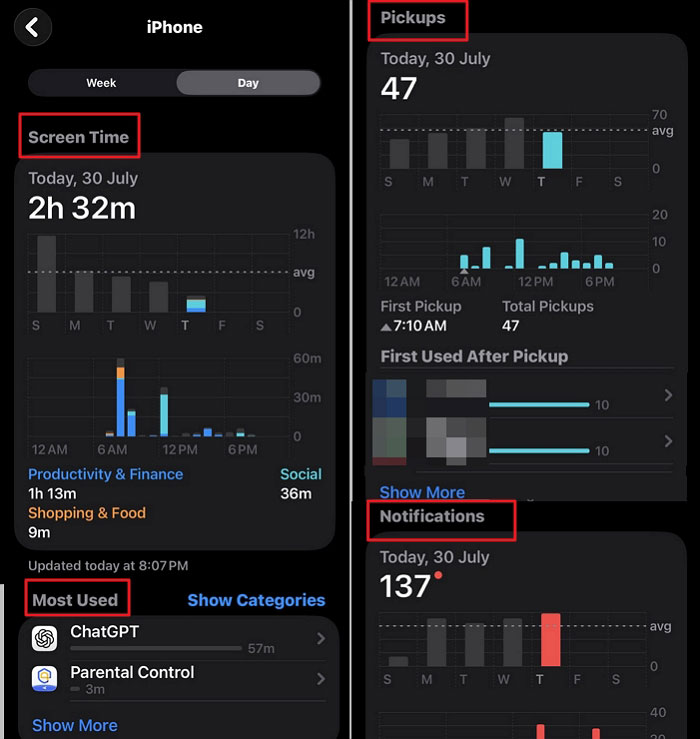
If a habit needs to change, you can also use App Limits, Downtime, and Content & Privacy Restrictions.
Remote management is built around Apple Family Sharing. If you use only Android, you cannot manage your child’s Screen Time from your phone in the same way.
Location is handled separately through Find My rather than Screen Time. With location sharing enabled, you can view a family member’s location and set one-time or recurring notifications for when they arrive at, leave, or are not at a selected place. The person whose location is being used must approve recurring notifications before they take effect.
Google Family Link: Monitor Android Usage, Controls, and Location
Family Link can show app activity and the location of a supervised Android child device when location sharing is enabled. You can set daily or app-specific limits, create schedules, manage apps, and adjust Google Play settings.
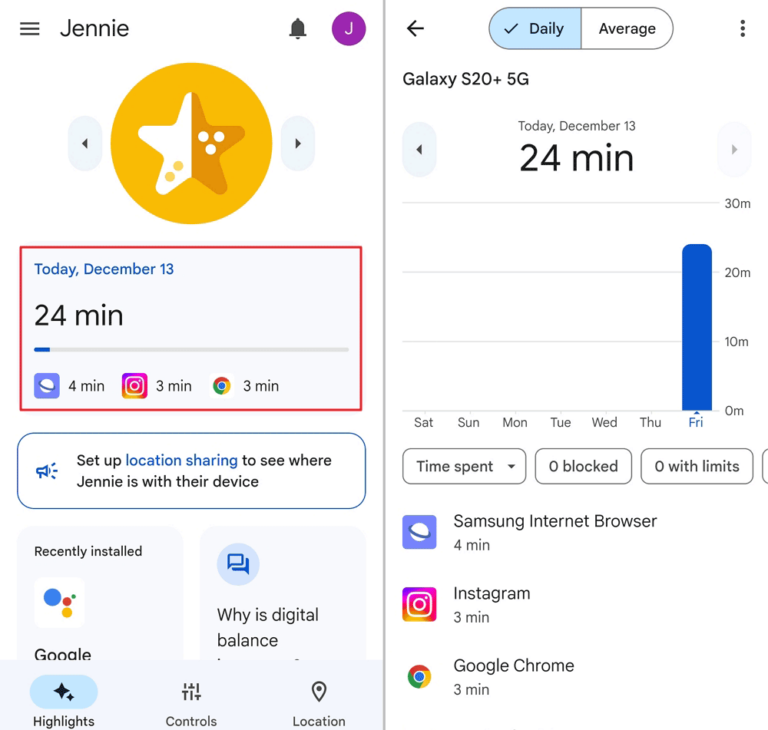
It also allows you to create saved family places, such as home or school, and receive alerts when the child device arrives or leaves.
The Family Link parent app works on Android and iPhone, but that only changes where you manage the account. A child’s iPhone or iPad cannot be supervised in the same way as an Android child device.
Use Manual Checks for a Specific Question
Safari history, App Store purchase history, Google Account activity, and the installed-app list may answer one narrow question. These records may be local, linked to one account, removable, or unable to show what happened inside an app. They are not a complete ongoing activity report.
If a built-in tool covers your goal, you may not need another app. If it does not, identify what is missing, such as cross-platform access, shared caregiver access, safety alerts, or deeper context.
When Built-In Monitoring Tools Aren’t Enough
A third-party parental-control app becomes more useful when the missing piece is remote access, cross-platform management, shared family access, safety alerts, or deeper context on a supported child device.
You may need another tool if:
- You and your child use different operating systems.
- You cannot review the built-in reports remotely from your own device.
- Another parent or caregiver needs separate access.
- You manage several children or a mix of Android and iPhone devices.
- You want usage, website, location, and supported safety information in one place.
- The built-in tool does not provide the alert or device context required by a specific concern.
Before choosing an app, confirm what it provides on your child’s operating system. Also check whether a feature gives you a usage summary, stored history, a safety alert, a remote control, or live access, and whether setup requires physical access, extra permissions, a configuration profile, a computer connection, or a supervised-device mode.
Choose the service that fills the specific gap left by the built-in tool, not simply the one with the longest feature list.
Once you know what is missing, you may check whether AirDroid can provide the monitoring, controls, or safety information you need on your child’s Android or iPhone device.
What AirDroid Can Monitor on Android and iPhone
AirDroid Parental Control can help you understand phone-use patterns, apply supported controls, check location and safety signals, and get more context about specific concerns.
It supports child devices running Android 8.0 and later and iOS 16 and later. You can use the parent app on Android or iPhone, or access the dashboard from a web browser. Available features depend mainly on your child’s operating system and setup.
For a Child’s Android Device Running Android 8.0 or Later
- Review daily and weekly device and app activity reports, plus supported website history.
- Set app limits, Downtime, Focus Mode, website filtering, and website time limits.
- View live location and route history, create geofences.
- Receive supported image, social, AI, and SMS safety alerts for porn, cyberbully and so on.
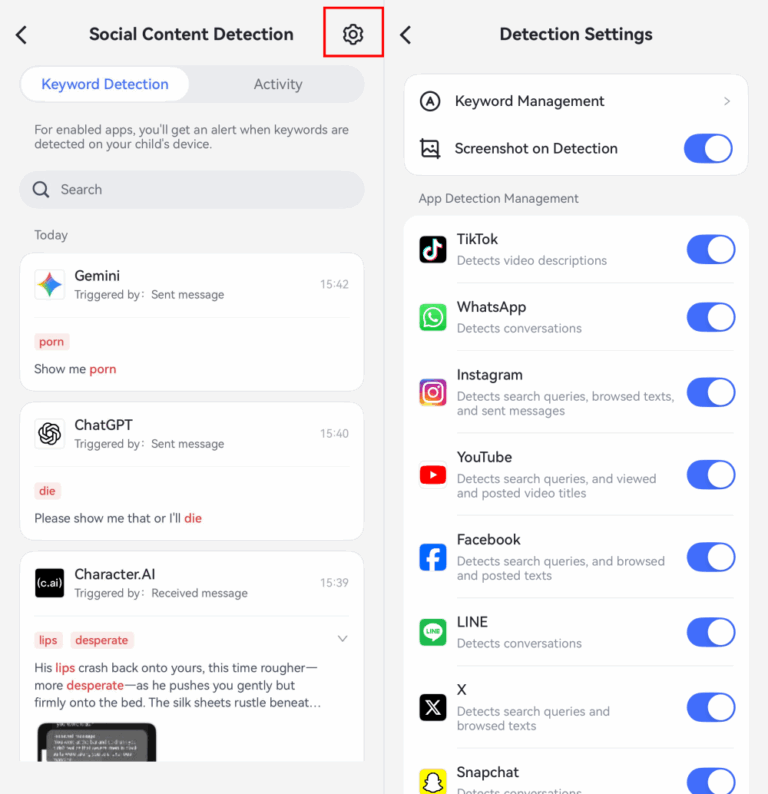

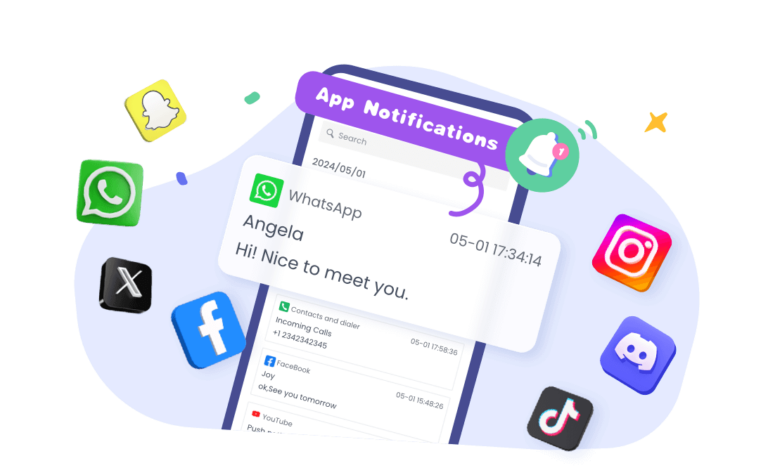
- Review supported notifications, SMS insights, incoming-call records, and selected social or AI activity, and block selected phone numbers.

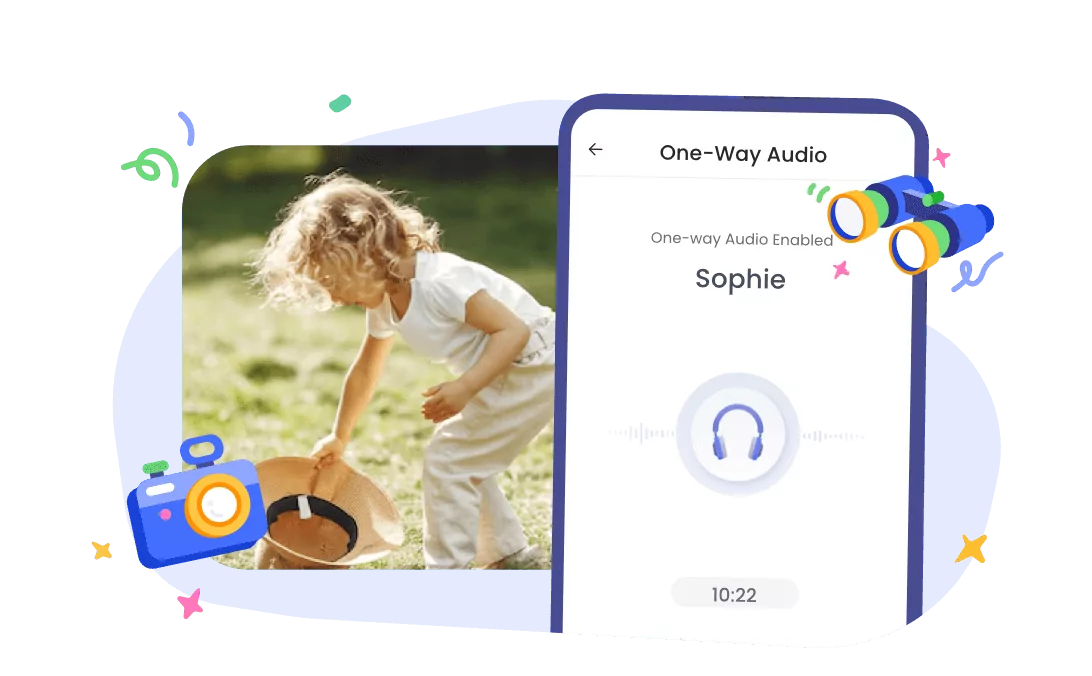
- Live Screen, Remote Camera, and One-Way Audio are on-demand features. They require the relevant permissions and an active, responsive child device, and they do not create continuous history.
For a Child’s Device Running iOS 16 or Later
- Review daily and weekly device and app activity reports.
- View supported website history separately in the app.
- Set app limits, Downtime, Focus Mode, website filtering, and website time limits.
- View live location and route history and create geofences.
- Receive real-time alerts for supported images in the Photos library, and monitor supported YouTube activity and keywords.
- When your child triggers SOS, receive the available location and a 15-second recording of the surrounding sound.
Location updates depend on location permission, background access, connectivity, and device availability. If the child device cannot send a new location, you may temporarily see the last updated position. Safety alerts cover supported sources and may be delayed by a weak connection; they do not provide full context by themselves.
Use the features that address your concern and reconsider that level of access as your child becomes more independent. You can even manage a child’s iPhone from Android.
A third-party review from Phandroid has also highlighted AirDroid’s usage reporting, location and geofencing, content alerts, and Android remote-monitoring tools.
How to Set Up Phone Activity Monitoring
If AirDroid provides the information or control you need, follow the setup path for your child’s operating system.
For an Android 8.0 or Later Child Device
- Step 1. Install AirDroid Parental Control on your phone and sign in.
- Step 2. Install AirDroid Kids on your child’s Android device and enter the binding code.
- Step 3. Grant the separate permissions or device settings required for the reports, location, notifications, and live-access features you select.
- Step 4. Complete the device-specific background, battery, and data settings.
- Step 5. Confirm that the expected report, alert, or live feature is updating.
For an iPhone or iPad Running iOS 16 or Later
- Step 1. Install AirDroid Parental Control on your phone and AirDroid Kids on your child’s device, then complete binding.
- Step 2. Allow the required location access and complete the basic iPhone setup.
- Step 3. Check whether the selected features are available after basic setup.
- Step 4. If a report or control requires Supervision Mode, enable it with AirDroid Parental Connector.
- Step 5. Confirm that the expected information appears in the parent dashboard.
- Step 6. Check the requirement for each report, alert, control, or live-access feature because binding the child app does not activate every feature.
Why Phone Activity May Be Missing or Delayed
If expected activity is missing, check the following before changing tools or repeating the setup.
The Child Device Is Offline
Reports, location, and alerts need an internet connection. New information may appear after the device reconnects.
A Permission or Background Setting Changed
Location access, Accessibility permissions, battery optimization, background activity, and mobile-data restrictions can affect monitoring. Android may also reset permissions or limit an app that has not been opened recently.
The Required Setup Is Incomplete
Some iPhone reports and controls require Supervision Mode. Installing AirDroid Kids alone does not confirm that the required profile, permission, or setup mode is active.
The Child App Was Removed or Unbound
New activity may stop if AirDroid Kids is deleted, disabled, linked to the wrong child profile, or disconnected from the parent account.
Different Features Update in Different Ways
On both platforms, Activity Reports may refresh shortly after synchronization but remain summaries, not an event-by-event feed. Location, alerts, history, and live-access features update differently. Offline devices, incomplete permissions, unsupported activity, or weak connections may cause delays or gaps.
Check that the device is online and bound, required permissions and background access are enabled, and the correct setup mode is active. Also confirm whether the feature provides a usage summary, alert, history, control, or live access.
Use Monitoring Data to Decide What to Do Next
A report or alert is useful only when it helps you decide what to do next.
Look for Repeated Patterns
One late night, one unfamiliar website, or one unusually long session may have an ordinary explanation. Check whether the pattern continues before changing a rule.
Check the Context Behind Alerts
An alert may reflect something your child received rather than searched for or created. Review the available context and talk with your child before drawing a conclusion.
Match the Response to the Concern
A screen-time problem may need a schedule or app limit. A location concern may need a clearer check-in plan. Use deeper monitoring only when you genuinely need more context.
Review the Arrangement Over Time
When the concern is resolved or your child shows greater responsibility, reduce or adjust the level of monitoring.
Frequently Asked Questions
What Phone Activity Can I Monitor?
Can I Monitor My Child’s Phone Remotely?
Yes. What you can review depends on your child’s operating system, permissions, setup, connectivity, and whether the feature provides a report, alert, history, control, or live view.
What Is the Difference Between an Activity Report and Live Monitoring?
An activity report summarizes supported data and may refresh after synchronization; it is not an event-by-event feed. Live monitoring shows information available at that moment, such as current location or a live screen.
Can I Monitor Calls, Texts, or Social Media?
This depends mainly on the child device. On supported Android devices, AirDroid can provide incoming-call records, SMS insights, notification monitoring, and selected social or AI activity. On iPhone, current safety coverage focuses on supported YouTube activity and image alerts.
Why Has My Child’s Activity Stopped Updating?
The device may be offline, a permission or background setting may have changed, setup may be incomplete, or AirDroid Kids may have been removed or unbound. A weak connection can also delay reports and alerts.
Sources and Review
- Apple: Use Screen Time to Manage Your Child’s iPhone or iPad
- Apple: Get Notified When a Friend’s Location Changes in Find My
- Google: Sign Your Child In on an iPhone or iPad
- Google: Find and Manage Your Child’s Location with Family Link
- Google: Learn Which Devices Can Be Supervised
- Phandroid: Android Parental Control Review of AirDroid
- Mobicip: AirDroid Parental Control App Review 2026
- Research: Protection or Punishment? Parental-Control Design and Family Perceptions
Platform and product claims were checked on July 30, 2026. Apple and Google sources support the built-in tool descriptions.







Leave a Reply.