AirDroid Parental Control
24/7 Kids' Guardian via App & Web
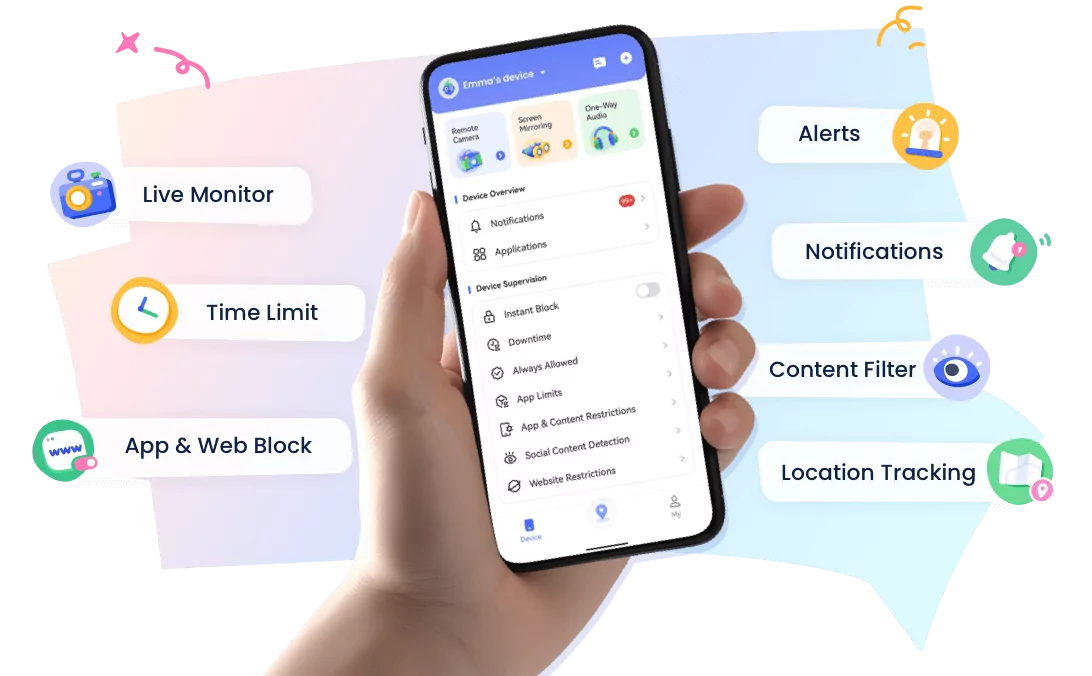
- 👀Live surroundings and location tracking
- 🔞Content Monitoring and App/Web Blocking
- ⚠Instant alerts for online risks and geofences
- ⌛Screen time control and monitor
mSpy VS Bark: Which one is Better?
Parental control apps like mSpy and Bark are often mentioned, but they are designed with very different ideas in mind. Choosing between them isn't just about features; it's about how much control and privacy you want in everyday parenting.
In this article, we'll compare mSpy and Bark to help you understand how each app works, where they differ, and which one may be a better fit for your family's needs.
What is mSpy?
Mspy is a phone monitoring app designed to give parents deep access to a child's device activity. It works in the background and allows parents to see what's happening on a phone remotely through an online dashboard.
With mSpy, parents can monitor things like calls, text messages, contacts, browser history, photos, videos, and installed apps. It also supports tracking activity on popular social and messaging platforms such as WhatsApp, Instagram, Snapchat, TikTok, Telegram, and Discord. mSpy also offers GPS location tracking and location history, which helps parents understand where their child has been throughout the day.
mSpy provides surroundings listening, remote camera access, live screen streaming, screenshot capture, and keylogging, which records everything typed on the device. mSpy also lets parents track keywords, view detailed activity timelines, and block apps, websites, or even specific Wi-Fi networks. Some versions even claim to monitor AI tools like ChatGPT and Gemini.
What is Bark?
Bark is a parental control app that focuses on detecting potential risks rather than showing parents everything their child does on a phone. Instead of full access to messages or apps, Bark uses automated systems to scan digital activity and alert parents when something may be wrong.
Bark monitors texts, emails, and supported social media platforms for signs of issues such as cyberbullying, self-harm, sexual content, drug use, and online predators. When Bark detects content that could indicate a problem, it sends parents an alert with a brief explanation and limited context. The goal is to help parents step in early without constantly checking their child's private conversations.
Features Comparison: mSpy VS Bark
- Detailed Comparison






- Google Play Store Rating3.1
3.6
- Pricing$10.00 / month(billed annually)$14.00/month
- Monitor Calls & MessagesRead More


 mspy can record incoming and outgoing calls, and view all SMS your child received.Bark does not provide call history monitoring, and it alerts parents only if it detects something inappropriate in texts.
 - Screen Time

- Block Websites & Apps
- Watch and Listen to Surroundings
- Live Location
- AI Monitoring
- Block Wifi
Social Media Monitoring: mSpy vs Bark
Bark: Bark mainly focuses on scanning texts, emails, and social media to spot risks like bullying or online predators. It's great at sending alerts, but it doesn't offer much real-time tracking.
mSpy: mSpy gives parents deep access to their child's social apps, and parents can even see deleted content.
mSpy
mSpy allows parents to see all conversations their child has with others on many popular social platforms. Parents can read messages, view chat histories, and see contact details such as names and numbers. On some platforms, mSpy can also show call records. The platforms mSpy monitors include WhatsApp, TikTok, Viber, LINE, Telegram, Facebook, Instagram, Snapchat, Tinder, Discord, and Kik. Among these, call records can be monitored on apps like WhatsApp, TikTok, Viber, and LINE. This makes mSpy appealing to parents who want full context and prefer to review conversations.
Bark
Bark supports monitoring across 30+ social media platforms, including well-known apps like WhatsApp, Facebook, Snapchat, Spotify, and YouTube. However, Bark does not show full conversations or contact lists. Instead, it scans messages and activity for signs of harmful or inappropriate content. Only when something risky is detected does Bark send an alert to parents, usually with a short explanation and partial context. If the content appears normal, parents won't see it at all.
Web Filtering: mSpy vs Bark
mSpy
mSpy allows parents to block specific websites, but it does not support automatic filtering by website categories. This means parents need to know exactly which sites they want to block and add them manually. If a new site appears, mSpy won't block it unless parents add it themselves.
Parents can also check their child's browsing history and browser bookmarks, view their child's search terms, and click on the links their child has visited. mSpy also allows parents to see top visited websites of the kid.
Bark
Bark can automatically group websites into categories such as adult content, violence, or gambling. Parents can then allow or block entire categories at once. For many families, this feels more practical and less time-consuming, especially as kids explore new sites all the time.
App Blocking: mSpy vs Bark
mSpy
mSpy gives parents stronger control over apps on the device. It can block specific apps even built-in apps like the camera. If parents want to limit certain functions completely, it may be useful.
Bark
Bark's app control is more limited. Bark can't block specific apps; it only allows parents to pause internet access. When the internet is paused, online apps stop working, but offline apps and specific system features can not be blocked directly. If a parent wants to block an app, Bark is limited.
Calls and Messages Monitoring: mSpy vs Bark
mSpy
mSpy allows parents to record both incoming and outgoing calls, not just call history. Also, mSpy monitors all sent and received text messages, so parents can see the complete message content instead of summaries or alerts. Parents can read conversations at any time through the dashboard. It can be helpful in serious situations where parents feel they need full visibility. But it also means mSpy is more like a surveillance tool than a traditional parental control app. For everyday use, some families may find this approach too intrusive, especially for older children.
Bark
Bark does not support call monitoring at all. Parents cannot see call logs, listen to calls, or know who their child is talking to on the phone. For text messages, Bark does not show full conversations either. Instead, it only sends parents an alert when it detects potentially harmful or risky content, such as bullying, sexual topics, or self-harm. If no risk is detected, parents see nothing. Bark protects a child's privacy and encourages trust, but it also means parents may lack full context.
mSpy and Bark's Alternative
For parents who feel mSpy goes too far and Bark doesn't go far enough, AirDroid Parental Control often feels like the most realistic choice.




Location Tracking: mSpy vs Bark
mSpy
mSpy allows parents to view a child's real-time location at any moment and their detailed location history. It updates automatically in the background, so parents don't need to rely on the child to do anything. mSpy also supports geo-fencing, so parents can set virtual boundaries around places like home or school and receive alerts when the child enters or leaves those areas.
Bark
Bark's location tracking is more child-driven. To share their location, the child needs to manually tap "check-in" in the Bark app. Only after this action can parents see the real-time location and location history. Bark also supports geo-fencing, so parents can still set safe zones and receive alerts when kids enter or leave these boundaries.
Screen Time Management: mSpy vs Bark
mSpy
While parents can see how a phone is being used and what apps are installed, mSpy does not offer built-in tools to manage daily screen time. There are no options to set usage limits, create schedules, or automatically lock the device during certain hours.
Bark
Bark allows parents to set screen time routines such as bedtime, school time, or homework hours. During these periods, parents can pause internet access to reduce distractions and encourage focus or rest. This makes Bark more practical for families trying to build consistent habits around device use, especially on school days or at night.
Compatibility and Price
Compatibility
Bark supports iOS, Android, Windows, Mac Computers, Chromebooks, and Amazon Fire.
mSpy supports iOS and Android.
Price
mSpy
- 1 Month – $48.99/mo*
- 3 Months – $27.99/mo*
- 12 Months – $11.66/mo*
- Free trial: No. But there's a demo on its official website.
- Money-back guarantee: You can request a refund within 14 days of purchase.
Bark
- Bark Jr: $5.00 / month or $49/year
- Bark Premium: $14.00 / month, or $99/year
- Free trial: 7 days
- Money-back guarantee: No. Bark doesn't mention it on its official website.
All plans support unlimited devices, but features vary widely.
Conclusion
mSpy focuses on deep monitoring and full access, allowing parents to see calls, messages, social media activity, and location data in detail. This can be helpful in serious situations where parents feel they need complete visibility, but it may also feel invasive for everyday use, especially with older kids and teens.
Bark puts privacy and trust first. Instead of showing everything, it scans online activity for potential risks and only sends alerts when something concerning appears. This makes Bark a better fit for families who want to stay informed without reading private conversations or closely tracking every action.
In the end, the right choice depends on your parenting style and your child's needs. If full control and detailed monitoring are your top priorities, mSpy may be the better option. If you prefer a lighter, alert-based approach that encourages communication and independence, Bark is likely the more suitable choice.










Leave a Reply.