What Is Event-Driven Automation in MDM? Turning Device Events into Context-Aware Workflows
Enterprise IT teams do not need more alerts. They need a better way to respond when device conditions change.
In mobile device management, or MDM, managed devices constantly generate signals: online status changes, app behavior changes, Kiosk state changes, location events, battery thresholds, network conditions, storage status, and policy updates. These signals are useful only when IT teams can turn them into the right operational response.
Traditional MDM operations often depend on scheduled checks, static alerts, and manual follow-up. That works for routine reporting, but it can be too slow or inconsistent when device issues affect business operations.
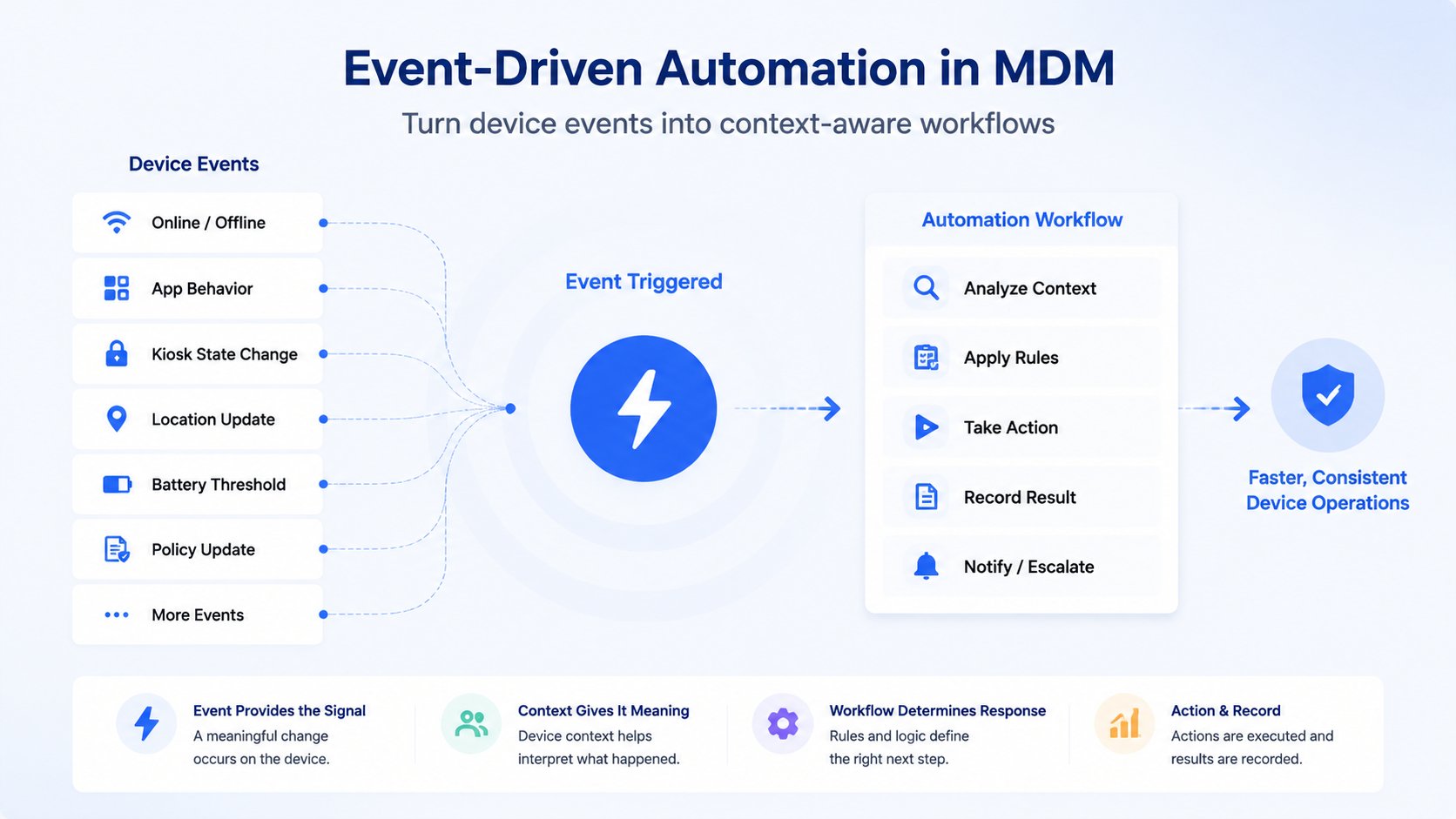
Event-driven automation in MDM helps IT teams turn device events into context-aware workflows. Instead of waiting for the next scheduled check, a device event can trigger a workflow that reads context, applies rules, routes the issue, prepares the next step, and records the result.
The goal is not to automate every device decision. The goal is to make common device operations faster, more consistent, and easier to review.
Device events tell IT teams what changed. Context helps determine what it means. Workflows define what happens next.
- Part 1: What Is Event-Driven Automation in MDM?
- Part 2: Why Traditional MDM Automation Falls Short
- Part 3: Event-Driven Automation vs Scheduled Automation
- Part 4: A Practical Framework for Event-Driven MDM Workflows
- Part 5: How ABEvent Variables and AI Workflow Support Event-Driven MDM
- Part 6: Use Cases: Examples of Event-Driven MDM Workflows
- Part 7: Best Practices for Event-Driven MDM Automation
- Part 8: How AirDroid Business Supports Event-Driven Device Operations
- Part 9: Conclusion: From Device Events to Context-Aware Workflows
- FAQs
Part 1: What Is Event-Driven Automation in MDM?
Event-driven automation is an automation model where a workflow or process is triggered when a specific event occurs, instead of waiting for a manual action or scheduled task.
In simple terms:
Event-driven automation starts a predefined response when something meaningful changes.
That change may be a system condition, user action, status update, threshold crossing, policy change, or device signal. The workflow then determines the appropriate next step.
In a general IT environment, event-driven automation may be used across infrastructure monitoring, security operations, service management, DevOps, or application workflows. In MDM, the focus is more specific: managed device events trigger operational workflows for IT teams.
This article focuses on event-driven automation for mobile device management, not event-driven software architecture.
1A Simple Definition of Event-Driven Automation
Event-driven automation is a workflow automation approach where an event triggers a predefined response process.
The response process may include:
- Notifying the right team.
- Creating a report.
- Exporting affected devices.
- Routing the issue for review.
- Starting a troubleshooting workflow.
- Preparing an approved device action.
- Recording the workflow result.
The defining characteristic is the trigger. The workflow starts because an event occurred, not because a scheduled time arrived.
2What Event-Driven Automation Means in MDM
In MDM, event-driven automation uses managed device events — such as status, app, Kiosk, location, battery, network, storage, or policy changes — to trigger predefined workflows for IT operations.
A device event may come from a change in device state, app behavior, Kiosk status, location, network usage, battery level, storage condition, policy status, or configuration state.
An alert is the notification. The event is the underlying device condition that starts the workflow.
The key difference is that event-driven automation does not stop at visibility. It helps IT teams move from “something happened” to “what should happen next.”
In this model:
- The event provides the signal.
- Device context helps interpret the signal.
- Workflow rules determine the response path.
- Actions or notifications are triggered based on configuration.
- Results are recorded for review.
That makes event-driven automation useful for distributed device environments where IT teams cannot manually watch every device in real time.
3What Counts as a Device Event in MDM?
A device event in MDM is a meaningful change in device state, app behavior, location, policy status, or operating condition.
Common categories of MDM device events include:
- Device status events: online or offline status changes, device check-in failures, enrollment changes, group changes, agent status changes, or permission changes.
- App and Kiosk events: required app status changes, business app foreground status, Kiosk status changes, Kiosk profile mismatch, or unexpected exit from a locked-down experience.
- Location, battery, storage, and network events: geofence entry or exit, low battery, storage thresholds, mobile data limits, network status changes, or abnormal network usage.
- Policy and configuration events: policy status changes, configuration mismatch, failed profile application, unexpected group assignment, or security-related setting changes.
These events matter because a device can be online but still operating outside its intended state.
Part 2: Why Traditional MDM Automation Falls Short
Traditional MDM automation is useful, but it has limits.
Many teams start with alerts, scheduled reports, and recurring checks. These are important foundations. They help administrators understand device status, identify trends, and maintain operational visibility.
The problem is that visibility alone does not create response.
A static alert can tell IT that something happened. A scheduled report can summarize device status at a fixed time. But neither automatically determines the right next step, adds context, routes the issue, or records the outcome of a follow-up process.
1Static Alerts Create Visibility, Not Response
Alerts are useful because they surface issues. But an alert by itself often leaves several questions unanswered:
- Which devices are affected?
- Is the event urgent?
- Which team should respond?
- Is the device in production or testing?
- Should the issue be recorded, escalated, or reviewed?
- Should a device action be prepared for approval?
- How will the result be tracked?
Without a workflow, every alert becomes a manual decision. That may work at small scale. It becomes harder as the number of devices, locations, device roles, and support teams grows.
AirDroid Business - Turn Device Events into Automated Workflows
AirDroid Business helps IT teams move beyond passive monitoring by connecting device events with automated workflows. Monitor device status, configure alerts, and create structured responses for common operational tasks across distributed devices.
2Scheduled Checks Are Useful but Not Always Fast Enough
Scheduled automation runs at a fixed time or interval. It is well suited for routine tasks such as daily reports, weekly exports, inventory snapshots, and periodic device health reviews.
But scheduled checks are not designed for every operational event.
If a device condition changes shortly after a scheduled report runs, IT may not see it until the next cycle. For low-risk reporting, that may be acceptable. For operational device issues, the delay can create unnecessary risk.
Event-driven automation helps close that gap by triggering a workflow closer to the moment a meaningful device event occurs.
3Manual Follow-Up Does Not Scale
Manual follow-up often includes searching for the device, checking its group, reviewing status, confirming recent activity, notifying another team, exporting data, and documenting what happened.
These steps are repetitive. They also vary from one administrator to another.
As device fleets grow, inconsistent follow-up becomes an operational problem. Event-driven workflows help standardize the response process so teams are not rebuilding the same triage steps every time a device condition changes.
Part 3: Event-Driven Automation vs Scheduled Automation
Scheduled automation and event-driven automation are both useful. They are not replacements for each other.
They serve different operational needs.
Scheduled automation runs because time has passed. Event-driven automation runs because something changed.
- DimensionScheduled AutomationEvent-Driven Automation
- TriggerFixed time or intervalSpecific device event
- Best forRoutine reports and periodic checksDevice state changes and operational events
- Response timingWaits until the next scheduleStarts closer to the moment of change
- ContextOften based on report scopeCan use event and device context
- MDM exampleDaily inventory export or weekly health reportWorkflow triggered by a device condition change
1Scheduled Automation Runs by Time
Scheduled automation is useful for predictable work.
- It helps IT teams maintain operational rhythm through: Daily device reports.
- Weekly status summaries.
- Periodic inventory exports.
- Scheduled compliance reviews.
- Recurring battery or storage summaries.
- Routine device health checks.
These workflows are valuable because they reduce manual reporting and create consistent visibility.
2Event-Driven Automation Runs by Change
Event-driven automation is useful when the trigger is not time, but change.
A workflow begins when a device condition changes or when a defined threshold is met. This allows IT teams to respond based on operational signals rather than waiting for the next scheduled task.
Event-driven automation is most useful when the timing of the event matters.
3When to Use Each Approach
Use scheduled automation when the task is predictable, routine, and not time-sensitive.
Use event-driven automation when the workflow should begin because a device condition changed.
Many enterprise IT teams need both. Scheduled workflows create regular visibility. Event-driven workflows create faster operational response.
Part 4: A Practical Framework for Event-Driven MDM Workflows
A practical event-driven MDM model can be understood as:
Event → Context → Workflow → Action → Verification
This model helps IT teams avoid two common mistakes:
- 1. Treating every event as only a notification.
- 2. Treating every event as something that should trigger immediate action.
The right approach is more structured. An event starts the process. Context shapes the meaning. A workflow defines the next step. Actions are triggered based on configuration and approval rules. Verification records what happened.
1Event → Context → Workflow → Action → Verification
Event: What changed
The event is the signal that something changed. It may come from device status, app behavior, Kiosk status, location, battery level, storage, network usage, policy state, or configuration status.
The event answers the first question: What happened?
Context: What it means
Context helps determine whether the event matters and how it should be handled.
- Context may include:
- Device group.
- Device role.
- Device owner or support team.
- Location.
- Business hours.
- Production or test status.
- Current app or Kiosk state.
- Battery, storage, or network state.
- Recent operation history.
Context answers the second question:
What does this event mean for this device?
Workflow: What should happen next
The workflow defines the response logic.
It may check conditions, branch based on device context, route the event, notify a team, generate a report, prepare an action, or send the event to manual review.
The workflow answers:
What process should run next?
Action: What the process triggers
The action is the output of the workflow.
It may be low risk, such as a notification, report, or device list export. It may also be a controlled operational step, such as preparing a remote action for administrator approval.
The action answers:
What should the system or administrator do?
Verification: What gets recorded
Verification confirms what happened after the workflow ran.
- Workflow status.
- Affected device list.
- Trigger time.
- Action result.
- Failure reason.
- Skipped step.
- Manual review requirement.
- Operation log.
Verification answers:
What was the result, and can the team review it later?
AirDroid Business - Build Smarter Device Operations with Context-Aware Workflows
AirDroid Business combines device management, workflow automation, and AI-assisted capabilities to help IT teams understand device conditions, organize operational data, and streamline repetitive device management tasks.
2How the Workflow Runs
Event-driven MDM workflows should follow a structured sequence. This helps teams create automation that is fast enough to be useful, but controlled enough for enterprise operations.
Detect the event
The process starts when a device event is detected. The event may be generated by a device status change, alert condition, app state, Kiosk status, location change, battery threshold, storage condition, network event, or policy state.
Read the device context
After the event is detected, the workflow reads available device context. This context may include device identity, group, role, status, time, location, operating condition, app status, Kiosk status, policy state, or previous activity. The purpose is to prevent the workflow from reacting only to the event name.
Match workflow conditions
The workflow then evaluates conditions. These conditions may be based on event type, device group, device role, severity, business time window, device availability, current device state, recent event frequency, or required approval rules. This step allows the workflow to choose a path.
Trigger the configured workflow
Once conditions are matched, the workflow triggers the configured next step. Depending on product configuration, permissions, and available integrations, this may include sending a notification, generating an event summary, exporting affected devices, creating a report, routing to manual review, updating a workflow record, preparing a controlled remote action, or triggering another follow-up process. Workflow rules should reflect device risk, environment, and required approval level.
Verify and record the result
The workflow should record what happened. A complete workflow should make it possible to review which event triggered the workflow, which device was affected, what context was used, what workflow path ran, what output was generated, whether any step succeeded or failed, and whether administrator review is still required.
This closes the loop between event detection and operational accountability.
Part 5: How ABEvent Variables and AI Workflow Support Event-Driven MDM
Event-driven workflows depend on context. Without context, a workflow can only respond to a trigger. With context, it can make the response more relevant.
In the AirDroid Business and GoInsight.AI model:
- AirDroid Business provides MDM context and device events.
- ABEvent variables can provide event-specific context.
- GoInsight.AI Workflow can define the follow-up process.
This turns device events into workflow-based follow-up processes rather than isolated notifications.
1ABEvent Variables Provide Event Context
ABEvent variables can act as the context layer for event-driven MDM workflows. They help workflows understand what happened, which device was affected, and what device context should guide the next step.
A workflow does not only need to know that an event occurred. It may also need to know which device was affected, which group it belongs to, which rule triggered the event, when the event occurred, and what device state should influence the next step.
Depending on product configuration and available variables, event context may include:
- Event type.
- Device name or device ID.
- Device group.
- Alert rule.
- Trigger time.
- Location or geofence context.
- Battery, storage, or network status.
- App or Kiosk status.
- Policy or configuration context.
These variables help workflows evaluate conditions and determine the appropriate path.
2AI Workflow Defines the Follow-Up Process
If ABEvent variables describe what happened, AI Workflow defines what happens next.
A workflow can use event context to apply conditions, route the event, generate follow-up outputs, or prepare approved actions. This is where event-driven automation becomes an operational process rather than a static notification.
Depending on configuration, the workflow may:
- Check conditions.
- Notify a team.
- Generate a summary.
- Create or update a report.
- Export affected devices.
- Route the event to manual review.
- Start a troubleshooting workflow.
- Prepare a controlled follow-up action.
The workflow is where the event becomes a response process.
3Product Scope and Integration Boundaries
Before building customer-facing workflows or external claims around event variables, teams should confirm:
- Which device events can trigger workflows.
- Which ABEvent variables are available.
- Which workflow actions are supported.
- Which integrations are available.
- Which actions require administrator confirmation.
- Which permissions or plans apply.
Available event variables, workflow triggers, external integrations, and executable actions may vary by release scope, permissions, and configuration.
External integrations should be described carefully. It is safer to say:
Depending on configured workflows and available integrations, event information may be sent to collaboration tools, spreadsheets, email, or ticketing systems.
Avoid implying that every device event can be sent to every system, or that every device issue can be fixed automatically.
Enterprise IT teams need automation that is configurable, permission-aware, and traceable.
Part 6: Use Cases: Examples of Event-Driven MDM Workflows
The following examples show how device events, context, and workflows can work together in MDM.
These are workflow patterns, not universal product guarantees. Actual availability depends on MDM platform capabilities, product configuration, device permissions, workflow setup, and supported integrations.
- Use CaseDevice EventContext to CheckPossible WorkflowExpected Outcome
- Offline Device Follow-UpDevice goes offlineDevice group, last online time, business hours, device roleNotify admin, export affected devices, route to manual reviewFaster triage of unreachable devices
- Kiosk Status InspectionKiosk status changesExpected Kiosk profile, production or test status, app stateRun status check, notify IT, generate status reportIdentify devices outside expected operating state
- Business App Status RecoveryBusiness app stops runningApp importance, device role, Kiosk state, device availabilityCheck app status, notify support, prepare approved app recovery stepStandardize app troubleshooting and follow-up
These workflows do not need to automate every step. In many enterprise environments, the most valuable workflow is one that gathers context, routes the issue, prepares the next step, and records the result.
That is still automation. It reduces manual searching, filtering, copying, and follow-up while keeping administrators in control.
Part 7: Best Practices for Event-Driven MDM Automation
Event-driven automation works best when it is scoped, contextual, and governed.
The goal is not to automate every device issue. The goal is to turn common device events into repeatable response processes.
1Start with Low-Risk Workflows
Begin with workflows that do not directly change device behavior.
Good starting points include:
- Notifications.
- Device reports.
- Offline device exports.
- Battery reports.
- Kiosk status checks.
- Device inventory snapshots.
These workflows reduce manual work while helping teams build confidence in event-driven processes.
2Use Context Before Taking Action
Do not build workflows based only on event type.
- Device group.
- Device role.
- Location.
- Business hours.
- Production or test status.
- App or Kiosk context.
- Recent operation history.
Context-aware automation helps reduce false urgency and avoids unnecessary actions.
3Separate Notifications from Remediation
Notification workflows and remediation workflows should not be treated the same way.
Notification workflows are usually lower risk. They inform the right team, generate reports, or route events for review.
Remediation workflows may change device state. They may include actions such as rebooting a device, clearing app data, switching configurations, locking a device, or starting another operational process.
Keep these workflows separate. Start with visibility and routing, then introduce controlled actions gradually.
4Require Approval for High-Impact Actions
High-impact actions should follow stronger guardrails.
- Rebooting a device.
- Clearing app data or cache.
- Locking or powering off a device.
- Switching a critical configuration.
- Factory reset or unenrollment.
For production devices, event-driven automation should be governed by role-based permissions, approval workflows, and operation logs.
A workflow can prepare the action, show affected devices, summarize the reason, and request administrator confirmation before execution.
AI can assist by summarizing event context, identifying affected devices, explaining device status, and suggesting possible next steps. But AI should not become unchecked execution. High-impact actions should remain permission-based, auditable, and under administrator control.
5Keep Workflows Traceable and Reviewable
Event-driven automation should be traceable.
Workflow logs should help teams review:
- What event occurred.
- Which device was affected.
- Which workflow ran.
- What output was generated.
- Whether the workflow succeeded, failed, or was skipped.
- Whether manual review is still required.
This is especially important for distributed device fleets where multiple administrators, regions, or support teams may be involved.
IT teams should also review workflows over time, including trigger frequency, success rates, repeated device issues, false positives, manual review cases, common failure reasons, and whether the workflow still matches operational needs.
Over time, recurring processes can become reusable automation templates. This helps teams standardize response without rebuilding every workflow from scratch.
Part 8: How AirDroid Business Supports Event-Driven Device Operations
AirDroid Business helps IT teams manage Android devices across distributed environments, including frontline tablets, Kiosks, POS terminals, digital signage devices, logistics devices, and other managed endpoints.
In an event-driven MDM model, AirDroid Business provides the device management context, including alerts, device groups, Kiosk and Policy status, reports, and remote operations.
ABEvent variables can provide event context for workflow decisions. GoInsight.AI Workflow can define the follow-up process based on configured logic, available variables, permissions, and supported integrations.
This creates a practical structure for AI-assisted device operations:
- AirDroid Business provides device management context.
- ABEvent variables provide event context.
- GoInsight.AI Workflow defines follow-up processes.
Together, this supports a workflow-based approach to device operations: event-driven, context-aware, and designed for administrator control.
This is not fully autonomous MDM. It is a practical way to connect device events with repeatable follow-up processes, while keeping high-impact actions governed by permissions, confirmation, and review.
AirDroid Business - Manage Business-Critical Devices with Automated Monitoring and Support
From kiosks and POS terminals to frontline tablets and digital signage devices, AirDroid Business helps organizations monitor device health, respond to changes, and maintain reliable operations through centralized device management.
Part 9: Conclusion: From Device Events to Context-Aware Workflows
Event-driven automation helps IT teams move beyond scheduled checks and static alerts.
In MDM, the event is only the beginning. The real value comes from combining device events with context, workflow logic, follow-up actions, and verification.
Device events tell IT teams what changed. Context helps determine what it means. Workflows define what happens next.
That is the practical value of event-driven automation in MDM: moving from static alerts to context-aware device operations.
FAQs








Leave a Reply.