AI MDM for MSPs: Scale Device Management with Copilot and Automation
- Part 1: What Is AI-Powered MDM for MSPs?
- Part 2: Why Traditional MDM Becomes Hard to Scale for MSPs
- Part 3: The Three Layers of AI-Powered MDM for MSPs
- Part 4: A Practical AI MDM Workflow for MSPs
- Part 5: What MSPs Should Look for in an AI MDM Platform
- Part 6: How AirDroid Business Helps MSPs Deliver AI-Enabled MDM
- Part 7: Conclusion
- Part 8: FAQ
Managed service providers do not manage one uniform fleet. They support devices across multiple clients, service-level agreements, security policies, locations, and operating environments. Every new customer adds more alerts to investigate, reports to produce, applications to update, and standard operating procedures (SOPs) to follow. Traditional mobile device management (MDM) software centralizes much of this work, but technicians still spend valuable time finding the right data, assessing risk, and repeating routine actions.
AI MDM gives MSPs a more scalable operating model. By connecting live device data, monitoring, alerts, approved SOPs, and workflow automation, it helps teams move from simply seeing issues to understanding and resolving them consistently. The goal is not to replace skilled technicians. It is to reduce context switching, shorten response times, and turn proven operational practices into repeatable managed services. This guide explains how AI-powered MDM works, where it creates value, and what MSPs should evaluate before selecting a platform.
What Is AI-Powered MDM for MSPs?
AI-powered Mobile Device Management is a device-management operating model that connects endpoint telemetry, alerts, policies, SOPs, and controlled actions. Instead of asking technicians to open several dashboards and manually assemble context, an AI layer helps them:
- Query operational data
- Identify relevant conditions
- Summarize findings
- Initiate approved next steps
This is different from adding a general-purpose chatbot to an MDM knowledge base. A chatbot may explain how a setting works. AI-powered MDM should help answer operational questions such as which devices are affected, when a condition began, whether the same issue has occurred before, and which approved procedure applies. It should also respect roles, permissions, and human approval boundaries.
For an MSP, the progression is practical: see a problem, understand its scope, follow a defined response, and retain a record of what happened. That creates faster triage for technicians and more consistent outcomes for clients without treating every event as a unique support case.
Why Traditional MDM Becomes Hard to Scale for MSPs
Traditional MDM remains indispensable, but scale creates operational friction. An MSP may manage Android devices at retail locations, rugged devices in logistics, tablets in education, Windows endpoints, and unattended kiosks for different customers. Each environment can have its own device groups, policies, business hours, escalation rules, and SLA commitments.
The issue is rarely a lack of device data. It is the time required to turn that data into an appropriate action:
- Is this isolated or site-wide?
- Is it still occurring?
- Can a safe remediation run automatically?
- Who must be notified?
- What belongs in the service review?
Without an operating model for those questions, a growing MSP often experiences clear differences between traditional device management and an AI-enabled approach:
| Operational Area | Traditional MDM | AI-Powered MDM |
|---|---|---|
| Alert Handling | Technicians review and prioritize alerts manually | AI helps summarize scope, impact, and urgency |
| Diagnosis | Relies on filters, dashboards, and individual checks | Supports natural-language queries and pattern analysis |
| Response | Technicians select and perform each response step | Approved workflows can guide or trigger repeatable actions |
| Consistency | Results may depend on technician experience | SOPs, approvals, and workflows standardize execution |
| Reporting | Incident details are often collected manually | Actions and outcomes can form a traceable service record |
| Scaling | More devices often require more manual coordination | Repeatable processes reduce avoidable work per device |
AI and automation do not eliminate the need for MDM discipline. They make that discipline easier to apply at scale. The most effective first use cases are usually high-volume, well-understood, and low-risk: device-health checks, information gathering, notifications, ticket or record creation, scheduled reviews, and approved recovery steps.
Reduce Manual Work as Your Managed Fleet Grows
Explore how AirDroid Business helps MSP teams centralize device visibility, handle routine checks more consistently, and support distributed endpoints remotely.
The Three Layers of AI-Powered MDM for MSPs
AI-powered MDM is not defined by a chatbot or a single automation feature. Across the MDM and UEM market, useful AI capabilities generally depend on three connected layers: reliable operational data, intelligence that helps teams interpret that data, and governed automation that turns decisions into repeatable actions.
1. A Trusted Operational Data Foundation
AI is only as useful as the device data and business context available to it. An AI-enabled platform should have access to current inventory, operating-system and application versions, device health, update history, policy assignments, compliance status, alerts, and previous events. Without that foundation, even a sophisticated model may produce an incomplete or misleading assessment.
For an MSP, technical data alone is not enough. The platform must preserve the customer, site, device group, service tier, and SLA associated with each event. A critical application failure at a retail checkout may require a different response from the same failure on a nonessential test device. Reliable timestamps and event history also help technicians distinguish a recurring pattern from an isolated incident.
Customer separation, role-based access, and audit trails are therefore part of the AI foundation, not optional governance added later. The system should only use data that the technician is authorized to access, and its conclusions should remain traceable to the relevant device records. This trusted context reduces the time MSP teams spend reconstructing incidents across consoles and customer environments.
2. AI-Assisted Detection, Investigation, and Decision Support
Current AI capabilities in MDM and UEM are increasingly focused on helping administrators explore data, summarize incidents, prioritize risk, and troubleshoot devices. The purpose is not simply to explain how a product setting works. It is to help a technician determine what is happening, how widely it is affecting a client, and which issue deserves attention first.
An MSP might use this layer to ask:
- “Which client devices became noncompliant after the latest policy change?”
- “Do these offline devices share an application version, location, or network pattern?”
- “Which unresolved device events pose the greatest risk to current SLAs?”
- “Summarize the affected endpoints and identify the appropriate approved SOP.”
The resulting summary should be treated as decision support. Technicians need to see the underlying devices and conditions, verify the conclusion, and account for information the platform may not have. In AirDroid Business, Ask Copilot reflects this operational-data approach by helping technicians query managed-device data, analyze conditions, and perform SOP-based inspections. It is one implementation of a broader industry shift toward context-aware MDM assistance.
3. Governed Automation and Closed-Loop Remediation
Analysis creates value only when it leads to a consistent response. The third layer connects device signals and AI-assisted decisions to operational workflows. A platform may notify the correct team, create or update a ticket, attach device context, invoke an approved SOP, or perform a low-risk corrective action when predefined conditions are met.
For MSPs, governance is as important as speed. Each workflow should respect customer-specific permissions and escalation rules. High-impact actions should require human approval, while uncertain cases should pause or route to a technician. Logs should show what triggered the workflow, which steps ran, who approved them, and what result followed. Where appropriate, the process should also support retry, rollback, or escalation.
A mature workflow closes the loop by checking whether the device returned to its expected state. This prevents an MSP from counting an executed action as a successful resolution when the underlying issue remains. AirDroid Business Alert Workflows and Automation Templates align with this layer by helping teams connect recurring device events with predefined notifications, records, and response steps. Their role is to support a governed service process—not to remove technicians from decisions that require judgment.
Move from Device Data to Governed Action
See how AirDroid Business connects real-time device insight, Ask Copilot, and workflow automation to help MSP teams investigate issues and follow approved response paths.
A Practical AI MDM Workflow for MSPs
Consider an MSP that manages Android point-of-sale devices for a retail customer. Several devices at one location go offline, while others report that a critical application is not running correctly.
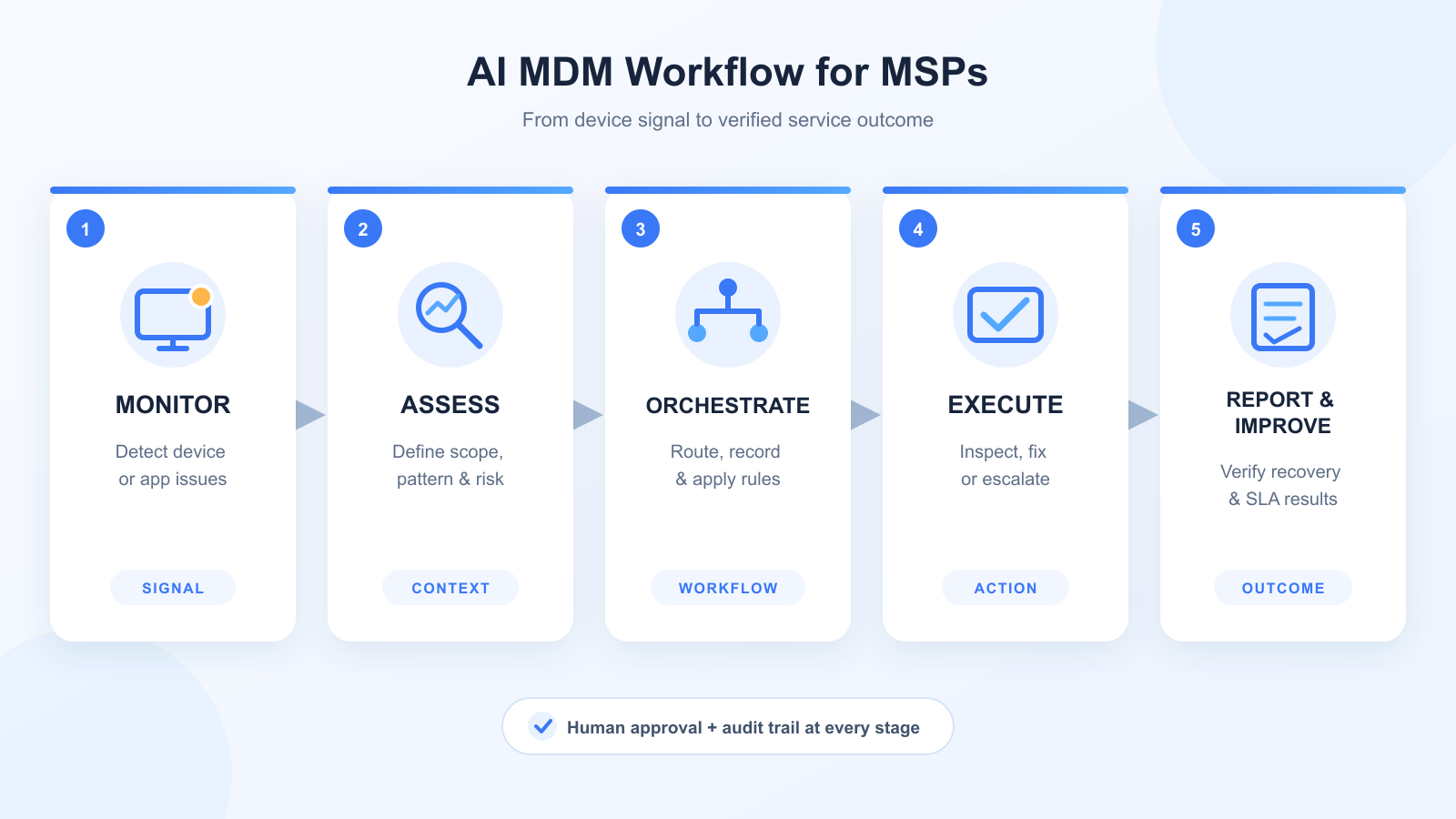
- Step 1. Monitor. Real-time monitoring detects the connectivity or application condition and creates an alert. Because devices are grouped by customer and location, the MSP can identify the affected service without mixing data from other accounts.
- Step 2. Assess. A technician uses Ask Copilot to determine the impact: which devices are affected, how long they have been offline, whether the events share an application version or network pattern, and whether the issue has occurred recently. The technician receives a concise starting point rather than reconstructing the incident manually.
- Step 3. Orchestrate. The alert invokes a predefined workflow. It notifies the assigned support group, records the event, attaches relevant device context, and applies the customer's escalation rules. A high-impact condition can pause for human approval instead of proceeding automatically.
- Step 4. Execute. The technician follows an approved SOP to inspect the devices remotely. Depending on the cause and permissions, the response could include checking configuration, restarting an application, deploying an approved update, rebooting a device, or escalating to an on-site contact.
- Step 5. Report and improve. The incident record captures the detection time, scope, actions, result, and SLA status. The MSP can turn this history into a client-readable summary and use recurring patterns to improve the workflow.
The MSP should measure the workflow against a simple baseline:
- Time to identify affected devices
- Time to assign the incident
- Time to restore service
- Number of manual handoffs
- Percentage of cases completed within the SLA
It should also track false positives and exceptions. Faster automation is not an improvement if it produces unnecessary escalations or hides cases that need expert review.
This monitor-assess-orchestrate-execute-report loop is the real value of AI MDM. AI is not simply attached to a management console; it helps convert device events into a documented, repeatable service process.
What MSPs Should Look for in an AI MDM Platform
When MSPs compare MDM software, feature count alone is not enough. The platform must support the operating model used to serve multiple clients. Evaluate these six areas:
| Checklist Item | Quick Check | Verify Before Buying |
|---|---|---|
| 1. Customer Separation | Separate devices, policies, roles, and reports by client | No cross-client data exposure or access |
| 2. Fleet Coverage | Required OS, device types, and ownership models | Enrollment support and feature parity by platform |
| 3. Scalable Management | Bulk enrollment, policy templates, and staged app rollout | Update tracking and exception handling |
| 4. Secure Remote Support | Remote diagnostics and secure unattended access | Permissions, session safeguards, and auditability |
| 5. Alerts and Workflows | Alert triggers, reusable workflows, and service records | Customization, logs, and SLA reporting |
| 6. Operational AI | Queries real device data and supports controlled tasks | RBAC, approval gates, and traceable results |
How AirDroid Business Helps MSPs Deliver AI-Enabled MDM
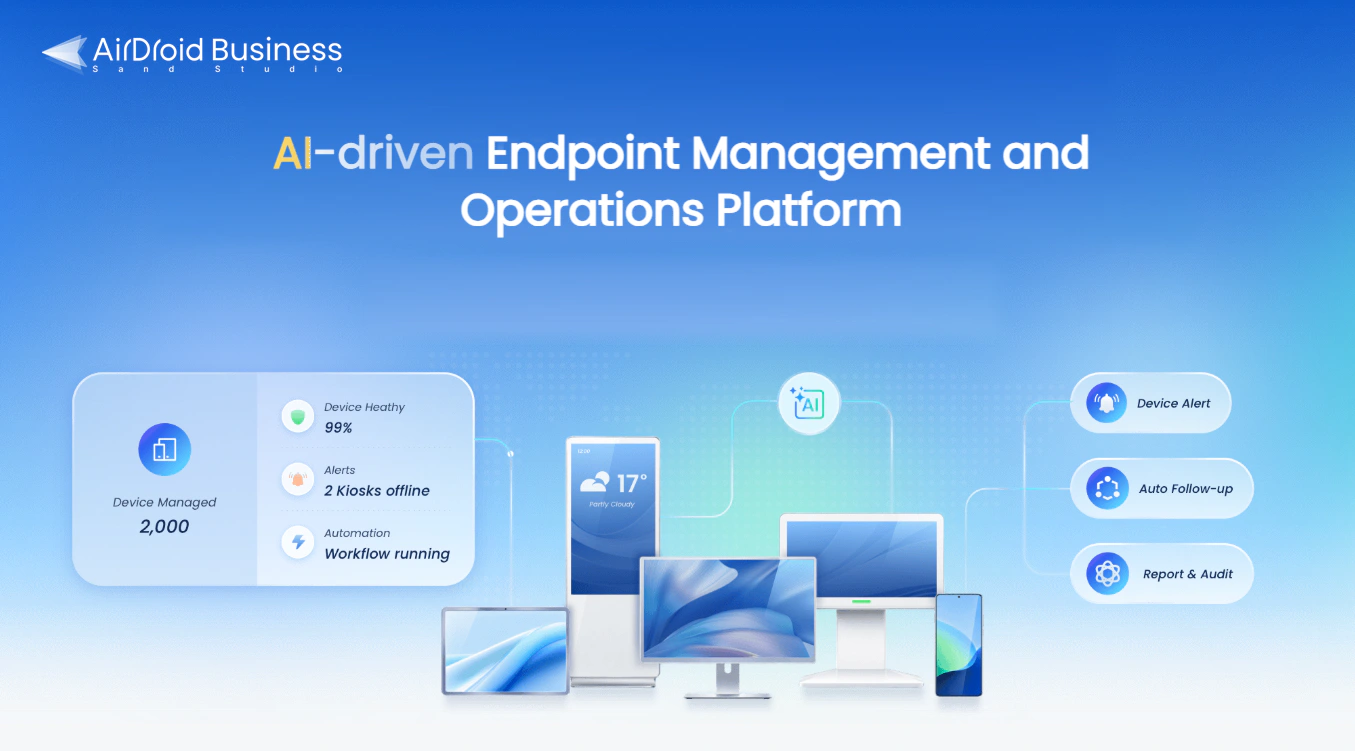
AirDroid Business gives MSPs a common operational layer for managing distributed Android and Windows devices.
- Centralized visibility: Organize enrolled devices into groups and monitor device status and alerts from a central console.
- Scalable management: Manage applications, policies, and kiosk configurations across distributed fleets.
- Remote support: Let authorized technicians investigate device issues remotely and reduce unnecessary site visits.
- Flexible deployment: Choose cloud or on-premises deployment according to client hosting and data-control requirements.
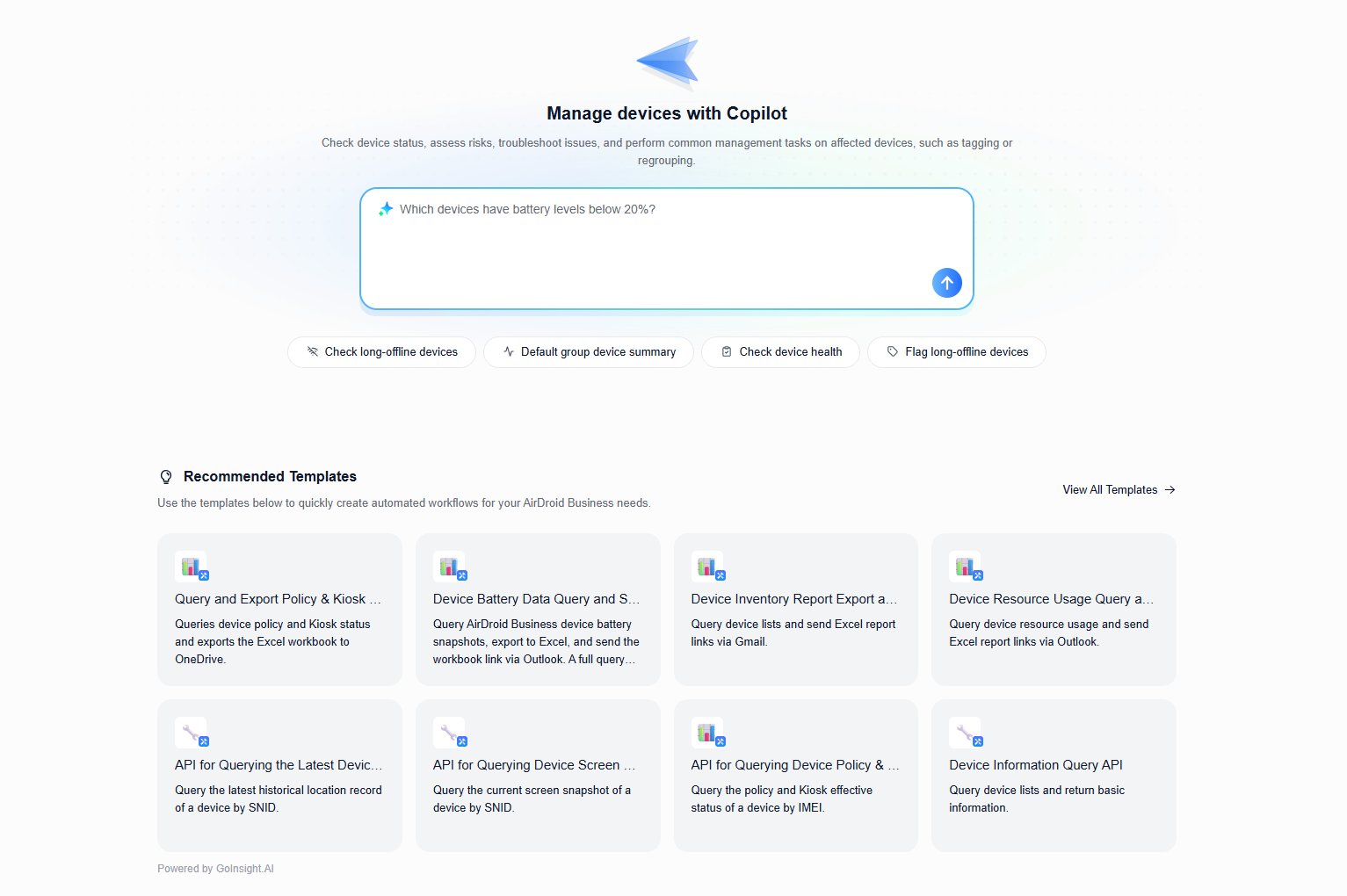
Ask Copilot adds a faster way to query device operations, analyze conditions, and perform SOP-based inspections. Instead of manually assembling context for every alert, technicians can focus sooner on affected devices, likely priorities, and the approved response. Controlled lightweight actions keep the technician and the organization's permission model in the loop.
Automation Templates and Alert Workflows help turn frequent procedures into repeatable managed services. MSPs can standardize how an event is routed, documented, and handled while preserving client-specific rules where needed. Over time, this can reduce manual coordination and make service quality less dependent on a particular technician.
Put AI-Enabled Device Operations into Practice
Bring device management, remote support, real-time monitoring, Ask Copilot, and workflow automation into a more repeatable operating model for your MSP team.
Conclusion
AI MDM is most valuable when it helps technicians spend less time finding and interpreting device events and more time delivering consistent outcomes. For MSPs, that means combining reliable device management with operational data, approved SOPs, human oversight, and automation that can be reused across customers.
Start with one frequent, well-understood incident. Define the alert, required context, approval boundary, response steps, and client-facing record. Then measure whether the workflow improves response time, SLA consistency, and technician effort before expanding it. This disciplined approach produces more value than trying to automate every device operation at once.
Explore AirDroid Business to bring device management, remote support, real-time monitoring, Ask Copilot, and workflow automation into an MSP-ready operating model. Book a demo or start a free trial to test the workflow against a real client scenario and confirm that its controls match your service requirements.
FAQ









Leave a Reply.