How to Lock Samsung Galaxy A Series to One App with Android Kiosk Mode
In today's wave of digital transformation, enterprise management of mobile devices for frontline workers has shifted from simple "compliance checks" to in-depth "functionality customization." To ensure business continuity and security, deploying a comprehensive Samsung MDM solution has become a core strategy for multinational corporations and medium-to-large organizations.
By implementing Android Kiosk Mode, IT administrators can transform ordinary smartphones into dedicated productivity tools, effectively locking down Android for business.
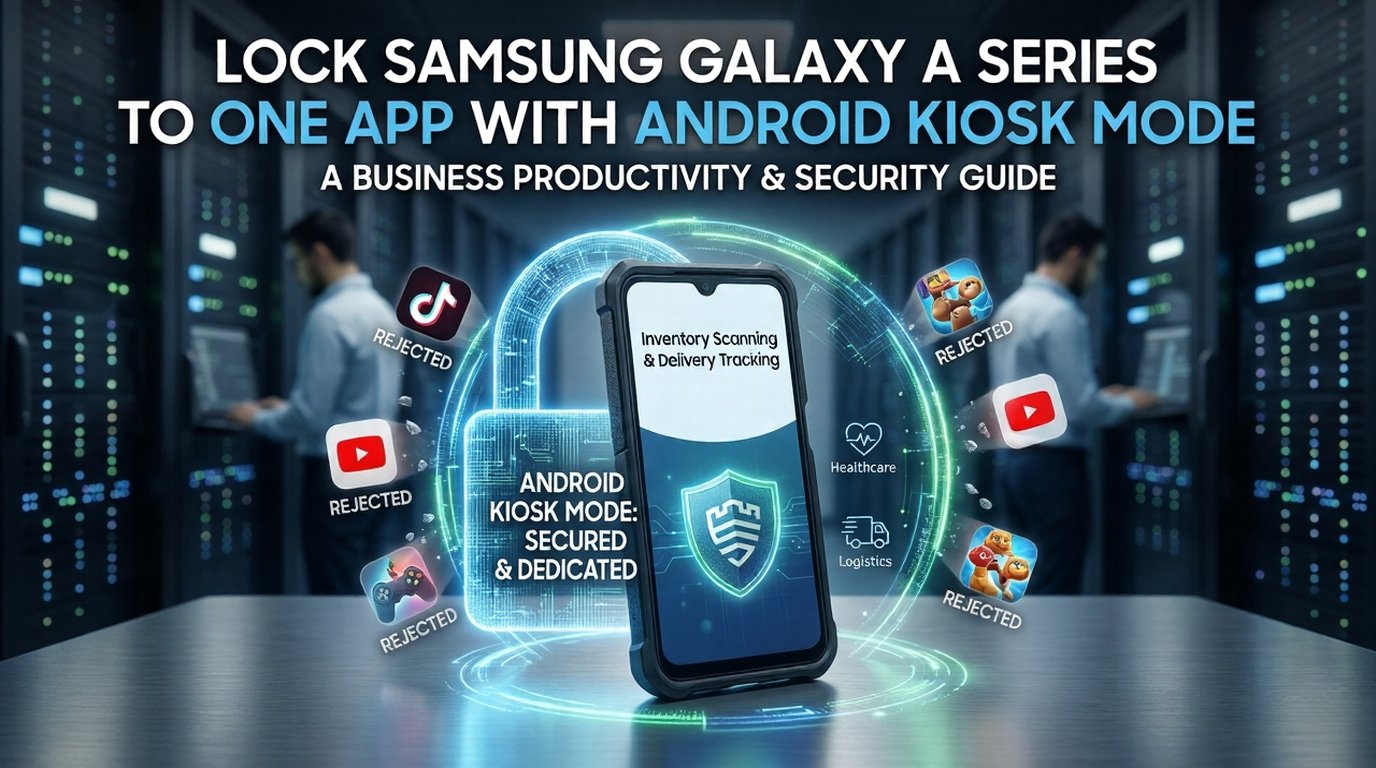
This article will delve into how to configure single-app kiosk mode for Samsung Galaxy A series devices, disable notification bars and system settings, strictly prohibit non-work applications such as TikTok, and utilize unattended remote control technology for real-time maintenance of globally distributed devices. Whether in healthcare or cross-border logistics scenarios, this article will provide a highly valuable implementation path.
- Part 1: Why Mission-Critical Teams Must Lock Down Android for Business
- Part 2: How to Lock Samsung Phone to One App (Android Kiosk Mode)
- Part 3: Prevent Employees from Using TikTok on Work Phones
- Part 4: Unattended Remote Support for Samsung:
- Part 5: Frontline Worker Device Security: Healthcare & Logistics
- Part 6: Model & Samsung-Specific Notes
- Part 7: Conclusion & Checklist
Part 1: Why Mission-Critical Teams Must Lock Down Android for Business
For teams performing mission-critical operations, mobile devices are not just communication tools, but also extensions of business processes. However, uncontrolled devices often become "black holes" in enterprise operations, consuming unnecessary maintenance budgets and data traffic.
The core logic of implementing deep lockout lies in transforming general-purpose hardware into dedicated terminals, thereby eliminating human error and security vulnerabilities.
1Manage Samsung Galaxy A Series as Dedicated Work Devices
Samsung's Galaxy A series (such as the SM-A12 and SM-A04) has become the top choice for large-scale enterprise procurement worldwide due to its extremely high cost-performance ratio. However, these devices are designed as consumer-grade products by default, pre-installed with a large number of social and entertainment applications.
To effectively manage the Samsung Galaxy A series, IT decision-makers must shift their mindset and treat them as dedicated workstations rather than ordinary mobile phones.
Through enterprise-level management methods, these budget devices can be "terminalized." This means that the devices no longer offer the ability to make personal calls, access social media, or arbitrarily change themes. Instead, they are configured in a "clean mode" that boots up directly into the business system.
This shift not only reduces the learning curve for employees, but more importantly, it significantly improves the device's responsiveness and stability in harsh working environments by limiting system resource consumption.
AirDroid Business - Transform Your Devices with AirDroid Business
Discover how AirDroid Business can turn your Samsung Galaxy A series into dedicated work devices, enhancing security and efficiency.
2Compliance Is Efficiency: Battery, CPU, and Data Plan Control
Compliance is not only a security requirement but also a guarantee of efficiency. In frontline scenarios, device battery life and data costs directly impact daily business profit. Research shows that entertainment applications (such as short videos and mobile games) not only consume a significant number of CPU cycles but also accelerate battery aging and exceed data usage limits.
Regarding the question of "How to save battery on frontline worker devices," lock screen management offers the most direct solution. By disabling unnecessary background processes and limiting power-intensive applications, the continuous operating time of devices can often be significantly improved.
When devices are locked to a single business application, the processor does not need to frequently switch between different tasks, thereby reducing heat generation and extending hardware lifespan.
Furthermore, by prohibiting non-work traffic through MDM policies, enterprises can reduce monthly data usage bills by more than 85%, allowing the saved budget to be invested in more valuable technology research and development.
3Eliminate the “Management Blind Spot” in Distributed Frontline Fleets
Distributed field teams often operate outside the reach of IT headquarters. If devices aren't deeply registered with Enterprise Mobility Management (EMM), employees might attempt to evade oversight by resetting systems, uninstalling management software, or modifying network configurations.
To achieve true frontline worker device security, "beyond user" enforcement authority must be established. This means devices need to be registered with the enterprise via Device Owner (DO) mode. In this architecture, the MDM client has system privileges exceeding those of ordinary users, allowing it to force security updates, modify Wi-Fi certificates, or block unauthorized operations without user cooperation.
This deep system control completely eliminates management "blind spots," ensuring that devices remain within pre-defined compliance boundaries regardless of their location.
Part 2: How to Lock Samsung Phone to One App (Android Kiosk Mode)
Locking a Samsung phone into a single app is the most classic use case for Kiosk mode. This single-app mode ensures that the target application automatically launches after the device is powered on and cannot be exited to the home screen under any circumstances.
1Enrollment Choices That Enable Real Enforcement
Before starting the configuration, understanding Enrollment is crucial. Ordinary "app lock" software only overrides the application layer; users can bypass restrictions by starting in safe mode or forcibly stopping the process.
To achieve true enforcement, an Enterprise Mobility Management (EMM) framework is required. For Samsung devices, the most recommended approach is to combine Samsung Knox Mobile Enrollment (KME) with mainstream Samsung MDM solutions. This way, even if the device is factory reset, it will automatically re-download and reinstall management policies upon reconnecting to the internet.
This hardware-level persistence is fundamental to business security. During this process, the administrator needs Device Owner privileges to gain deep control over physical buttons, system updates, and advanced network settings.
2Configure Single-App Kiosk Mode
The core of configuring single-app mode lies in defining a never-ending "main activity."
- Policy Creation: Create a new configuration file in the management backend and select the "Android Kiosk Mode" type.
- Application Selection: Select the business apps to be locked from the organization's application library. If the app is not available in an app store, it can be added manually by package ID.
- Mode Locking: Set the app as the "default launcher." This means that the app will appear in the foreground whenever the screen is turned on or the device restarts.
Auto-relaunch rules to avoid downtime
In practice, application crashes are unavoidable. To prevent business interruptions caused by crashes, administrators must configure "automatic restart" rules.
Samsung MDM solutions allow you to configure the system to restart a target application within 0 seconds if it unexpectedly closes. This "Always-on" logic ensures that even if an application malfunctions, the device will instantly return to a working state, thus avoiding the possibility of employees being confused by the Android desktop or engaging in unauthorized operations.
3Stop Users from Changing Settings on Android
To completely lock down Android for business, administrators must remove user permissions to access system settings. This includes hiding the settings icon, restricting network changes, and disabling any paths that could cause the device to become unmanaged.
Disable status bar and notification drawer (Android MDM hardening)
The notification bar and pull-down status bar are the "control center" of the Android system. Users typically use them to enable airplane mode, reset Wi-Fi, or access sensitive notifications.
- Hide the notification center: Checking "Disable status bar and notification drawer Android MDM" in the policy will completely disable the top pull-down gesture.
- Status icon management: If needed, administrators can selectively hide the clock, battery status, or system icons to make the interface cleaner and prevent information leaks.
Hide Settings + block unknown sources installs
In addition to hiding the top-level entry point, sensitive functions also need to be blocked at the lower levels.
- Completely disable settings: Configure a policy to "Stop users from changing settings on Android," preventing the settings menu from being opened via any shortcut.
- Disable installation from unknown sources: This is crucial for preventing malware. Administrators must disable the "Unknown Sources" switch to prevent employees from installing unapproved APK files via browsers or USB drives.
- Physical button remapping: For the side buttons on the Galaxy A series, Knox policies can be used to disable the long press of the power button from bringing up the shutdown menu, or disable the volume buttons to prevent employees from arbitrarily adjusting system volume and affecting important alerts.
AirDroid Business - Simplify Device Management with AirDroid Business
Lock your Samsung devices to a single app with ease. AirDroid Business provides seamless kiosk mode configuration for your enterprise.
Part 3: Prevent Employees from Using TikTok on Work Phones
The short video app TikTok has become one of the main reasons for low productivity among frontline employees. To prevent employees from using TikTok on work phones, IT administrators need to establish a dynamic whitelist defense system, rather than getting bogged down in endless blacklisting.
1App Allowlist Strategy (Single-App vs Multi-App Kiosk)
In Android Kiosk Mode, a whitelist policy is the most thorough governance method.
- 1. Whitelist Logic: Administrators only need to list 3-5 essential applications (such as scanning tools, ERP, and IM). All other applications (including TikTok, pre-installed games, browsers, etc.) will be automatically removed from the desktop and prohibited from running.
- 2. Package Name Detection: Even if employees attempt to change the TikTok app icon or name, the system will still implement a ban by detecting its unique package name (e.g., com.zhiliaoapp.musically).
- 3. Silent Uninstallation: If TikTok was already installed on the device before registration, the EMM policy can execute a silent uninstallation command the moment the device is activated, without user confirmation.
2Browser Control for Work-Only Web Access (Website Allowlist)
If the app is blocked, employees may switch to the web version. Therefore, "Lock down Android for business" must extend to the browser.
- Restricted Browser: Deploy a dedicated browser in Kiosk mode and configure a "website whitelist." For example, only allow access to company intranet domains, Google Maps, or specific logistics tracking systems.
- URL Filtering: Any requests to tiktok.com or douyin.com will be blocked by the system and redirected to a custom warning page, thus completely cutting off the path for non-work-related content to spread.
3How to Save Battery on Frontline Worker Devices
Limiting entertainment apps not only improves focus but also has profound implications for device maintenance.
- 1. Reduced Background Activity: Apps like TikTok frequently request location and push notifications, consuming significant battery power while running in the background. Kiosk locking completely disables these background wake-up behaviors.
- 2. Thermal Management: Prolonged playback of short videos can cause high CPU load, especially in outdoor logistics environments, easily leading to overheating, throttling, or even system crashes. Locking work apps helps maintain device temperature within a reasonable range.
- 3. Network Optimization: Disabling automatic updates and data synchronization for unnecessary apps reduces the active time of the cellular antenna, resulting in immediate benefits in the "How to save battery on frontline worker devices" practice.
Part 4: Unattended Remote Support for Samsung:
In the complex global supply chain, equipment failures can occur in any time zone. Unattended Remote Support for Samsung allows IT teams to perform rapid repairs across time zones without the need for on-site personnel.
1Remote control Samsung phone without user intervention
Traditional remote control requires the end user to click "Allow." However, this interaction is redundant and inefficient at self-service kiosks or in the hands of busy healthcare workers.
- Silent Authorization: By setting the MDM client as the Device Owner and utilizing Samsung Knox's underlying API, IT administrators can pre-authorize remote control requests. When a remote control request for a Samsung phone is initiated without user intervention, the device screen is directly synchronized with the administrator's backend, eliminating the intermediate confirmation step.
- System-Level Privileges: This deep integration allows administrators not only to see the screen but also to simulate clicks, long-press gestures, and even operate the virtual navigation bar, which is crucial for troubleshooting deep configuration issues.
2Rapid Recovery Playbook: Reboot, Clear App Cache/Data, Re-apply Kiosk
Risk note for destructive actions (clear data / reboot)
Administrators should note that the "clean data" operation is destructive; it deletes local accounts, offline caches, and personal settings within the application.
Before performing this operation, IT should ensure that business data has been synchronized via the cloud. Furthermore, frequent forced restarts may affect the lifespan of storage chips and should therefore be used as a last resort.
3Privacy-Safe Remote Maintenance in Public Environments
When performing remote maintenance on equipment in public places such as shopping malls and train stations, protecting privacy and preventing interference are equally important.
- Black Screen Maintenance Mode: This is a patented technology of AirDroid Business. During remote control, the physical screen of the controlled device turns black and displays a customized "Maintenance in Progress" message. This prevents passersby from seeing sensitive account passwords or device logs entered by the administrator in the background.
- Local Gesture Lock: During black screen maintenance, the system automatically locks all local touch inputs, ensuring that the maintenance process is not interrupted by unintentional touches from on-site personnel.
Part 5: Frontline Worker Device Security: Healthcare & Logistics
Different industries have different requirements for mobile device security. Through in-depth MDM configuration, the Samsung Galaxy A series can be perfectly adapted to various high-pressure, high-frequency work scenarios.
1Dedicated device management for caregivers
In healthcare and elderly care settings, devices serve as vital sign monitoring and emergency call centers.
- Preventing missed alarms: Caregivers may inadvertently silence their phones, causing them to miss urgent patient calls. Dedicated device management for caregivers allows IT to enforce maximum system volume and disable Do Not Disturb (DND) mode.
- 24/7 business readiness: Configure devices to automatically wake up upon power-on and ensure business apps remain in the foreground. For managing tablets in healthcare facilities, stricter geofencing restrictions can be implemented to ensure devices do not leave designated ward areas.
2MDM for logistics and transportation
In the logistics sector, equipment must not only be durable but also tamper-proof.
- Preventing Time Fraud: Some drivers may try to circumvent mandatory rest checks by modifying system time. MDM policies can disable "manual modification of date and time" and enforce network time synchronization (NTP).
- Disabling USB Debugging: To prevent drivers from using unauthorized devices to read company data or bypass monitoring by flashing firmware, ADB commands must be completely blocked at the underlying level, and developer options must be disabled.
- Hardware Interface Control: Policies restrict Bluetooth pairing, Wi-Fi hotspot sharing, and USB media transfer to prevent the unauthorized export of company data assets.
Part 6: Model & Samsung-Specific Notes
When implementing Kiosk mode, subtle differences in hardware model and firmware version may affect the effectiveness of the strategy.
1Samsung SM-A125F MDM / Samsung SM-A042F Kiosk Mode
For specific Galaxy A-series models, IT administrators should verify the following before deployment:
- OS Version Verification: SM-A125F (A12) natively supports Android 10 and can be updated to Android 14 or later. SM-A042F (A04e) supports Android 12 to Android 14. Since Android 11+ has stricter restrictions on Device Owner permissions, it is recommended to update to the latest stable version before deployment.
- Enterprise Registration Prerequisites: Ensure the device's bootloader is unlocked and supports Knox 3.7 or later. Although these budget models have limited performance, their built-in Knox security chip still provides defensive hardware encryption.
- Policy Compatibility: On entry-level models like the SM-A125F, avoid configuring too many animated icons or live wallpapers to conserve valuable RAM and ensure smooth operation of the Kiosk Launcher.
2Samsung Knox Service Plugin (KSP)
Samsung Knox Service Plugin (KSP) is a suite of enhancement plugins based on the OEMConfig standard.
- Instant Function Access: KSP allows enterprises to access new features (such as the latest network configurations or special hardware controls) as soon as Samsung releases them, without waiting for software updates from MDM vendors.
- Robust Balance: While KSP provides strong hardware customization capabilities (such as remapping side keys), the entire lifecycle management of devices, application distribution, and remote assistance still rely on the overall scheduling of the Enterprise Mobility Management (EMM) platform.
- Implementation Tips: Administrators should prioritize configuring standard policies in the EMM backend and only introduce KSP policies when deep hardware tuning is required to avoid policy conflicts at different levels.
AirDroid Business - Secure and Optimize Your Fleet with AirDroid Business
Maximize productivity and security with AirDroid Business. Start your free trial today and see the difference.
Conclusion
By deploying a systematic Samsung MDM solution, enterprises can fundamentally transform the operating models of their frontline field teams. Android Kiosk Mode is not just a lock screen technology, but a productivity framework that integrates security, compliance, and efficiency. Through deep customization for Samsung Galaxy A series devices, IT teams can effectively lock down Android for business, ensuring that devices always serve core business processes.
IT Administrator Compliance Checklist
- Registration Mode: Has Device Owner privileges been obtained through Knox Mobile Enrollment?
- Kiosk Configuration: Is the 0-second automatic restart rule enabled in single-application mode?
- Permission Restriction: Has the notification bar pull-down, hidden settings menu, and unknown source installations been disabled?
- Application Control: Has the whitelist policy covered all business apps and completely isolated entertainment apps such as TikTok?
- Operation and Maintenance Preparation: Have unattended remote control and black screen maintenance modes been tested to ensure privacy and security during maintenance?
Through this series of in-depth management practices, enterprises can not only reduce maintenance costs by more than 75%, but also establish a solid digital boundary in a rapidly changing business environment. The true value of Enterprise Mobility Management (EMM) lies in transforming every end device into a reliable business anchor.


Leave a Reply.